



59-01-8
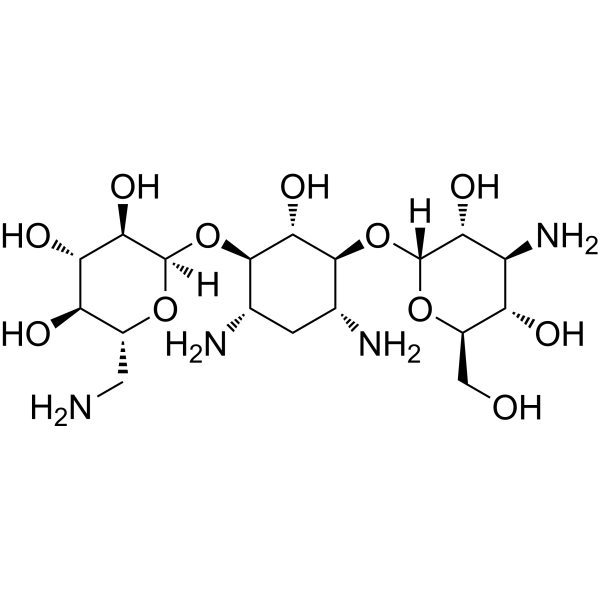
Chemical Structure
Kanamycin
Synonym(s): Kanamycin A
- CAS No.: 59-01-8
- Formula:C18H36N4O11
- Molecular Weight:484.50
IUPAC Name: (2R,3S,4S,5R,6R)-2-(aminomethyl)-6-(((1R,2R,3S,4R,6S)-4,6-diamino-3-(((2S,3R,4S,5S,6R)-4-amino-3,5-dihydroxy-6-(hydroxymethyl)tetrahydro-2H-pyran-2-yl)oxy)-2-hydroxycyclohexyl)oxy)tetrahydro-2H-pyran-3,4,5-triol
InChIKey: SBUJHOSQTJFQJX-NOAMYHISSA-N
SMILES: O[C@H]1[C@](O[C@@H]2[C@@H](N)C[C@@H](N)[C@H](O[C@@]3([H])O[C@H](CO)[C@@H](O)[C@H](N)[C@H]3O)[C@H]2O)([H])O[C@H](CN)[C@@H](O)[C@@H]1O
Biological Activity: Kanamycin (Kanamycin A) is an antibacterial agent. Kanamycin blocks Kir4.1 channels. Kanamycin inhibits bacterial mRNA translation and exerts bactericidal effects against Gram-positive, Gram-negative, and acid-resistant microorganisms. Kanamycin produces ROS and superoxide and induces caspase-3-mediated apoptosis. Kanamycin inhibits biofilms and reduces persister bacteria, and reduces Mycobacterium tuberculosis within macrophages. Kanamycin can be used in research on bacterial infections, urinary tract infections, tuberculosis, and Staphylococcus aureus-induced peritonitis[1][2][3][4][5][6][7].
| Cat. No. | Product Name | Purity | Description | Pricing | |||||||||||||||||||
|---|---|---|---|---|---|---|---|---|---|---|---|---|---|---|---|---|---|---|---|---|---|---|---|
|
|
Kanamycin | 99.82% | Kanamycin (Kanamycin A) is an antibacterial agent. Kanamycin blocks Kir4.1 channels. Kanamycin inhibits bacterial mRNA translation and exerts bactericidal effects against Gram-positive, Gram-negative, and acid-resistant microorganisms. Kanamycin produces ROS and superoxide and induces caspase-3-mediated apoptosis. Kanamycin inhibits biofilms and reduces persister bacteria, and reduces Mycobacterium tuberculosis within macrophages. Kanamycin can be used in research on bacterial infections, urinary tract infections, tuberculosis, and Staphylococcus aureus-induced peritonitis. | ||||||||||||||||||||
|
loading...
/
|
|||||||||||||||||||||||
|
|
Kanamycin (Standard) | 99.55% | Kanamycin (Standard) (Kanamycin A (Standard)) is the analytical standard of Kanamycin (HY-16566). This product is intended for research and analytical applications. Kanamycin (Kanamycin A) is an antibacterial agent. Kanamycin blocks Kir4.1 channels. Kanamycin inhibits bacterial mRNA translation and exerts bactericidal effects against Gram-positive, Gram-negative, and acid-resistant microorganisms. Kanamycin produces ROS and superoxide and induces caspase-3-mediated apoptosis. Kanamycin inhibits biofilms and reduces persister bacteria, and reduces Mycobacterium tuberculosis within macrophages. Kanamycin can be used in research on bacterial infections, urinary tract infections, tuberculosis, and Staphylococcus aureus-induced peritonitis. | ||||||||||||||||||||
|
loading...
/
|
|||||||||||||||||||||||
-
Similarity Score 0.93
 HY-16566ARKanamycin sulfate (Standard)
-
Similarity Score 0.91
 HY-1803283''-Deamino-3''-hydroxykanamycin B
-
Similarity Score 0.91
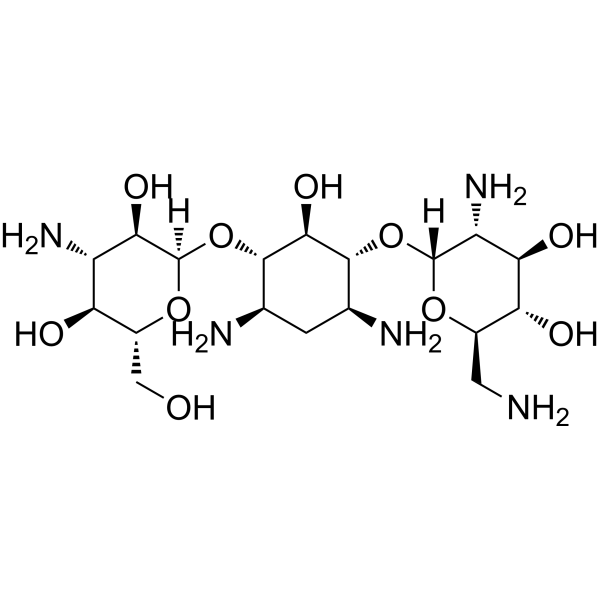 HY-B1174Bekanamycin
-
Similarity Score 0.88
 HY-W718156Kanamycin disulfate
-
Similarity Score 0.86
 HY-B1174ABekanamycin sulfate
-
Similarity Score 0.85
 HY-B0441RTobramycin (Standard)
-
Similarity Score 0.82
 HY-B0441BTobramycin monosulfate
-
Similarity Score 0.82
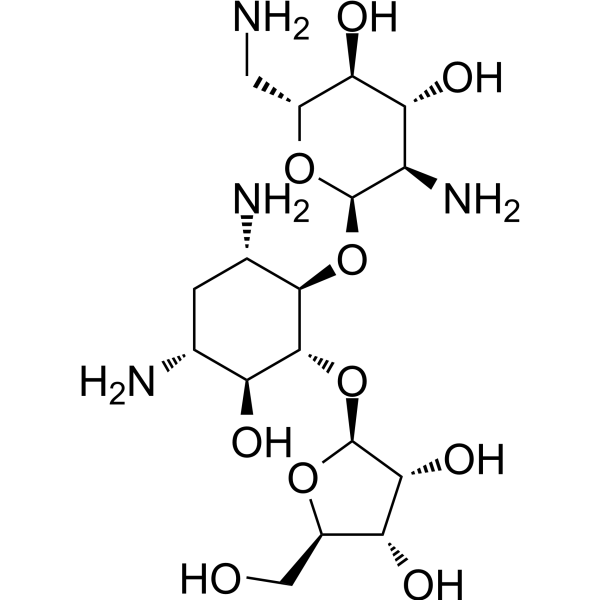 HY-142127Ribostamycin
-
Similarity Score 0.79
 HY-N14485Nebramycin Ⅳ
-

Explore the MedChemAI to find more analogs


References
- [1]. Morán-Zendejas R, et al. In vitro and in silico characterization of the inhibition of Kir4.1 channels by aminoglycoside antibiotics. British journal of pharmacology. 2020 Oct;177(19):4548-4560.
- [2]. Peng B, et al. Exogenous alanine and/or glucose plus kanamycin kills antibiotic-resistant bacteria. Cell metabolism. 2015 Feb 03;21(2):249-262. [Content Brief]
- [3]. Brezden A, et al. Dual Targeting of Intracellular Pathogenic Bacteria with a Cleavable Conjugate of Kanamycin and an Antibacterial Cell-Penetrating Peptide. Journal of the American Chemical Society. 2016 Aug 31;138(34):10945-9. [Content Brief]
- [4]. Hawkins Jr JE. XLIX The Ototoxicity of Kanamycin. Annals of Otology, et al. 1959 Sep;68(3):698-715.
- [5]. Cai JY, et al. Concentration-dependent dual effects of silibinin on kanamycin-induced cells death in Staphylococcus aureus. Biomedicine & pharmacotherapy = Biomedecine & pharmacotherapie. 2018 Jun;102:782-791.
- [6]. Gao K, et al. Kanamycin Damages Early Postnatal, but Not Adult Spiral Ganglion Neurons. Neurotoxicity research. 2017 Nov;32(4):603-613.
- [7]. John T, et al. How kanamycin A interacts with bacterial and mammalian mimetic membranes. Biochimica et biophysica acta. Biomembranes. 2017 Nov;1859(11):2242-2252.



