



Kanamycin disulfate
Based on 27 publication(s) in Google Scholar
Kanamycin disulfate (Kanamycin A disulfate) is an antibacterial agent. Kanamycin disulfate blocks Kir4.1 channels. Kanamycin disulfate inhibits bacterial mRNA translation and exerts bactericidal effects against Gram-positive, Gram-negative, and acid-resistant microorganisms. Kanamycin disulfate produces ROS and superoxide and induces caspase-3-mediated apoptosis. Kanamycin disulfate inhibits biofilms and reduces persister bacteria, and reduces Mycobacterium tuberculosis within macrophages. Kanamycin disulfate can be used in research on bacterial infections, urinary tract infections, tuberculosis, and Staphylococcus aureus-induced peritonitis.
For research use only. We do not sell to patients.
- Purity : 99.43%
- CAS No.: 64013-70-3
- Formula: C18H40N4O19S2
- Molecular Weight:680.66
-
Storage:
Store at room temperature, keep dry and cool.
In solvent -80°C, 1 year , -20°C, 6 months


To place orders, for customer services and technical support, please contact: MedChemExpress USA
Tel: 609-228-6898 E-mail: [email protected] [email protected]


-
 Biological Activity
-
Chemical Information
-
Solvent & Solubility
- Protocols
- Purity & Documentation
- References
-
 Help & FAQs


Publications Citing Use of MedChemExpress (MCE) Kanamycin disulfate
More- Nat Microbiol. 2025 Nov;10(11):2949-2965. [Abstract]
- Nucleic Acids Res. 2026 Apr 23;54(8):gkag290. [Abstract]
- Adv Sci (Weinh). 2024 Aug;11(31):e2308307. [Abstract]
- Food Chem. 2023 Mar 1:403:134399. [Abstract]
- Food Res Int. 2026 Dec 1;245(Pt 3):120850.
- Food Res Int. 2026 Jul 31:236:119200. [Abstract]
- J Med Chem. 2026 Jan 23. [Abstract]
- mLife. 2025 Apr 15;4(2):155-168. [Abstract]
- Commun Biol. 2025 Oct 6;8(1):1425. [Abstract]
- Int Immunopharmacol. 2025 Jun 26:159:114888. [Abstract]
- BMC Microbiol. 2025 Apr 29;25(1):257. [Abstract]
- Aquat Toxicol. 2025 Mar:280:107284. [Abstract]
- iScience. 2025 Nov 12;28(12):114030. [Abstract]
- ACS Infect Dis. 2025 Apr 1. [Abstract]
- J Periodontol. 2024 Sep;95(9):867-879. [Abstract]
- J Virol. 2026 May 14:e0003526. [Abstract]
- Microbiol Spectr. 2025 Oct 16:e0160325. [Abstract]
- Microbiol Spectr. 2025 Aug 29:e0059025. [Abstract]
- AMB Express. 2024 Dec 24;14(1):141. [Abstract]
- J Sep Sci. 2026 Apr;49(4):e70402. [Abstract]
- PLoS One. 2026 Jul 8;21(7):e0352997.
- Int J Med Microbiol. 2023 Mar 28;313(2):151578. [Abstract]
- Transbound Emerg Dis. 2026;2026(1):e2248363.
- Vet Res Commun. 2024 Dec;48(6):3859-3872. [Abstract]
- Authorea. 2026 May 12.
- bioRxiv. 2025 May 29.
- bioRxiv. 2025 January 19.
 Customer Validation & Images

-
Microbiological Assay
All Caspase Isoforms
More

Biological Activity
Description
IC50 & Target
[6]|
Caspase 3 |
Cellular Effect
|
Cell Line

|
Type | Value | Description | References |
|---|---|---|---|---|
| HEK293 | IC50 |
76.8 μM
|
Blockade of rat Kir4.1 WT outward current in inside-out patches from HEK-293 cells at +80 mV by patch-clamp electrophysiology.
Blockade of rat Kir4.1 WT outward current in inside-out patches from HEK-293 cells at +80 mV by patch-clamp electrophysiology.
|
32726456 |
In Vitro
Kanamycin disulfate (0.1-1 mM; 24 h) damages cochlear hair cells in adult rats, but adult spiral ganglion neurons remain largely tolerant at concentrations up to 1 mM[6].
Kanamycin disulfate (1 mM; 3-24 h) activates caspase-3 in spiral ganglion neurons earlier than in organ of Corti hair cells in P3 rat cochlear cultures; the former is detectable as early as 3 h, whereas the latter reaches 85-90% caspase-3 positivity at 12-24 h[6].
Kanamycin disulfate exhibits MIC values of 2-16 µM against E. coli, S. aureus, S. enteritidis, B. abortus, S. flexneri, M. smegmatis, and M. tuberculosis, whereas the MIC against biofilm-forming S. epidermis isolates is >128 µM[3].
Kanamycin disulfate (300 µM) blocks Kir4.1-WT more strongly than the Kir4.1-T128A and Kir4.1-E158N mutants in inside-out membrane patches from HEK-293 cells, confirming that T128 and E158 contribute to the blocking site[1].
Kanamycin disulfate (300 µM; 20 min) weakly inhibits Kir4.1 channels in whole-cell recordings from HEK-293 cells, reducing the current at -30 mV by 18%[1].
Kanamycin disulfate (300 µM) weakly inhibits Kir1.1 channels in inside-out membrane patches from HEK-293 cells, blocking 12.63% of the current[1].
Kanamycin disulfate (1 mM; 24-48 h) causes extensive loss of neurofilament-positive SGNs and auditory nerve fibers in P3 rat cochlear cultures, but largely spares peripherin-positive type II SGNs and their fibers[6].
MedChemExpress (MCE) has not independently confirmed the accuracy of these methods. They are for reference only.
-
Cell Line:P3 rat spiral ganglion neurons and auditory nerve fibers
-
Concentration:0, 0.1, 0.2, 0.5, 1 mM
-
Incubation Time:24 h
-
Result:Caused shrinkage of the cell bodies, with many spiral ganglion neurons exhibiting nuclear pyknosis and/or karyorrhexis.
Reduced the staining signal for neurofilaments in spiral ganglion neurons.
In Vivo
MedChemExpress (MCE) has not independently confirmed the accuracy of these methods. They are for reference only.
-
Animal Model:Balb/c (female, 4 weeks old, 20-25 g)[2]
-
Dosage:3, 3000 mg/kg
-
Administration:i.p.; twice daily; 3 days
-
Result:Inhibited infection in the urinary tract and suppressed spread of infection to the kidneys.
-
Animal Model:Kunming (female, 18 g)[5]
-
Dosage:40 mg/kg
-
Administration:i.v.; once daily; 7 consecutive days
-
Result:Yielded a 74.29% survival ratio at 40 mg/kg.
Decreased viable bacterial counts in the lung, liver, and spleen.
Reduced H2O2 levels in these organs, and enhanced CAT activity in the lung, liver, and spleen.
- Research Protocol for Infectious Diseases
- RNA extraction experimental
- Detection of Apoptosis
- TUNEL staining for apoptotic DNA fragmentation
- Annexin V plus membrane-impermeant dye apoptosis staining
- ROS/oxidative-stress fluorescent staining
- Zymosan-Induced Peritonitis
- Apoptosis Solutions
- Gram Staining of Tissue Sections


Chemical Information
-
CAS No. 64013-70-3
-
Appearance Solid
-
Molecular Weight 680.66
-
Formula C18H40N4O19S2
-
Color White to off-white
-
SMILES
O[C@@H]([C@@H]([C@H](C[C@H]1N)N)O[C@H]2O[C@@H]([C@H]([C@@H]([C@H]2O)O)O)CN)[C@H]1O[C@H]3O[C@@H]([C@H]([C@@H]([C@H]3O)N)O)CO.O=S(O)(O)=O.O=S(O)(O)=O
-
Synonyms
Kanamycin A disulfate
-
Shipping
Room temperature in continental US; may vary elsewhere.
-
Storage
Store at room temperature, keep dry and cool
In solvent -80°C 1 year -20°C 6 months


Publications (27)
-
Journal Impact Factor
-
Most Recent
-
Nat Microbiol
Mycobacterium tuberculosis-derived linoleic acid increases regulatory T cell function to promote bacterial survival within macrophages. [Abstract]2025 Nov;10(11):2949-2965. PMID: 41073667 -
Nucleic Acids Res
PhoP-regulated VirK acts as an accessory factor to maintain virulence in polymyxin-resistant Klebsiella pneumoniae. [Abstract]2026 Apr 23;54(8):gkag290. PMID: 42033226 -
Adv Sci (Weinh)
Aloperine Suppresses Cancer Progression by Interacting with VPS4A to Inhibit Autophagosome-lysosome Fusion in NSCLC. [Abstract]2024 Aug;11(31):e2308307. PMID: 39166458 -
Food Chem
Electrochemical sensor for detecting streptomycin in milk based on label-free aptamer chain and magnetic adsorption. [Abstract]2023 Mar 1:403:134399. PMID: 36182859 -
-
Food Res Int
Fructooligosaccharides alleviate early-life antibiotic-exposed food allergy via the Indole-3-propionic acid-AhR-Nrf2 Axis: A multi-omics prospective cohort study. [Abstract]2026 Jul 31:236:119200. PMID: 42116470 -
J Med Chem
Discovery of 2-Chloro-pyrrolo[2,3- d]pyrimidin-4-one Derivatives as Protein Disulfide Isomerase Inhibitors with a Novel Allosteric-Covalent Binding Mode and Anti-Glioblastoma Activity. [Abstract]2026 Jan 23. PMID: 41574754 -
mLife
Identification of a phenyl ester covalent inhibitor of caseinolytic protease and analysis of the ClpP1P2 inhibition in mycobacteria. [Abstract]2025 Apr 15;4(2):155-168. PMID: 40313980 -
Commun Biol
The acetyltransferase CysE modulates virulence and drug resistance of Mycobacterium tuberculosis by interfering with oxidative stress responses. [Abstract]2025 Oct 6;8(1):1425. PMID: 41053365 -
Int Immunopharmacol
Early-life antibiotic dysbiosis impairs microbial tryptophan- nicotinic acid metabolism exacerbating food allergy in adulthood. [Abstract]2025 Jun 26:159:114888. PMID: 40403504 -
BMC Microbiol
Klebsiella pneumoniae under xylose pressure: the growth adaptation, antimicrobial susceptibility, global proteomics analysis and role of XylA and XylB proteins. [Abstract]2025 Apr 29;25(1):257. PMID: 40301709 -
Aquat Toxicol
Antibacterials exert toxic effects on aquatic organisms by inhibiting respiration, inducing oxidative stress, mitochondrial dysfunction and autophagy. [Abstract]2025 Mar:280:107284. PMID: 39951902 -
iScience
2025 Nov 12;28(12):114030. PMID: 41377656 -
ACS Infect Dis
Toward a Bactericidal Oral Drug Combination for the Treatment of Mycobacterium abscessus Lung Disease. [Abstract]2025 Apr 1. PMID: 40168319 -
J Periodontol
Gingipain and oncostatin M synergistically disrupt kidney tight junctions in periodontitis-associated acute kidney injury. [Abstract]2024 Sep;95(9):867-879. PMID: 38963713 -
J Virol
Generation of HBV cccDNA using single-stranded M13 phage DNA for authentic minichromosome functionality. [Abstract]2026 May 14:e0003526. PMID: 42132423 -
Microbiol Spectr
The adaptive growth and mechanisms of Klebsiella pneumoniae under sucrose and glucose exposure. [Abstract]2025 Oct 16:e0160325. PMID: 41099518 -
Microbiol Spectr
2025 Aug 29:e0059025. PMID: 40879403 -
AMB Express
Repurposing pinaverium bromide against Staphylococcus and its biofilms with new mechanisms. [Abstract]2024 Dec 24;14(1):141. PMID: 39718732
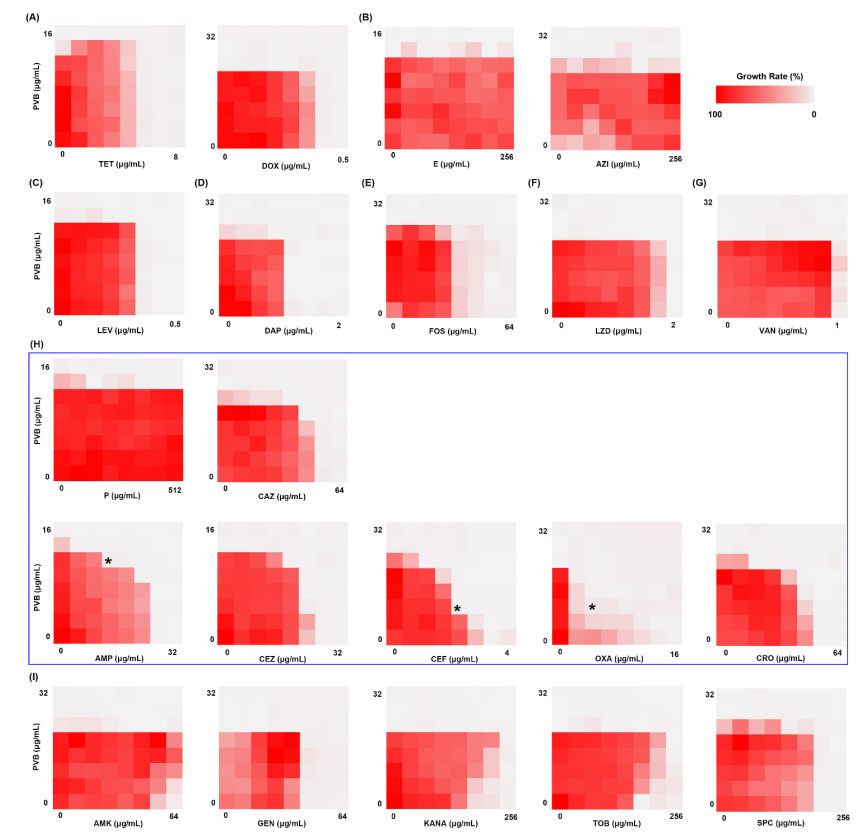
Kanamycin disulfate purchased from MedChemExpress. Usage Cited in: AMB Express. 2024 Dec 24;14(1):141. [Abstract]
Combinational antimicrobial effects between PVB and conventional antibiotics against MRSA ATCC 43,300. TET, Tetracycline. DOX, Doxycycline. E, Erythromycin. AZI, Azithromycin. P, Penicillin. CAZ, Ceftazidime. AMP, Ampicillin. CEZ, Cefazolin. CEF, Cefotaxime. OXA, Oxacillin. CRO, Ceftriaxone. AMK, Amikacin. GEN, Gentamycin, KANA, Kanamycin. TOB, Tobramycin. SPC, Spectinomycin.
-
J Sep Sci
Oriented Immobilization Coupled With Ligand Fishing Strategy for Rapid Discovery of Direct HMGB1 Inhibitors in Taxus wallichiana var. mairei. [Abstract]2026 Apr;49(4):e70402. PMID: 41906428 -
-
Int J Med Microbiol
Antibacterial and antibiofilm efficacy of repurposing drug hexestrol against methicillin-resistant Staphylococcus aureus. [Abstract]2023 Mar 28;313(2):151578. PMID: 37001448 -
-
Vet Res Commun
Biological characterization of lipoic acid- and heme-dependent Escherichia coli small colony variants isolated from sheep in Xinjiang, China. [Abstract]2024 Dec;48(6):3859-3872. PMID: 39325108 -
-
-


Solvent & Solubility
In Vitro:
H2O : 100 mg/mL (146.92 mM; Need ultrasonic)
Please refer to the solubility information to select the appropriate solvent. Once prepared, please aliquot and store the solution to prevent product inactivation from repeated freeze-thaw cycles.
Storage method and period of stock solution: -80°C, 1 year; -20°C, 6 months. When stored at -80°C, please use it within 1 year. When stored at -20°C, please use it within 6 months.
* Note: If you choose water as the stock solution, please dilute it to the working solution, then filter and sterilize it with a 0.22 μm filter before use.
Concentration (start) × Volume (start) = Concentration (final) × Volume (final)
In Vivo Dissolution Calculator
Please enter the basic information of animal experiments:
-
-
-
-
Recommended: Prepare an additional quantity of animals to account for potential losses during experiments.
Working solution concentration: 0.22 mg/mL
This product has good water solubility, please refer to the measured solubility data in water/PBS/Saline for details.


Purity & Documentation
-
Data Sheet (305 KB)
-
SDS (419 KB)
- English - EN (419 KB)
- Français - FR (419 KB)
- Deutsch - DE (419 KB)
- Norwegian - NO (419 KB)
- Español - ES (419 KB)
- Swedish - SV (419 KB)
- Italian - IT (419 KB)
- Korean - KR (419 KB)
- Portuguese - PT (419 KB)
-
Handling Instructions (2659 KB)
References
[2]. Peng B, et al. Exogenous alanine and/or glucose plus kanamycin kills antibiotic-resistant bacteria. Cell metabolism. 2015 Feb 03;21(2):249-262. [Content Brief]
[3]. Brezden A, et al. Dual Targeting of Intracellular Pathogenic Bacteria with a Cleavable Conjugate of Kanamycin and an Antibacterial Cell-Penetrating Peptide. Journal of the American Chemical Society. 2016 Aug 31;138(34):10945-9. [Content Brief]
[4]. Hawkins Jr JE. XLIX The Ototoxicity of Kanamycin. Annals of Otology, et al. 1959 Sep;68(3):698-715.


Complete Stock Solution Preparation Table
Please refer to the solubility information to select the appropriate solvent. Once prepared, please aliquot and store the solution to prevent product inactivation from repeated freeze-thaw cycles.
Storage method and period of stock solution: -80°C, 1 year; -20°C, 6 months. When stored at -80°C, please use it within 1 year. When stored at -20°C, please use it within 6 months.
| Optional Solvent | Concentration Solvent Mass | 1 mg | 5 mg | 10 mg | 25 mg |
|---|---|---|---|---|---|
| H2O | 1 mM | 1.4692 mL | 7.3458 mL | 14.6916 mL | 36.7291 mL |
| 5 mM | 0.2938 mL | 1.4692 mL | 2.9383 mL | 7.3458 mL | |
| 10 mM | 0.1469 mL | 0.7346 mL | 1.4692 mL | 3.6729 mL | |
| 15 mM | 0.0979 mL | 0.4897 mL | 0.9794 mL | 2.4486 mL | |
| 20 mM | 0.0735 mL | 0.3673 mL | 0.7346 mL | 1.8365 mL | |
| 25 mM | 0.0588 mL | 0.2938 mL | 0.5877 mL | 1.4692 mL | |
| 30 mM | 0.0490 mL | 0.2449 mL | 0.4897 mL | 1.2243 mL | |
| 40 mM | 0.0367 mL | 0.1836 mL | 0.3673 mL | 0.9182 mL | |
| 50 mM | 0.0294 mL | 0.1469 mL | 0.2938 mL | 0.7346 mL | |
| 60 mM | 0.0245 mL | 0.1224 mL | 0.2449 mL | 0.6122 mL | |
| 80 mM | 0.0184 mL | 0.0918 mL | 0.1836 mL | 0.4591 mL | |
| 100 mM | 0.0147 mL | 0.0735 mL | 0.1469 mL | 0.3673 mL |
* Note: If you choose water as the stock solution, please dilute it to the working solution, then filter and sterilize it with a 0.22 μm filter before use.


Kanamycin disulfate Related Classifications
HY-W718156 Related Classifications
 Powered by Bioz
Keywords
- Kanamycin disulfate
- 64013-70-3
- Kanamycin A disulfate
- Bacterial
- Potassium Channel
- Reactive Oxygen Species (ROS)
- Caspase
- Apoptosis
- KcsA
- Gram-negative
- Gram-positive
- Kir4.1 channels
- acid-fast organisms
- caspase-3-mediated apoptosis
- mRNA translation
- nephrotoxicity
- ototoxicity
- reactive oxygen species
- superoxide
- Inhibitor
- inhibitor
- inhibit