



Fluxapyroxad
Based on 1 publication(s) in Google Scholar
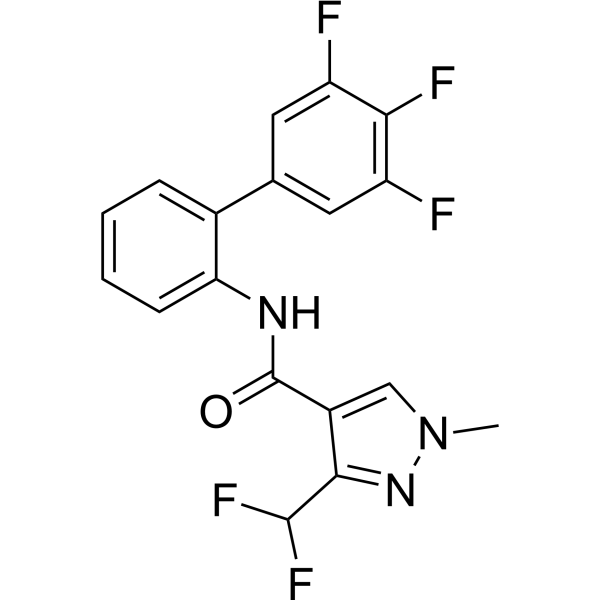
Fluxapyroxad is a synthetic broad-spectrum fungicide for the control of fungal diseases. Fluxapyroxad inhibits succinate dehydrogenase in complex II of the mitochondrial respiratory chain, resulting in inhibition of spore germination, germ tubes and mycelia growth within the fungus target species.
Nur für Forschungszwecke. Wir verkaufen nicht an Patienten.
- Reinheit : 99.92%
- CAS. Nr.: 907204-31-3
- Formel: C18H12F5N3O
- Molecular Weight:381.30
-
Speicherung:Powder -20°C, 3 years , 4°C, 2 years ; In solvent -80°C, 6 months , -20°C, 1 month

To place orders, for customer services and technical support, please contact: MedChemExpress USA
Tel: 609-228-6898 E-mail: [email protected] [email protected]


-
 Biologische Aktivität
-
Chemical Information
-
Lösungsmittel & Löslichkeit
- Reinheit & Dokumentation
- Verweise
-
 Help & FAQs


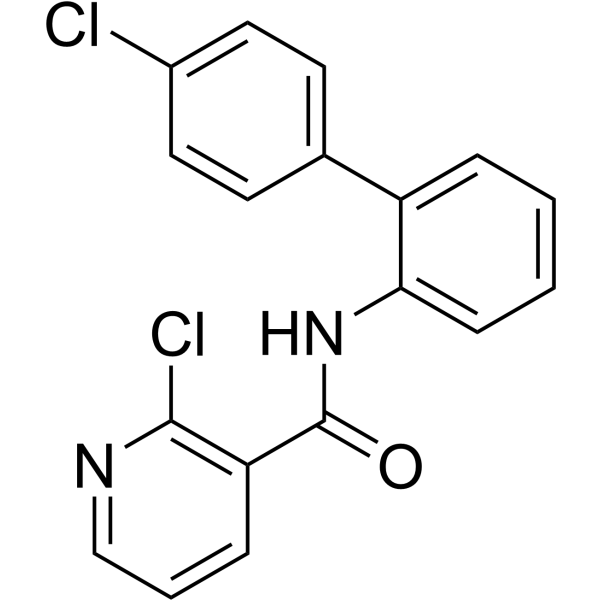

Publications Citing Use of MedChemExpress (MCE) Fluxapyroxad
MoreAlle Antibiotic Isoform-spezifische Produkte anzeigen
More

Biologische Aktivität
Beschreibung
In Vitro
Fluxapyroxad (0.1-100 μM, 48 h) inhibits the cell viability of HT-29, downregulates the expression of AHR, CYP1A1, and CYP1A2 genes in cell HT-29, leads to damage of the intestinal barrier and a decrease in the anti-inflammatory cytokine IL-22[2].
Fluxapyroxad (0.03-3 μM, 3 days) decreases the expression of erythrocyte marker genes hbbe1, hbbe2, and gata1a, disrupts the erythropoiesis in zebrafish embryos[3].
Fluxapyroxad inhibits succinate cytochrome c reductase with IC50 of 2.1, 0.71, 11.7 and 0.095 μM in Homo sapiens, Lumbricus terrestrix, Apis mellifera and Botrytis cinerea, respectively[4].
MedChemExpress (MCE) has not independently confirmed the accuracy of these methods. They are for reference only.
-
Cell Line:HT-29
-
Concentration:0.1-100 μM
-
Incubation Time:48 h
-
Result:Inhibited the cell viability in a dose-dependent manner.
In Vivo
MedChemExpress (MCE) has not independently confirmed the accuracy of these methods. They are for reference only.
-
Animal Model:C57BL/6 J mouse model[2].
-
Dosage:10 mg/kg/day
-
Administration:po via diet for 13 weeks
-
Result:Decreased body weight gain, shortened the colon length, damaged the colonic crypts, increased the levels of proinflammatory cytokines IL-6, IL-1β, and TNF-α, decreased the level of IL-22, impaired the intestinal barrier integrity.


Chemical Information
-
CAS. Nr. 907204-31-3
-
Appearance Solid
-
Molecular Weight 381.30
-
Formel C18H12F5N3O
-
Color White to off-white
-
SMILES
O=C(C1=CN(C)N=C1C(F)F)NC2=CC=CC=C2C3=CC(F)=C(F)C(F)=C3
-
Versand
Room temperature in continental US; may vary elsewhere.
-
Speicherung
Powder -20°C 3 years 4°C 2 years In solvent -80°C 6 months -20°C 1 month


Publications (1)
-
Journal Impact Factor
-
Most Recent
-
Pestic Biochem Physiol
The function of the alternative oxidase gene in the tolerance of Fusarium graminearum to azoxystrobin. [Abstract]2026 Feb:217:106853. PMID: 41461432


Lösungsmittel & Löslichkeit
In Vitro:
DMSO : ≥ 100 mg/mL (262.26 mM; Hygroscopic DMSO has a significant impact on the solubility of product, please use newly opened DMSO)
* "≥" means soluble, but saturation unknown.
Please refer to the solubility information to select the appropriate solvent. Once prepared, please aliquot and store the solution to prevent product inactivation from repeated freeze-thaw cycles.
Storage method and period of stock solution: -80°C, 6 months; -20°C, 1 month. When stored at -80°C, please use it within 6 months. When stored at -20°C, please use it within 1 month.
Please refer to the solubility information to select the appropriate solvent. Once prepared, please aliquot and store the solution to prevent product inactivation from repeated freeze-thaw cycles.
Storage method and period of stock solution: -80°C, 6 months; -20°C, 1 month. When stored at -80°C, please use it within 6 months. When stored at -20°C, please use it within 1 month.
Konzentration (Stammlösung) × Volumen (Stammlösung) = Konzentration (Ziellösung) × Volumen (Ziellösung)
In Vivo:
Select the appropriate dissolution method based on your experimental animal and administration route.
- For the following dissolution methods, please ensure to first prepare a clear stock solution using an In Vitro approach and then sequentially add co-solvents:
- To ensure reliable experimental results, the clarified stock solution can be appropriately stored based on storage conditions. As for the working solution for In Vivo experiments, it is recommended to prepare freshly and use it on the same day.
- The percentages shown for the solvents indicate their volumetric ratio in the final prepared solution. If precipitation or phase separation occurs during preparation, heat and/or sonication can be used to aid dissolution.
In Vivo Dissolution Calculator
Please enter the basic information of animal experiments:
-
-
-
-
Recommended: Prepare an additional quantity of animals to account for potential losses during experiments.
Please enter your animal formula composition:
-
%DMSO +
Recommended: Keep the proportion of DMSO in working solution below 2% if your animal is weak.
-
%+
-
+%Tween-80 + +
-
%Saline +
The co-solvents required include: DMSO, . All of co-solvents are available by MedChemExpress (MCE). , Tween 80. All of co-solvents are available by MedChemExpress (MCE).
Working solution concentration: 0.22 mg/mL
Method for preparing stock solution: mg drug dissolved in μL DMSO. Stock solution concentration: mg/mL.
1. Take μL DMSO stock solution;
2. Add μL .
μL , mix evenly;
3. Then add μL Tween 80, mix evenly;
4. Then add μL
Please ensure that the stock solution in the first step is dissolved to a clear state, and add co-solvents in sequence. You can use ultrasonic heating (ultrasonic cleaner, recommended frequency 20-40 kHz), vortexing, etc. to assist dissolution.


Reinheit & Dokumentation
-
Data Sheet (278 KB)
-
SDS (563 KB)
- English - EN (563 KB)
- Français - FR (563 KB)
- Deutsch - DE (563 KB)
- Norwegian - NO (563 KB)
- Español - ES (563 KB)
- Swedish - SV (563 KB)
- Italian - IT (563 KB)
- Korean - KR (563 KB)
- Portuguese - PT (563 KB)
-
Handling Instructions (2659 KB)
Verweise
[1]. Chen X, et al. Effective Monitoring of Fluxapyroxad and Its Three Biologically Active Metabolites in Vegetables, Fruits, and Cereals by Optimized QuEChERS Treatment Based on UPLC-MS/MS. J Agric Food Chem. 2016 Nov 23;64(46):8935-8943. [Content Brief]
[2]. Cao Y, et al., Fluxapyroxad induces chronic colonic inflammation via inhibiting intestinal aryl hydrocarbon receptors in mice. Sci Total Environ. 2025 Apr 10;973:179134. [Content Brief]
[3]. Chen X, et al., Fluxapyroxad disrupt erythropoiesis in zebrafish (Danio rerio) embryos. Ecotoxicol Environ Saf. 2022 Dec 1;247:114259. [Content Brief]
[4]. Bénit P, et al., Evolutionarily conserved susceptibility of the mitochondrial respiratory chain to SDHI pesticides and its consequence on the impact of SDHIs on human cultured cells. PLoS One. 2019 Nov 7;14(11):e0224132. [Content Brief]


Complete Stock Solution Preparation Table
Please refer to the solubility information to select the appropriate solvent. Once prepared, please aliquot and store the solution to prevent product inactivation from repeated freeze-thaw cycles.
Storage method and period of stock solution: -80°C, 6 months; -20°C, 1 month. When stored at -80°C, please use it within 6 months. When stored at -20°C, please use it within 1 month.
| Optional Solvent | Concentration Solvent Mass | 1 mg | 5 mg | 10 mg | 25 mg |
|---|---|---|---|---|---|
| DMSO | 1 mM | 2.6226 mL | 13.1130 mL | 26.2261 mL | 65.5652 mL |
| 5 mM | 0.5245 mL | 2.6226 mL | 5.2452 mL | 13.1130 mL | |
| 10 mM | 0.2623 mL | 1.3113 mL | 2.6226 mL | 6.5565 mL | |
| 15 mM | 0.1748 mL | 0.8742 mL | 1.7484 mL | 4.3710 mL | |
| 20 mM | 0.1311 mL | 0.6557 mL | 1.3113 mL | 3.2783 mL | |
| 25 mM | 0.1049 mL | 0.5245 mL | 1.0490 mL | 2.6226 mL | |
| 30 mM | 0.0874 mL | 0.4371 mL | 0.8742 mL | 2.1855 mL | |
| 40 mM | 0.0656 mL | 0.3278 mL | 0.6557 mL | 1.6391 mL | |
| 50 mM | 0.0525 mL | 0.2623 mL | 0.5245 mL | 1.3113 mL | |
| 60 mM | 0.0437 mL | 0.2186 mL | 0.4371 mL | 1.0928 mL | |
| 80 mM | 0.0328 mL | 0.1639 mL | 0.3278 mL | 0.8196 mL | |
| 100 mM | 0.0262 mL | 0.1311 mL | 0.2623 mL | 0.6557 mL |


Fluxapyroxad Related Classifications
HY-135549 Related Classifications
 Powered by Bioz