



RU28362
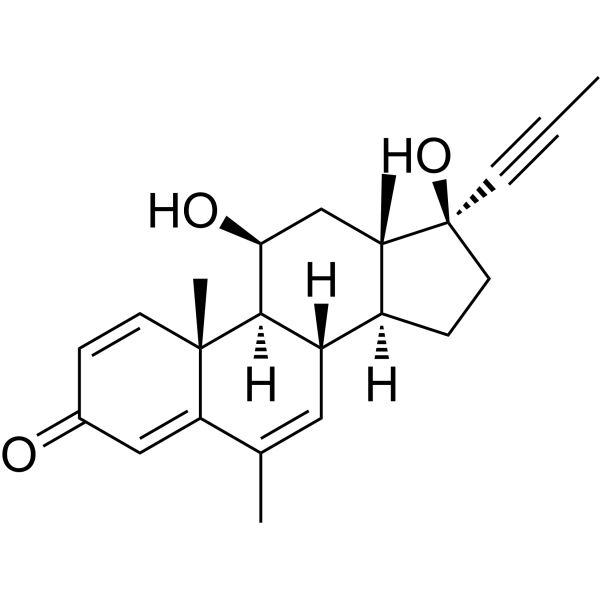
RU28362 is a potent and selective glucocorticoid agonist. RU28362 increases the Bnip3 mRNA levels in neurons. RU28362 inhibits adrenocorticotrophic hormone (ACTH) and corticosterone secretion. RU28362 is a click chemistry reagent, it contains an Alkyne group and can undergo copper-catalyzed azide-alkyne cycloaddition (CuAAc) with molecules containing Azide groups.
Nur für Forschungszwecke. Wir verkaufen nicht an Patienten.
- CAS. Nr.: 74915-64-3
- Formel: C23H28O3
- Molecular Weight:352.47
-
Speicherung:
Please store the product under the recommended conditions in the Certificate of Analysis.

To place orders, for customer services and technical support, please contact: MedChemExpress USA
Tel: 609-228-6898 E-mail: [email protected] [email protected]


-
 Biologische Aktivität
-
Chemical Information
- Protokoll
- Reinheit & Dokumentation
- Verweise
-
 Help & FAQs




Biologische Aktivität
Beschreibung
IC50 & Target
|
BNIP3 |
In Vitro
RU28362 (0.1, 1, 5, 10 nM; 72 h) increases the Bnip3 mRNA levels in a dose-dependent manner after 72 h in neurons[1].
MedChemExpress (MCE) has not independently confirmed the accuracy of these methods. They are for reference only. Further protocols information, click here.
-
Cell Line:Primary cortical neurons
-
Concentration:0.1, 1.0, 5.0, 10.0 nM
-
Incubation Time:48, 72 h
-
Result:Significantly increased the Bnip3 mRNA levels in a dose-dependent manner after 72 h, Bnip3 mRNA levels were not changed after treatment with RU28362 for 48 h.
In Vivo
MedChemExpress (MCE) has not independently confirmed the accuracy of these methods. They are for reference only.
-
Animal Model:250-350 g, adult male Sprague-Dawley rats[2]
-
Dosage:150 µg/kg
-
Administration:I.p.; 60 min before exposure to a 15-min period of restraint stress
-
Result:Inhibited adrenocorticotrophic hormone (ACTH) and corticosterone secretion and selectively suppressed the stress-induced increase in POMC hnRNA in the anterior pituitary gland.


Chemical Information
-
CAS. Nr. 74915-64-3
-
Molecular Weight 352.47
-
Formel C23H28O3
-
SMILES
O=C1C=C[C@@]2([C@]3([C@H](C[C@@]4([C@@](O)(CC[C@]4([C@@]3(C=C(C2=C1)C)[H])[H])C#CC)C)O)[H])C
-
Versand
Room temperature in continental US; may vary elsewhere.
-
Speicherung
Please store the product under the recommended conditions in the Certificate of Analysis.

Protokoll
-
RNA extraction experimental
By lysing cells, releasing RNA, and removing impurities such as proteins and DNA, high-purity RNA products are finally obtained. The commonly used traditional method is the guanidine isothiocyanate/phenol/chloroform method (Trizol), which is suitable for a variety of animal materials including animal tissues, microorganisms, cultured cells, etc., and most plant materials.
-
EdU Incorporation Assay (Click Chemistry-Based DNA Synthesis Measurement)
The EdU incorporation assay measures DNA synthesis by adding the thymidine analog 5-ethynyl-2′-deoxyuridine to cells or tissues, where it is incorporated into newly synthesized DNA during S phase. Incorporated EdU is detected by copper-catalyzed azide-alkyne cycloaddition, in which a fluorescent azide covalently reacts with the ethynyl group on EdU, allowing S-phase cells to be detected by fluorescence microscopy, flow cytometry, or high-content imaging. EdU detection does not require DNA denaturation or anti-BrdU antibody access, which preserves sample structure and improves compatibility with immunostaining and multiparameter cytometry compared with BrdU-based detection. EdU can be cytotoxic in a cell-type- and exposure-dependent manner, so pulse duration, concentration, and continuous-labeling designs should be validated for each cell type.
-
Research Protocol for Endocrine Diseases
Endocrine diseases often arise from disrupted hormone production, hormone signaling, or target-tissue responsiveness; for diabetes-focused endocrine disease models, insulin signaling regulates glucose uptake, hepatic glucose output, lipid metabolism, and β-cell compensation. Type 2 diabetes develops through interacting defects in insulin resistance, β-cell dysfunction, adipose inflammation, hepatic glucose overproduction, altered incretin signaling, and ectopic lipid metabolism. A major unresolved question is whether endocrine dysfunction is driven primarily by target-tissue insulin resistance, intrinsic β-cell failure, immune/inflammatory stress, or combined multi-organ failure that differs by disease stage.


Reinheit & Dokumentation
Verweise
[1]. Sandau US, et al. Glucocorticoids exacerbate hypoxia-induced expression of the pro-apoptotic gene Bnip3 in the developing cortex. Neuroscience. 2007 Jan 19;144(2):482-94. [Content Brief]
[2]. Ginsberg AB, et al. Specific and time-dependent effects of glucocorticoid receptor agonist RU28362 on stress-induced pro-opiomelanocortin hnRNA, c-fos mRNA and zif268 mRNA in the pituitary. J Neuroendocrinol. 2006 Feb;18(2):129-38. [Content Brief]

Calculators
Konzentration (Stammlösung) × Volumen (Stammlösung) = Konzentration (Ziellösung) × Volumen (Ziellösung)


RU28362 Related Classifications
HY-121859 Related Classifications
 Powered by Bioz