



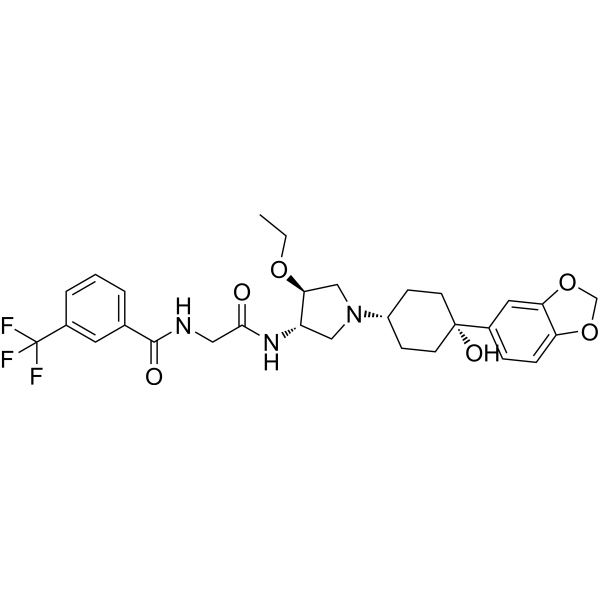
cis-INCB3344
Based on 1 publication(s) in Google Scholar
cis-INCB3344 is the isomer of INCB3344 (HY-50674), and can be used as an experimental control. INCB3344 is a potent, selective and orally bioavailable CCR2 antagonist with IC50 values of 5.1 nM (hCCR2) and 9.5 nM (mCCR2) in binding antagonism and 3.8 nM (hCCR2) and 7.8 nM (mCCR2) in antagonism of chemotaxis activity.
For research use only. We do not sell to patients.
- Purity : 95.10%
- CAS No.: 1285539-85-6
- Formula: C29H34F3N3O6
- Molecular Weight:577.59
-
Storage:Powder -20°C, 3 years , 4°C, 2 years ; In solvent -80°C, 6 months , -20°C, 1 month

To place orders, for customer services and technical support, please contact: MedChemExpress USA
Tel: 609-228-6898 E-mail: [email protected] [email protected]


-
 Biological Activity
-
Chemical Information
-
Solvent & Solubility
- Protocols
- Purity & Documentation
- References
-
 Help & FAQs


Publications Citing Use of MedChemExpress (MCE) cis-INCB3344
More

Biological Activity
Description


Chemical Information
-
CAS No. 1285539-85-6
-
Appearance Solid
-
Molecular Weight 577.59
-
Formula C29H34F3N3O6
-
Color White to off-white
-
SMILES
O=C(NCC(N[C@H]1CN([C@@H]2CC[C@](C3=CC=C(OCO4)C4=C3)(O)CC2)C[C@@H]1OCC)=O)C5=CC=CC(C(F)(F)F)=C5
-
Shipping
Room temperature in continental US; may vary elsewhere.
-
Storage
Powder -20°C 3 years 4°C 2 years In solvent -80°C 6 months -20°C 1 month


Publications (1)
-
Journal Impact Factor
-
Most Recent
-
Dev Cell
Mast cells proliferate in the peri-hippocampal space during early development and modulate local and peripheral immune cells. [Abstract]2025 Mar 24;60(6):853-870.e7. PMID: 39662467


Solvent & Solubility
In Vitro:
DMSO : 100 mg/mL (173.13 mM; Need ultrasonic; Hygroscopic DMSO has a significant impact on the solubility of product, please use newly opened DMSO)
Please refer to the solubility information to select the appropriate solvent. Once prepared, please aliquot and store the solution to prevent product inactivation from repeated freeze-thaw cycles.
Storage method and period of stock solution: -80°C, 6 months; -20°C, 1 month. When stored at -80°C, please use it within 6 months. When stored at -20°C, please use it within 1 month.
Please refer to the solubility information to select the appropriate solvent. Once prepared, please aliquot and store the solution to prevent product inactivation from repeated freeze-thaw cycles.
Storage method and period of stock solution: -80°C, 6 months; -20°C, 1 month. When stored at -80°C, please use it within 6 months. When stored at -20°C, please use it within 1 month.
Concentration (start) × Volume (start) = Concentration (final) × Volume (final)


Purity & Documentation
-
Data Sheet (272 KB)
-
SDS (393 KB)
- English - EN (393 KB)
- Français - FR (393 KB)
- Deutsch - DE (393 KB)
- Norwegian - NO (393 KB)
- Español - ES (393 KB)
- Swedish - SV (393 KB)
- Italian - IT (393 KB)
- Korean - KR (393 KB)
- Portuguese - PT (393 KB)
-
Handling Instructions (2659 KB)
References
[1]. Xue CB, et al. Discovery of INCB3344, a potent, selective and orally bioavailable antagonist of human and murine CCR2. Bioorg Med Chem Lett. 2010 Dec 15;20(24):7473-8 [Content Brief]
[2]. Zhao W, et al. Enrichment of Ly6Chi monocytes by multiple GM-CSF injections with HBV vaccine contributes to viral clearance in a HBV mouse model. Hum Vaccin Immunother. 2017 Dec 2;13(12):2872-2882. [Content Brief]
[3]. Aye-Mon A, et al. CCR2 upregulation in DRG neurons plays a crucial role in gastric hyperalgesia associated with diabetic gastropathy. Mol Pain. 2018 Jan-Dec;14:1744806917751322. [Content Brief]
[4]. Chan CT, et al. Reversal of vascular macrophage accumulation and hypertension by a CCR2 antagonist in deoxycorticosterone/salt-treated mice. Hypertension. 2012 Nov;60(5):1207-12. [Content Brief]
[5]. Brodmerkel CM, et al. Discovery and pharmacological characterization of a novel rodent-active CCR2 antagonist, INCB3344. J Immunol. 2005 Oct 15;175(8):5370-8. [Content Brief]
[6]. Cassini MF, et al. Mcp1 Promotes Macrophage-Dependent Cyst Expansion in Autosomal Dominant Polycystic Kidney Disease. J Am Soc Nephrol. 2018 Oct;29(10):2471-2481. [Content Brief]
[7]. Dansereau MA, et al. Spinal CCL2 pronociceptive action is no longer effective in CCR2 receptor antagonist-treated rats. J Neurochem. 2008 Jul;106(2):757-69. [Content Brief]


Complete Stock Solution Preparation Table
Please refer to the solubility information to select the appropriate solvent. Once prepared, please aliquot and store the solution to prevent product inactivation from repeated freeze-thaw cycles.
Storage method and period of stock solution: -80°C, 6 months; -20°C, 1 month. When stored at -80°C, please use it within 6 months. When stored at -20°C, please use it within 1 month.
| Optional Solvent | Concentration Solvent Mass | 1 mg | 5 mg | 10 mg | 25 mg |
|---|---|---|---|---|---|
| DMSO | 1 mM | 1.7313 mL | 8.6567 mL | 17.3133 mL | 43.2833 mL |
| 5 mM | 0.3463 mL | 1.7313 mL | 3.4627 mL | 8.6567 mL | |
| 10 mM | 0.1731 mL | 0.8657 mL | 1.7313 mL | 4.3283 mL | |
| 15 mM | 0.1154 mL | 0.5771 mL | 1.1542 mL | 2.8856 mL | |
| 20 mM | 0.0866 mL | 0.4328 mL | 0.8657 mL | 2.1642 mL | |
| 25 mM | 0.0693 mL | 0.3463 mL | 0.6925 mL | 1.7313 mL | |
| 30 mM | 0.0577 mL | 0.2886 mL | 0.5771 mL | 1.4428 mL | |
| 40 mM | 0.0433 mL | 0.2164 mL | 0.4328 mL | 1.0821 mL | |
| 50 mM | 0.0346 mL | 0.1731 mL | 0.3463 mL | 0.8657 mL | |
| 60 mM | 0.0289 mL | 0.1443 mL | 0.2886 mL | 0.7214 mL | |
| 80 mM | 0.0216 mL | 0.1082 mL | 0.2164 mL | 0.5410 mL | |
| 100 mM | 0.0173 mL | 0.0866 mL | 0.1731 mL | 0.4328 mL |


cis-INCB3344 Related Classifications
HY-77111 Related Classifications
 Powered by Bioz