



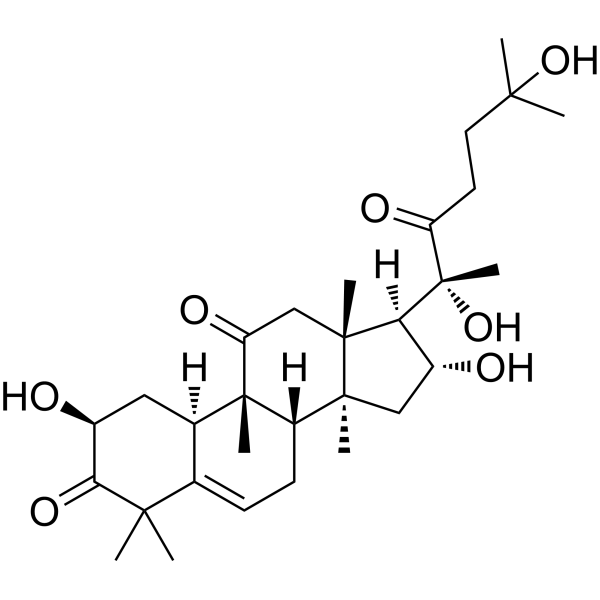
Cucurbitacin R

Based on 1 Customer Validation
Cucurbitacin R is an orally active anti-inflammatory agent. Cucurbitacin R is isolated from the roots of Cayaponia tayuya. Cucurbitacin R inhibits Cyclooxygenase-2. Cucurbitacin R inhibits Interleukin-6-induced STAT3 activation and cytokine production, blocks NF-κB activation, and selectively prevents NFAT nuclear translocation without affecting Calcineurin activity. Cucurbitacin R inhibits TNF-α production and Nitric-oxide synthase-2 expression. Cucurbitacin R reduces joint damage, soft tissue swelling, paw edema, ear edema, inflammatory cell infiltration, and epithelial thickness. Cucurbitacin R can be used for research on arthritis and delayed-type hypersensitivity.
商品は「研究用試薬」です。人や動物の医療用・臨床診断用・食品用の製品ではありません。
研究用途以外に使用した場合、当社は一切の責任を負いかねます。
- 純度 : 97.56%
- CAS 番号: 55903-92-9
- 分子式: C30H46O7
- 分子量:518.68
-
保管条件:
-20°C, protect from light
* In solvent : -80°C, 6 months; -20°C, 1 month (protect from light)

To place orders, for customer services and technical support, please contact: MedChemExpress USA
Tel: 609-228-6898 E-mail: [email protected] [email protected]


-
 生物活性
生物活性
-
化学情報
-
溶剤 & 溶解度
- プロトコル
- 純度とドキュメンテーション
- 参考文献
-
 Help & FAQs




生物活性
製品説明
IC50 & Target
[1]|
COX-2 |
STAT3 |
Cellular Effect
|
Cell Line

|
Type | Value | Description | References |
|---|---|---|---|---|
| RAW264.7 | IC50 |
65 μM
|
Inhibition of TNF-α production in lipopolysaccharide-stimulated RAW 264.7 murine macrophages incubated for 24 hrs by enzyme immunoassay.
Inhibition of TNF-α production in lipopolysaccharide-stimulated RAW 264.7 murine macrophages incubated for 24 hrs by enzyme immunoassay.
|
17065367 |
体外実験
Cucurbitacin R (100 μM; 24 h) inhibits prostaglandin E2 production in lipopolysaccharide-stimulated RAW 264.7 mouse macrophages[1].
Cucurbitacin R (25-100 μM; 2 h) does not directly affect Nitric-oxide synthase-2 activity in lipopolysaccharide-stimulated RAW 264.7 mouse macrophages[1].
Cucurbitacin R (25-100 μM; 2 h) directly inhibits cyclooxygenase-2 activity in lipopolysaccharide-stimulated RAW 264.7 mouse macrophages[1].
Cucurbitacin R (30 μM; 18 h) inhibits the production of IL-2, IL-4, IL-10, and interferon-γ and decreases their mRNA expression in Phytohemagglutinin A-stimulated T lymphocytes[2].
MedChemExpress (MCE) has not independently confirmed the accuracy of these methods. They are for reference only.
-
Cell Line:RAW 264.7 murine macrophages
-
Concentration:100 μM
-
Incubation Time:24 h
-
Result:Inhibited prostaglandin E2 production by 53%.
-
Cell Line:RAW 264.7 murine macrophages
-
Concentration:100, 50, 25, 12.5, 6.25 μM
-
Incubation Time:1 h
-
Result:Inhibited TNF-α production in a concentration-dependent manner with an IC50 value of 65 μM.
-
Cell Line:Human T lymphocytes
-
Concentration:30 μM (RT-PCR); various concentrations (ELISA)
-
Incubation Time:18 h (RT-PCR); 4 days (ELISA)
-
Result:Inhibited the production of IL-2, IL-4, IL-10, and interferon-γ by stimulated T lymphocytes.
Reduced cytokine mRNA expression with respect to the control group.
体内実験
Cucurbitacin R (3 mg/kg; i.p.; single dose; 30 min before PLA2 injection) exhibits anti-inflammatory activity in the PLA2-induced mouse paw edema model, with an inhibition rate of 61% at 60 min[3].
Cucurbitacin R (0.5 mg/kg; subcutaneous injection; single dose; 3 h before serotonin injection) exhibits anti-inflammatory activity in the Serotonin (HY-B1473A)-induced mouse paw edema model with an inhibition rate of 79%, and its effect depends on protein synthesis but not on the glucocorticoid receptor[3].
Cucurbitacin R (0.1 mg/ear, 4 mg/kg; topical, p.o.; administered simultaneously with TPA, single dose) exhibits potent anti-inflammatory activity in the TPA-induced acute mouse ear edema model, with an inhibition rate of 87% at 0.1 mg/ear topically and 36% at 4 mg/kg p.o.[3].
Cucurbitacin R (0.1-0.5 mg/ear; topical administration; 2, 24, and 48 h after challenge) inhibits oxazolone-induced DTH responses in mice, with a maximum inhibition rate of 60% at 0.5 mg/ear, whereas the 0.1 mg/ear dose is ineffective[2].
Cucurbitacin R (0.1-0.5 mg/ear; topical administration; 2, 24, and 48 h after challenge) inhibits DNFB-induced DTH responses in mice, with a maximum inhibition rate of 40% at 0.5 mg/ear, whereas the 0.1 mg/ear dose is ineffective[2].
Cucurbitacin R (5 mg/kg; p.o.; single dose; 1 h before acetic acid injection) shows no analgesic activity in the acetic acid writhing test[3].
MedChemExpress (MCE) has not independently confirmed the accuracy of these methods. They are for reference only.
-
Animal Model:Lewis rats (female, 7 weeks old, 200-240 g)[1]
-
Dosage:1 mg/kg (paw swelling); 0.25 mg/kg (paw swelling)
-
Administration:p.o.; once daily; days 17 to 23
-
Result:Reduced hind paw swelling by 48% at 1 mg/kg.
Reduced hind paw swelling by 10% at 0.25 mg/kg.
Inhibited in vivo production of prostaglandin E2 by 94%.
Inhibited TNF-α production in arthritic paws by 76%.
Reduced nitric-oxide synthase-2 and cyclooxygenase-2 expression in paw homogenates.
-
Animal Model:Swiss mice (female, 8 weeks old, 25-30 g)[1]
-
Dosage:10 mg/kg
-
Administration:p.o.; 1 h before acetic acid injection
-
Result:Showed significant analgesic activity with a 47% reduction in writhing compared with the control group.
-
Animal Model:Swiss mice (female, 8 weeks old, 25-30 g)[2]
-
Dosage:0.1, 0.3, 0.5 mg/ear
-
Administration:topical; 2, 24, and 48 h after challenge
-
Result:At 0.1 mg/ear, had no effect.
At 0.3 mg/ear, reduced ear edema with inhibition percentages of 45% at 24 h, 49% at 48 h, and 39% at 72 h.
At 0.5 mg/ear, reduced ear edema with inhibition percentages of 50% at 24 h, 60% at 48 h, and 53% at 72 h.\nAt 0.1 mg/ear, had no effect.
At 0.3 mg/ear, reduced ear edema with inhibition percentages of 23% at 24 h, 35% at 48 h, and 27% at 72 h.
At 0.5 mg/ear, reduced ear edema with inhibition percentages of 30% at 24 h, 40% at 48 h, and 40% at 72 h.
-
Animal Model:Swiss mice (female, 8 weeks old, 25-30 g)[2]
-
Dosage:10 mg/kg
-
Administration:i.p.; 0 h and 16 h after challenge
-
Result:At 10 mg/kg, significantly reduced paw edema with inhibition percentages of 64% at 18 h, 61% at 24 h, and 62% at 48 h.
Reduced cytokine levels in inflamed paws: TNF-α was 244 pg/mL, IL-1β was 542 pg/mL, and IL-4 was 9 pg/mL.
-
Animal Model:Swiss mice (female, 25-30 g)[3]
-
Dosage:4 mg/kg
-
Administration:p.o.; single dose; 1 h before carrageenan injection
-
Result:Inhibited paw oedema by 27% at 5 h.
-
Animal Model:Swiss mice (female, 25-30 g)[3]
-
Dosage:3 mg/kg
-
Administration:i.p.; single dose; 30 min before PLA2 injection
-
Result:Inhibited the oedema by 61% at 60 min.
-
Animal Model:Swiss mice (female, 25-30 g)[3]
-
Dosage:0.5 mg/kg
-
Administration:s.c.; single dose; 3 h before serotonin injection
-
Result:Inhibited serotonin-induced paw oedema by 79%.
The anti-oedema effect was not modified by mifepristone, but was abolished by cycloheximide.
-
Animal Model:Swiss mice (female, 25-30 g)[3]
-
Dosage:0.1 mg/ear (topical); 4 mg/kg (p.o.)
-
Administration:topical (simultaneous with TPA); p.o. (single dose)
-
Result:Inhibited the oedema by 87% when administered topically at 0.1 mg/ear.
Showed 36% inhibition when administered orally at 4 mg/kg.
-
Animal Model:Swiss mice (female, 25-30 g)[3]
-
Dosage:0.1-0.2 mg/ear
-
Administration:topical; twice daily for four days (morning only on the last day)
-
Result:At 0.1 mg/ear, inhibited swelling by 56% and neutrophil infiltration by 69%.
At 0.2 mg/ear, inhibited swelling by 60% and neutrophil infiltration by 75%.
Reduced epithelium thickness to 6.37 cells compared to 7.43 in the control.
-
Animal Model:Swiss mice (female, 25-30 g)[3]
-
Dosage:5 mg/kg
-
Administration:p.o.; single dose; 1 h before acetic acid injection
-
Result:Showed no significant analgesic properties at the dose assayed.


化学情報
-
CAS 番号 55903-92-9
-
性状 Solid
-
分子量 518.68
-
分子式 C30H46O7
-
Color White to off-white
-
SMILES
C[C@]12[C@@]([C@@]([C@@H](C1)O)([H])[C@@](C)(O)C(CCC(C)(O)C)=O)(CC([C@@]3([C@@]2([H])CC=C4[C@@]3([H])C[C@@H](C(C4(C)C)=O)O)C)=O)C
-
Structure Classification
-
Initial Source
-
輸送条件
Room temperature in continental US; may vary elsewhere.
-
保管条件
-20°C, protect from light
* In solvent : -80°C, 6 months; -20°C, 1 month (protect from light)


溶剤 & 溶解度
体外:
DMSO : 10 mg/mL (19.28 mM; Need ultrasonic and warming; Hygroscopic DMSO has a significant impact on the solubility of product, please use newly opened DMSO)
Please refer to the solubility information to select the appropriate solvent. Once prepared, please aliquot and store the solution to prevent product inactivation from repeated freeze-thaw cycles.
Storage method and period of stock solution: -80°C, 6 months; -20°C, 1 month (protect from light). When stored at -80°C, please use it within 6 months. When stored at -20°C, please use it within 1 month.
Please refer to the solubility information to select the appropriate solvent. Once prepared, please aliquot and store the solution to prevent product inactivation from repeated freeze-thaw cycles.
Storage method and period of stock solution: -80°C, 6 months; -20°C, 1 month (protect from light). When stored at -80°C, please use it within 6 months. When stored at -20°C, please use it within 1 month.
濃度 (開始) × 体積 (開始) = 濃度 (終了) × 体積 (終了)


純度とドキュメンテーション
-
データシート (308 KB)
-
SDS (252 KB)
- English - EN (252 KB)
- Français - FR (252 KB)
- Deutsch - DE (252 KB)
- Norwegian - NO (252 KB)
- Español - ES (252 KB)
- Swedish - SV (252 KB)
- Italian - IT (252 KB)
- Korean - KR (252 KB)
- Portuguese - PT (252 KB)
-
取扱説明書 (2659 KB)
参考文献


Complete Stock Solution Preparation Table
Please refer to the solubility information to select the appropriate solvent. Once prepared, please aliquot and store the solution to prevent product inactivation from repeated freeze-thaw cycles.
Storage method and period of stock solution: -80°C, 6 months; -20°C, 1 month (protect from light). When stored at -80°C, please use it within 6 months. When stored at -20°C, please use it within 1 month.
| Optional Solvent | Concentration Solvent Mass | 1 mg | 5 mg | 10 mg | 25 mg |
|---|---|---|---|---|---|
| DMSO | 1 mM | 1.9280 mL | 9.6399 mL | 19.2797 mL | 48.1993 mL |
| 5 mM | 0.3856 mL | 1.9280 mL | 3.8559 mL | 9.6399 mL | |
| 10 mM | 0.1928 mL | 0.9640 mL | 1.9280 mL | 4.8199 mL | |
| 15 mM | 0.1285 mL | 0.6427 mL | 1.2853 mL | 3.2133 mL |


Cucurbitacin R 関連分類
HY-N11080 関連分類
 Powered by Bioz