



Dicyclomine
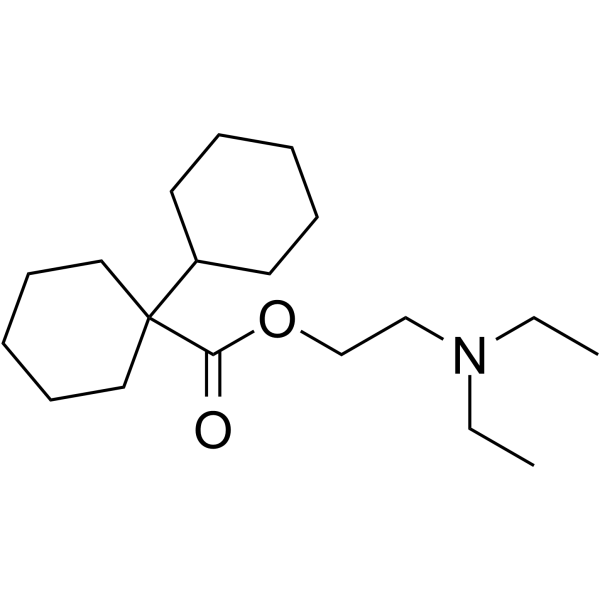
Dicyclomine (Dicycloverine) is a potent and orally active muscarinic cholinergic receptors antagonist. Dicyclomine (Dicycloverine) shows high affinity for muscarinic M1 receptor subtype (Ki=5.1 nM) and M2 receptor subtype (Ki=54.6 nM) in brush-border membrane and basal plasma membranes, respectively. Dicyclomine is an antispasmodic agent and relieves smooth muscle spasm of the gastrointestinal tract in vivo.
For research use only. We do not sell to patients.
- CAS No.: 77-19-0
- Formula: C19H35NO2
- Molecular Weight:309.49
-
Storage:Powder -20°C, 3 years ; In solvent -80°C, 6 months , -20°C, 1 month

To place orders, for customer services and technical support, please contact: MedChemExpress USA
Tel: 609-228-6898 E-mail: [email protected] [email protected]


-
 Biological Activity
-
Chemical Information
- Purity & Documentation
- References
-
 Help & FAQs




Biological Activity
Description
IC50 & Target
|
mAChR1 |
mAChR2 |
In Vivo
MedChemExpress (MCE) has not independently confirmed the accuracy of these methods. They are for reference only.
-
Animal Model:C57Bl/6 mice[1]
-
Dosage:2.0, 4.0, and 8.0 mg/kg
-
Administration:Intraperitoneal injection; daily; 7 days
-
Result:Produced impairments due to actions of the agent outside of the hippocampus.


Chemical Information
-
CAS No. 77-19-0
-
Appearance Solid
-
Molecular Weight 309.49
-
Formula C19H35NO2
-
Color White to off-white
-
SMILES
O=C(C1(C2CCCCC2)CCCCC1)OCCN(CC)CC
-
Synonyms
Dicycloverine
-
Shipping
Room temperature in continental US; may vary elsewhere.
-
Storage
Powder -20°C 3 years In solvent -80°C 6 months -20°C 1 month


Purity & Documentation
References
[1]. Antonella Caccamo, et al. M1 Receptors Play a Central Role in Modulating AD-like Pathology in Transgenic Mice. 2006 Mar 2;49(5):671-82.doi: 10.1016/j.neuron.2006.01.020. [Content Brief]
[2]. Antonella Caccamo, et al. M1 Receptors Play a Central Role in Modulating AD-like Pathology in Transgenic Mice. 2006 Mar 2;49(5):671-82.doi: 10.1016/j.neuron.2006.01.020. [Content Brief]
[3]. Susan J Bartko,et al. A Computer-Automated Touchscreen Paired-Associates Learning (PAL) Task for Mice: Impairments Following Administration of Scopolamine or Dicyclomine and Improvements Following Donepezil.Psychopharmacology (Berl). 2011 Mar;214(2):537-48. [Content Brief]

Calculators
Concentration (start) × Volume (start) = Concentration (final) × Volume (final)


Dicyclomine Related Classifications
HY-B1339A Related Classifications
 Powered by Bioz