



GSK761

Based on 1 Customer Validation
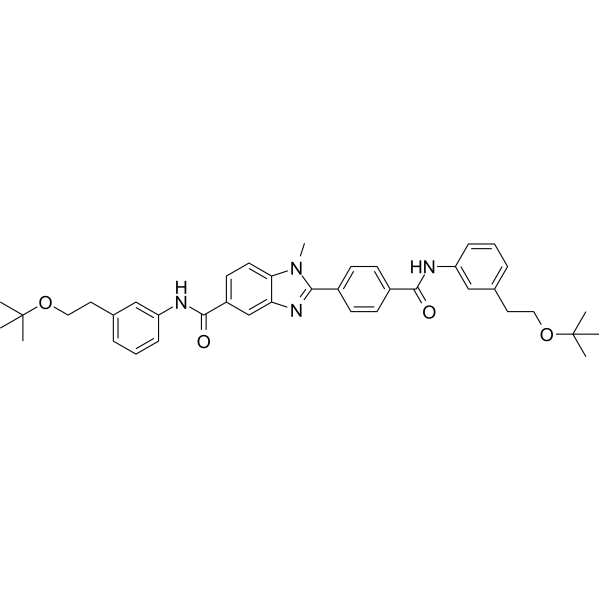
GSK761 is a selective inhibitor of speckled 140 kDa (SP140) with an IC50 value of 77.79 nM. GSK761 reduces monocyte-to-inflammatory macrophage differentiation and lipopolysaccharide (LPS)-induced inflammatory activation. GSK761 induces the production of CD206+ regulatory macrophages by inhibiting SP140.
For research use only. We do not sell to patients.
- Purity : 99.64%
- Formula: C40H46N4O4
- Molecular Weight:646.82
-
Storage:Powder -20°C, 3 years , 4°C, 2 years ; In solvent -80°C, 6 months , -20°C, 1 month

To place orders, for customer services and technical support, please contact: MedChemExpress USA
Tel: 609-228-6898 E-mail: [email protected] [email protected]


-
 Biological Activity
-
Chemical Information
-
Solvent & Solubility
- Protocols
- Purity & Documentation
- References
-
 Help & FAQs




Biological Activity
Description
IC50 & Target
IC50: 77.79 nM (Speckled 140 kDa, SP140)[1]
In Vitro
GSK761 combines with SP140 in HuT78 cells and HEK293 cells transfected with Halo-tagged SP140[1].
GSK761 (0.01-1.11 µM; 1 h) reduces the inflammatory activation and down-regulates the expression of TNF, IL-6, IL-12p70, IL-1β, IL-8, IL-10 pro-inflammatory cytokines in M1 polarized macrophages[1].
GSK761 (0.04 µM; 4 h) significantly decreases the expression of TNF, IL6 and IL10 in CD14+ mucosal macrophages[1].
MedChemExpress (MCE) has not independently confirmed the accuracy of these methods. They are for reference only. Further protocols information, click here.


Chemical Information
-
Appearance Solid
-
Molecular Weight 646.82
-
Formula C40H46N4O4
-
Color White to off-white
-
SMILES
CN1C2=CC=C(C=C2N=C1C3=CC=C(C=C3)C(NC4=CC(CCOC(C)(C)C)=CC=C4)=O)C(NC5=CC(CCOC(C)(C)C)=CC=C5)=O
-
Shipping
Room temperature in continental US; may vary elsewhere.
-
Storage
Powder -20°C 3 years 4°C 2 years In solvent -80°C 6 months -20°C 1 month


Solvent & Solubility
In Vitro:
DMSO : 125 mg/mL (193.25 mM; ultrasonic and warming and heat to 60°C; Hygroscopic DMSO has a significant impact on the solubility of product, please use newly opened DMSO)
Please refer to the solubility information to select the appropriate solvent. Once prepared, please aliquot and store the solution to prevent product inactivation from repeated freeze-thaw cycles.
Storage method and period of stock solution: -80°C, 6 months; -20°C, 1 month. When stored at -80°C, please use it within 6 months. When stored at -20°C, please use it within 1 month.
Please refer to the solubility information to select the appropriate solvent. Once prepared, please aliquot and store the solution to prevent product inactivation from repeated freeze-thaw cycles.
Storage method and period of stock solution: -80°C, 6 months; -20°C, 1 month. When stored at -80°C, please use it within 6 months. When stored at -20°C, please use it within 1 month.
Concentration (start) × Volume (start) = Concentration (final) × Volume (final)
In Vivo:
Select the appropriate dissolution method based on your experimental animal and administration route.
- For the following dissolution methods, please ensure to first prepare a clear stock solution using an In Vitro approach and then sequentially add co-solvents:
- To ensure reliable experimental results, the clarified stock solution can be appropriately stored based on storage conditions. As for the working solution for In Vivo experiments, it is recommended to prepare freshly and use it on the same day.
- The percentages shown for the solvents indicate their volumetric ratio in the final prepared solution. If precipitation or phase separation occurs during preparation, heat and/or sonication can be used to aid dissolution.
Add each solvent one by one: 10% DMSO 40% PEG300 5% Tween-80 45% Saline
Solubility: ≥ 2.08 mg/mL (3.22 mM); Clear solution
This protocol yields a clear solution of ≥ 2.08 mg/mL (saturation unknown).
Taking 1 mL working solution as an example, add 100 μL DMSO stock solution (20.8 mg/mL) to 400 μL PEG300, and mix evenly; then add 50 μL Tween-80 and mix evenly; then add 450 μL Saline to adjust the volume to 1 mL.
Preparation of Saline: Dissolve 0.9 g sodium chloride in ddH₂O and dilute to 100 mL to obtain a clear Saline solution.
In Vivo Dissolution Calculator
Please enter the basic information of animal experiments:
-
-
-
-
Recommended: Prepare an additional quantity of animals to account for potential losses during experiments.
Please enter your animal formula composition:
-
%DMSO +
Recommended: Keep the proportion of DMSO in working solution below 2% if your animal is weak.
-
%+
-
+%Tween-80 + +
-
%Saline +
The co-solvents required include: DMSO, . All of co-solvents are available by MedChemExpress (MCE). , Tween 80. All of co-solvents are available by MedChemExpress (MCE).
Working solution concentration: 0.22 mg/mL
Method for preparing stock solution: mg drug dissolved in μL DMSO. Stock solution concentration: mg/mL.
1. Take μL DMSO stock solution;
2. Add μL .
μL , mix evenly;
3. Then add μL Tween 80, mix evenly;
4. Then add μL
Please ensure that the stock solution in the first step is dissolved to a clear state, and add co-solvents in sequence. You can use ultrasonic heating (ultrasonic cleaner, recommended frequency 20-40 kHz), vortexing, etc. to assist dissolution.

Protocols
-
Phagocytosis Functional Assay
A phagocytosis functional assay measures the ability of phagocytic cells, such as neutrophils, macrophages, monocytes, or microglia/macrophages, to bind and internalize particulate targets including bacteria, yeast particles, beads, or myelin particles. Fluorescent flow-cytometry assays detect target uptake as fluorescence associated with gated phagocytes, while pH-sensitive dyes such as pHrodo increase signal in acidic phagosomal compartments and therefore preferentially report internalized particles rather than particles remaining outside the cell. Microscopy or high-content imaging can be used to confirm intracellular localization and, in some protocols, to follow uptake kinetics.
-
Primary monocyte-to-macrophage differentiation
Primary human monocytes can be differentiated ex vivo into monocyte-derived macrophages by culturing purified blood monocytes for approximately 5-7 days in macrophage-supporting cytokine conditions; M-CSF commonly yields CD14^high/CD163^high macrophages, while GM-CSF yields a phenotypically distinct macrophage population, so the cytokine condition should be chosen according to the downstream model. The readout of successful differentiation is a combined change in morphology, adherence, surface phenotype, and function: differentiated macrophages become adherent, enlarge, acquire macrophage-associated markers such as CD14, CD68, CD163, CD206, or HLA-DR depending on culture condition, and show increased phagocytic capacity compared with starting monocytes.
-
THP-1 macrophage-like differentiation
THP-1 monocytes are differentiated into macrophage-like adherent cells by exposure to phorbol 12-myristate 13-acetate (PMA), a phorbol ester used across published THP-1 macrophage differentiation studies; differentiation is assessed by adherence, macrophage-like morphology, altered macrophage-associated surface markers such as CD11b, CD14, CD36, and CD204, phagocytic capacity, lysosomal/mitochondrial enrichment, cytokine responsiveness, and transcriptomic or proteomic remodeling. Because PMA concentration, exposure duration, and post-PMA resting time change downstream phenotype and immune responses, this protocol treats PMA differentiation as a model-generation step rather than a universal macrophage replacement method; low-dose PMA with a rest period is preferred when subsequent inflammatory or infection assays are planned.


Purity & Documentation
-
Data Sheet (268 KB)
-
SDS (251 KB)
- English - EN (251 KB)
- Français - FR (251 KB)
- Deutsch - DE (251 KB)
- Norwegian - NO (251 KB)
- Español - ES (251 KB)
- Swedish - SV (251 KB)
- Italian - IT (251 KB)
- Korean - KR (251 KB)
- Portuguese - PT (251 KB)
-
Handling Instructions (2659 KB)
References


Complete Stock Solution Preparation Table
Please refer to the solubility information to select the appropriate solvent. Once prepared, please aliquot and store the solution to prevent product inactivation from repeated freeze-thaw cycles.
Storage method and period of stock solution: -80°C, 6 months; -20°C, 1 month. When stored at -80°C, please use it within 6 months. When stored at -20°C, please use it within 1 month.
| Optional Solvent | Concentration Solvent Mass | 1 mg | 5 mg | 10 mg | 25 mg |
|---|---|---|---|---|---|
| DMSO | 1 mM | 1.5460 mL | 7.7301 mL | 15.4603 mL | 38.6506 mL |
| 5 mM | 0.3092 mL | 1.5460 mL | 3.0921 mL | 7.7301 mL | |
| 10 mM | 0.1546 mL | 0.7730 mL | 1.5460 mL | 3.8651 mL | |
| 15 mM | 0.1031 mL | 0.5153 mL | 1.0307 mL | 2.5767 mL | |
| 20 mM | 0.0773 mL | 0.3865 mL | 0.7730 mL | 1.9325 mL | |
| 25 mM | 0.0618 mL | 0.3092 mL | 0.6184 mL | 1.5460 mL | |
| 30 mM | 0.0515 mL | 0.2577 mL | 0.5153 mL | 1.2884 mL | |
| 40 mM | 0.0387 mL | 0.1933 mL | 0.3865 mL | 0.9663 mL | |
| 50 mM | 0.0309 mL | 0.1546 mL | 0.3092 mL | 0.7730 mL | |
| 60 mM | 0.0258 mL | 0.1288 mL | 0.2577 mL | 0.6442 mL | |
| 80 mM | 0.0193 mL | 0.0966 mL | 0.1933 mL | 0.4831 mL | |
| 100 mM | 0.0155 mL | 0.0773 mL | 0.1546 mL | 0.3865 mL |


GSK761 Related Classifications
HY-148591 Related Classifications
 Powered by Bioz