



Doxorubicinone
Based on 2 publication(s) in Google Scholar
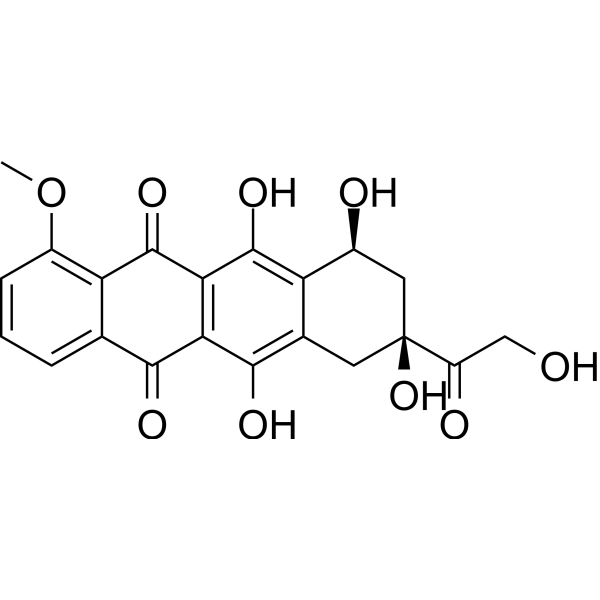
Doxorubicinone (Adriamycin aglycone) is the aglycone of the antibiotic Doxorubicin (HY-15142A), i.e., its sugar-free parent nucleus structure. Doxorubicinone does not induce DNA damage or bind to RelA, but still downregulates the expression of pro-inflammatory cytokines (such as TNF, IL-12, etc.) regulated by the NF-κB pathway. Doxorubicinone can be used in sepsis-related research.
Nur für Forschungszwecke. Wir verkaufen nicht an Patienten.
- Reinheit : 98.29%
- CAS. Nr.: 24385-10-2
- Formel: C21H18O9
- Molecular Weight:414.36
-
Speicherung:
4°C, stored under nitrogen
* In solvent : -80°C, 6 months; -20°C, 1 month (stored under nitrogen)

To place orders, for customer services and technical support, please contact: MedChemExpress USA
Tel: 609-228-6898 E-mail: [email protected] [email protected]


-
 Biologische Aktivität
-
Chemical Information
- Protokoll
- Reinheit & Dokumentation
- Verweise
-
 Help & FAQs


-

HY-121309R
Doxorubicinone (Standard)Standard of Doxorubicinone -
HY-D1075
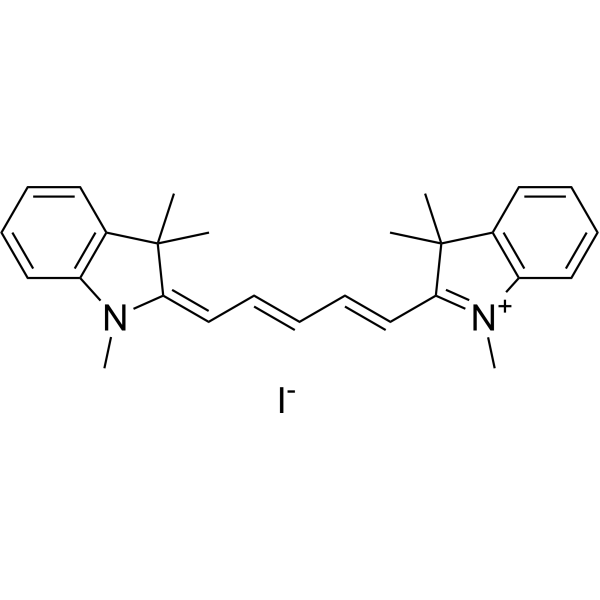
1,1',3,3,3',3'-Hexamethylindodicarbocyanine iodideFluorochrome -

HY-131495
(S)-6-O-DesmethylnaproxenMetabolite -

HY-N12223
Piericidin BAntibiotic -

HY-131495R
(S)-6-O-Desmethylnaproxen (Standard)Metabolite -
HY-129889
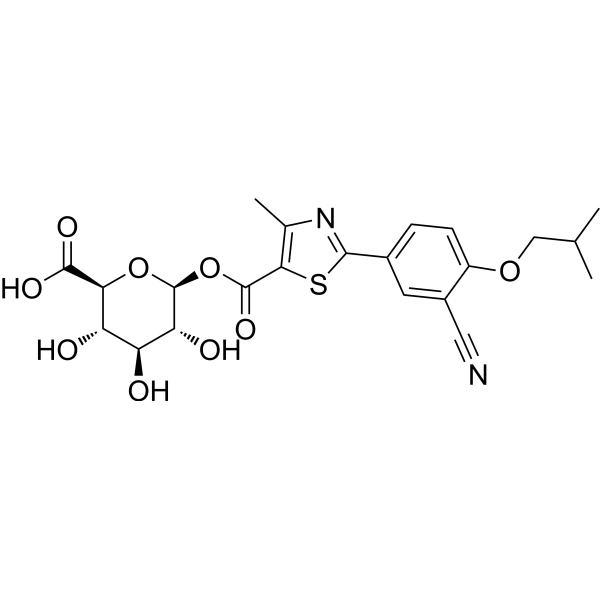
Febuxostat acyl glucuronideFebuxostat Metabolite -

HY-W653803
Lamotrigine N2-Oxide -

HY-W740244
4’-Hydroxy Trazodone -

HY-W704749
7-Hydroxychlorpromazine hydrochlorideChlorpromazine Active Metabolite
Publications Citing Use of MedChemExpress (MCE) Doxorubicinone
MoreAlle TNF Receptor Isoform-spezifische Produkte anzeigen
More

Biologische Aktivität
Beschreibung
In Vitro
Doxorubicinone (2 μM) weakly stabilizes CT DNA, increasing its melting temperature by 2.5 °C, which suggests minimal or no intercalation[2].
MedChemExpress (MCE) has not independently confirmed the accuracy of these methods. They are for reference only.
In Vivo


Chemical Information
-
CAS. Nr. 24385-10-2
-
Appearance Solid
-
Molecular Weight 414.36
-
Formel C21H18O9
-
Color Purple to purplish red
-
SMILES
OC1=C(C2=C(C(C3=O)=C1C(C4=CC=CC(OC)=C34)=O)O)C[C@](O)(C[C@@H]2O)C(CO)=O
-
Synonyms
Adriamycin aglycone; Adriamycinone
-
Structure Classification
-
Initial Source
-
Versand
Room temperature in continental US; may vary elsewhere.
-
Speicherung
4°C, stored under nitrogen
* In solvent : -80°C, 6 months; -20°C, 1 month (stored under nitrogen)


Publications (2)
-
Journal Impact Factor
-
Most Recent
-
Cell Death Dis
HJURP regulates cell proliferation and chemo-resistance via YAP1/NDRG1 transcriptional axis in triple-negative breast cancer. [Abstract]2022 Apr 22;13(4):396. PMID: 35459269 -
Exp Ther Med
miR-199b-5p mediates adriamycin-induced podocyte apoptosis by inhibiting the expression of RGS10. [Abstract]2021 Dec;22(6):1469. PMID: 34737809


Reinheit & Dokumentation
-
Data Sheet (274 KB)
-
SDS (644 KB)
- English - EN (644 KB)
- Français - FR (644 KB)
- Deutsch - DE (644 KB)
- Norwegian - NO (644 KB)
- Español - ES (644 KB)
- Swedish - SV (644 KB)
- Italian - IT (644 KB)
- Korean - KR (644 KB)
- Portuguese - PT (644 KB)
-
Handling Instructions (2659 KB)
Verweise
[1]. Chora AF, et al. DNA damage independent inhibition of NF-κB transcription by anthracyclines. Elife. 2022;11:e77443. Published 2022 Dec 7. [Content Brief]
[2]. Tartakoff SS, et al. Investigations into the DNA-binding mode of doxorubicinone. Org Biomol Chem. 2019;17(7):1992-1998. [Content Brief]
[3]. Qian L, et al. Identification of Gut Bacterial Enzymes for Keto-Reductive Metabolism of Xenobiotics. ACS Chem Biol. 2022;17(7):1665-1671. [Content Brief]

Calculators
Konzentration (Stammlösung) × Volumen (Stammlösung) = Konzentration (Ziellösung) × Volumen (Ziellösung)


Doxorubicinone Related Classifications
HY-121309 Related Classifications
 Powered by Bioz