



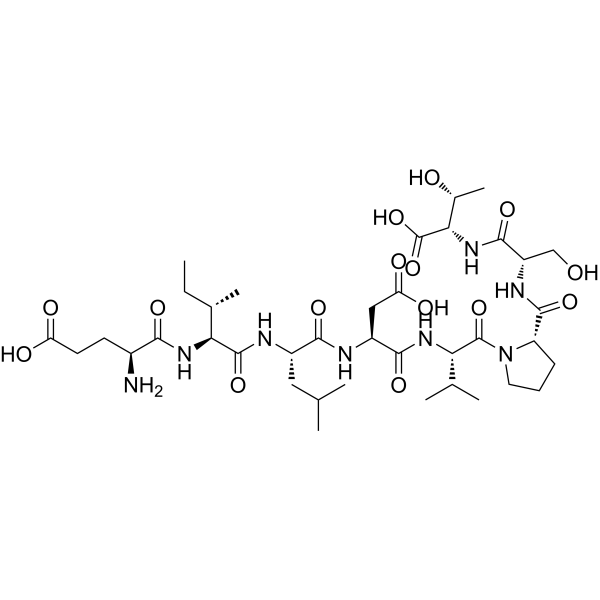
Fibronectin CS1 Peptide

Based on 1 Customer Validation
The connecting segment 1 (CS-1) is a cell attachment domain located in the type III homology connecting segment (IIICS) of fibronectin. Fibronectin CS1 Peptide lacks the Arg-Gly-Asp-containing domain, actively inhibits tumor metastases in spontaneous and experimental metastasis models.
Nos produits utilisent uniquement pour la recherche. Nous ne vendons pas aux patients.
- Pureté : 99.10%
- CAS No.: 136466-51-8
- Formule: C38H64N8O15
- Masse moléculaire:872.96
-
Stockage:
Sealed storage, away from moisture.
Powder -80°C, 2 years , -20°C, 1 year* In solvent : -80°C, 6 months; -20°C, 1 month (sealed storage, away from moisture)

To place orders, for customer services and technical support, please contact: MedChemExpress USA
Tel: 609-228-6898 E-mail: [email protected] [email protected]


-
 Activité biologique
-
Chemical Information
-
Solvant et solubilité
- Protocole
- Pureté et documentation
- Références
-
 Help & FAQs




Activité biologique
Description
Cellular Effect
|
Cell Line

|
Type | Value | Description | References |
|---|---|---|---|---|
| CCRF-CEM | IC50 |
824 μM
Compound: 1
|
Antagonist activity at integrin alpha4beta1 receptor in human CCRF-CEM cells assessed as inhibition of cell adhesion to fibronectin after 1 hr by calcein AM staining-based fluorescence assay
Antagonist activity at integrin alpha4beta1 receptor in human CCRF-CEM cells assessed as inhibition of cell adhesion to fibronectin after 1 hr by calcein AM staining-based fluorescence assay
|
10.1039/C1MD00229E |


Chemical Information
-
CAS No. 136466-51-8
-
Appearance Solid
-
Masse moléculaire 872.96
-
Formule C38H64N8O15
-
Color White to off-white
-
Sequence
Glu-Ile-Leu-Asp-Val-Pro-Ser-Thr
-
Sequence Shortening
EILDVPST
-
Livraison
Room temperature in continental US; may vary elsewhere.
-
Stockage
Sealed storage, away from moisture
Powder -80°C 2 years -20°C 1 year * In solvent : -80°C, 6 months; -20°C, 1 month (sealed storage, away from moisture)


Solvant et solubilité
In Vitro:
H2O : ≥ 100 mg/mL (114.55 mM)
DMSO : ≥ 100 mg/mL (114.55 mM; Hygroscopic DMSO has a significant impact on the solubility of product, please use newly opened DMSO)
* "≥" means soluble, but saturation unknown.
Please refer to the solubility information to select the appropriate solvent. Once prepared, please aliquot and store the solution to prevent product inactivation from repeated freeze-thaw cycles.
Storage method and period of stock solution: -80°C, 6 months; -20°C, 1 month (sealed storage, away from moisture). When stored at -80°C, please use it within 6 months. When stored at -20°C, please use it within 1 month.
* Note: If you choose water as the stock solution, please dilute it to the working solution, then filter and sterilize it with a 0.22 μm filter before use.
Please refer to the solubility information to select the appropriate solvent. Once prepared, please aliquot and store the solution to prevent product inactivation from repeated freeze-thaw cycles.
Storage method and period of stock solution: -80°C, 6 months; -20°C, 1 month (sealed storage, away from moisture). When stored at -80°C, please use it within 6 months. When stored at -20°C, please use it within 1 month.
* Note: If you choose water as the stock solution, please dilute it to the working solution, then filter and sterilize it with a 0.22 μm filter before use.
Concentration (start) × Volume (start) = Concentration (final) × Volume (final)


Pureté et documentation
-
Fiche technique (273 KB)
-
SDS (254 KB)
- English - EN (254 KB)
- Français - FR (254 KB)
- Deutsch - DE (254 KB)
- Norwegian - NO (254 KB)
- Español - ES (254 KB)
- Swedish - SV (254 KB)
- Italian - IT (254 KB)
- Korean - KR (254 KB)
- Portuguese - PT (254 KB)
-
Instruction de manipulation (2659 KB)
Références


Complete Stock Solution Preparation Table
Please refer to the solubility information to select the appropriate solvent. Once prepared, please aliquot and store the solution to prevent product inactivation from repeated freeze-thaw cycles.
Storage method and period of stock solution: -80°C, 6 months; -20°C, 1 month (sealed storage, away from moisture). When stored at -80°C, please use it within 6 months. When stored at -20°C, please use it within 1 month.
| Optional Solvent | Concentration Solvent Mass | 1 mg | 5 mg | 10 mg | 25 mg |
|---|---|---|---|---|---|
| H2O / DMSO | 1 mM | 1.1455 mL | 5.7276 mL | 11.4553 mL | 28.6382 mL |
| 5 mM | 0.2291 mL | 1.1455 mL | 2.2911 mL | 5.7276 mL | |
| 10 mM | 0.1146 mL | 0.5728 mL | 1.1455 mL | 2.8638 mL | |
| 15 mM | 0.0764 mL | 0.3818 mL | 0.7637 mL | 1.9092 mL | |
| 20 mM | 0.0573 mL | 0.2864 mL | 0.5728 mL | 1.4319 mL | |
| 25 mM | 0.0458 mL | 0.2291 mL | 0.4582 mL | 1.1455 mL | |
| 30 mM | 0.0382 mL | 0.1909 mL | 0.3818 mL | 0.9546 mL | |
| 40 mM | 0.0286 mL | 0.1432 mL | 0.2864 mL | 0.7160 mL | |
| 50 mM | 0.0229 mL | 0.1146 mL | 0.2291 mL | 0.5728 mL | |
| 60 mM | 0.0191 mL | 0.0955 mL | 0.1909 mL | 0.4773 mL | |
| 80 mM | 0.0143 mL | 0.0716 mL | 0.1432 mL | 0.3580 mL | |
| 100 mM | 0.0115 mL | 0.0573 mL | 0.1146 mL | 0.2864 mL |
* Note: If you choose water as the stock solution, please dilute it to the working solution, then filter and sterilize it with a 0.22 μm filter before use.


Fibronectin CS1 Peptide Related Classifications
HY-P1816 Related Classifications
 Powered by Bioz