



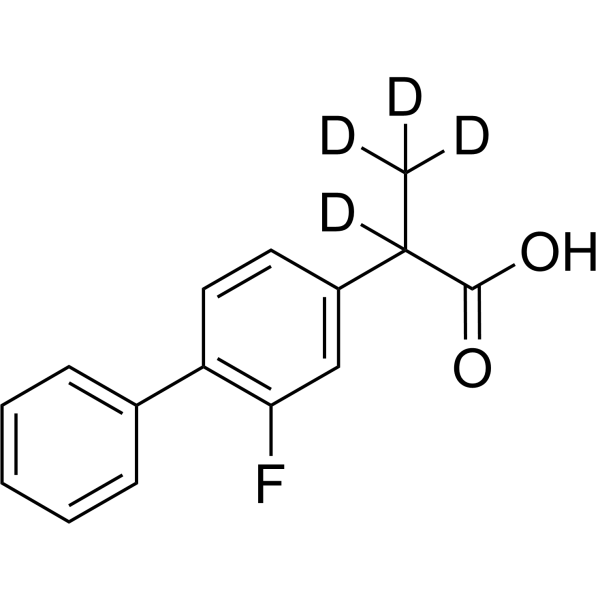
Flurbiprofen-d4
Flurbiprofen-d4 is deuterated labeled Flurbiprofen (HY-10582). Flurbiprofen (dl-Flurbiprofen) is a potent, orally active nonsteroidal anti-inflammatory agent (NSAIA/NSAID), with antipyretic and analgesic activities. Flurbiprofen is commonly used for the research of inflammatory diseases, including osteoarthritis and rheumatoid arthritis. Flurbiprofen is a non-selective cyclooxygenase (COX) inhibitor that can be used for the research of colorectal cancer.
For research use only. We do not sell to patients.
- Formula: C15H9D4FO2
- Molecular Weight:248.29
-
Storage:
Please store the product under the recommended conditions in the Certificate of Analysis.

To place orders, for customer services and technical support, please contact: MedChemExpress USA
Tel: 609-228-6898 E-mail: [email protected] [email protected]


-
 Biological Activity
-
Chemical Information
- Protocols
- Purity & Documentation
- References
-
 Help & FAQs




Biological Activity
Description
In Vitro
Stable heavy isotopes of hydrogen, carbon, and other elements have been incorporated into drug molecules, largely as tracers for quantitation during the drug development process. Deuteration has gained attention because of its potential to affect the pharmacokinetic and metabolic profiles of drugs[1].
Flurbiprofen (2-20 nM; 12-48 hours) significantly decreases SW620 cells proliferation in a concentration- and time-dependent manner[2].
Flurbiprofen (10 nM; 24 hours) decreases COX-2 expression[2].
Flurbiprofen (10 nM; 24 hours) inhibits the expression of inflammatory factors by inhibiting COX-2[2].
Flurbiprofen (10 nM; 24 hours) promotes the apoptosis of colorectal cancer cells by inhibiting COX-2[2].
MedChemExpress (MCE) has not independently confirmed the accuracy of these methods. They are for reference only.
In Vivo
Flurbiprofen (10 mg/kg; i.p.; daily; for 6 days) attenuates high-fat diet-induced obesity in mice[4].
MedChemExpress (MCE) has not independently confirmed the accuracy of these methods. They are for reference only.
Application
1. This compound can be used as a tracer
2. This compound can be used as an internal standard for quantitative analysis by NMR, GC-MS, or LC-MS.


Chemical Information
-
Unlabeled CAS 5104-49-4
-
Molecular Weight 248.29
-
Formula C15H9D4FO2
-
SMILES
FC1=C(C2=CC=CC=C2)C=CC(C([2H])(C([2H])([2H])[2H])C(O)=O)=C1
-
Synonyms
dl-Flurbiprofen-d4
-
Shipping
Room temperature in continental US; may vary elsewhere.
-
Storage
Please store the product under the recommended conditions in the Certificate of Analysis.


Purity & Documentation
References
[1]. Russak EM, et al. Impact of Deuterium Substitution on the Pharmacokinetics of Pharmaceuticals. Ann Pharmacother. 2019 Feb;53(2):211-216. [Content Brief]
[2]. Hosoi, T., et al., Flurbiprofen ameliorated obesity by attenuating leptin resistance induced by endoplasmic reticulum stress. EMBO Mol Med, 2014. [Content Brief]
[3]. Xiaobo Wang, et al. Flurbiprofen suppresses the inflammation, proliferation, invasion and migration of colorectal cancer cells via COX2. Oncol Lett. 2020 Nov; 20(5): 132. [Content Brief]
[4]. E M Glenn, et al. The pharmacology of 2-(2-fluoro-4-biphenylyl)propionic acid (flurbiprofen). A potent non-steroidal anti-inflammatory drug. Agents Actions. 1973 Nov;3(4):210-6. [Content Brief]

Calculators
Concentration (start) × Volume (start) = Concentration (final) × Volume (final)


Flurbiprofen-d4 Related Classifications
HY-10582S3 Related Classifications
 Powered by Bioz