



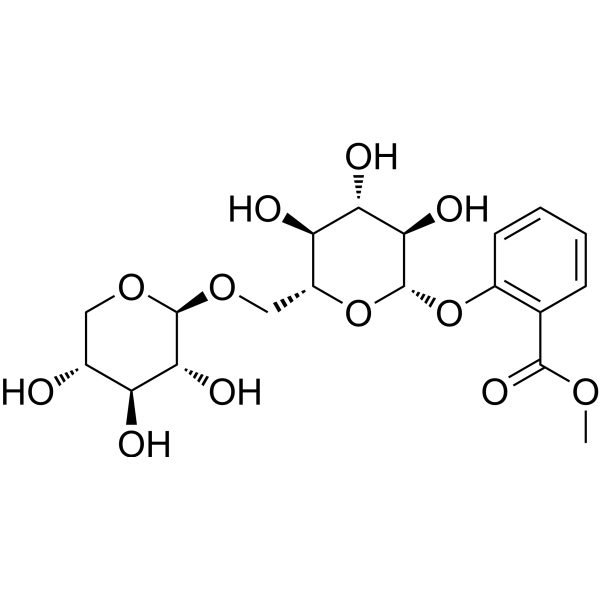
Gaultherin

Based on 1 Customer Validation
Gaultherin is an orally active non-steroidal anti-inflammatory agent. Gaultherin selectively inhibits NF-κB, MAPK, COX-2 (IC50 = 0.35 mg/mL), LOX (IC50 = 0.56 mg/mL) and HYAL (IC50 = 28.58 μg/mL) to exert anti-inflammatory, antipyretic and analgesic effects. Gaultherin exhibits modest direct antioxidant capacity, greater in cell-based models. Gaultherin does not affect COX-1 so that avoids the common gastrointestinal side effects of Aspirin (HY-14654).
For research use only. We do not sell to patients.
- Purity : 99.44%
- CAS No.: 490-67-5
- Formula: C19H26O12
- Molecular Weight:446.40
-
Storage:
4°C, protect from light
* In solvent : -80°C, 6 months; -20°C, 1 month (protect from light)

To place orders, for customer services and technical support, please contact: MedChemExpress USA
Tel: 609-228-6898 E-mail: [email protected] [email protected]


-
 Biological Activity
-
Chemical Information
-
Solvent & Solubility
- Protocols
- Purity & Documentation
- References
-
 Help & FAQs




Biological Activity
Description
IC50 & Target
[2]|
COX-2 250 μg/mL (IC50) |
MMP-9 |
IL-1β |
IL-8 |
NF-κB |
In Vitro
Gaultherin acts only after it is transformed into methyl salicylate by intestinal bacteria and then the absorbed methyl salicylate is hydrolyzed rapidly by esterases in intestine, blood and liver to produce salicylate[1].
.
Gaultherin presents low antioxidant activity, ferric reducing activity, and scavenging potential towards O2•− with SC50s of 265.69 μg/mL (DPPH), 0.64 mmol Fe²⁺/g (FRAP), 451.76 μg/mL (O2•−), 488.52 μg/mL (•OH), 587.86 μg/mL (H2O2)[2].
Gaultherin (25-75 μM) significantly inhibits the secretion of ROS in fMLP (HY-P0224)-stimulated human neutrophils and LPS (HY-D1056)-stimulated RAW264.7 murine macrophages[2].
Gaultherin inhibits the release of pro-inflammatory cytokines including IL-8, IL-1β, TNF-α, MMP-9 and ELA-2 in LPS/fMLP + Cytochalasin B (HY-16928)-stimulated human neutrophils and NO, TNF-α, IL-1β and IL-6 in LPS-stimulated RAW264.7 murine macrophages[2].
Gaultherin prevents phosphorylation and subsequent degradation of IκBα and blocks the translocation of NF-κB to the nucleus[2].
Gaultherin inhibits directly or via upstream modulation of MAPK kinases, particularly MEK1/2, MKK3/6, and MKK4/7, and thus suppresses the phosphorylation/activation of MAPKs, including JNKs, p38, and ERKs[2].
MedChemExpress (MCE) has not independently confirmed the accuracy of these methods. They are for reference only.
In Vivo
Gaultherin (400 mg/kg, p,o., once daily for 3 days) significantly inhibits the ear swelling after the application of croton oil[1].
Gaultherin (330 mg/kg, p,o., single dose) does not aggravate the stress-induced gastric damage and is significantly superior to Aspirin[1].
Gaultherin (100-300 mg/kg, p,o., single dose) induces a reduction in rectal temperature in feverish mice[2].
MedChemExpress (MCE) has not independently confirmed the accuracy of these methods. They are for reference only.
-
Animal Model:Acetic acid induced visceral pain model established in male Kunming mice weighing 27 g[1]
-
Dosage:400 mg/kg
-
Administration:Oral administration (p.o.), single dose
-
Result:Decreased the number of writhing of mice.
-
Animal Model:Croton oil induced inflammatory ear edema model established male Kunming mice weighing 27 g[1]
-
Dosage:400 mg/kg
-
Administration:Oral administration (p.o.), once daily for 3 days
-
Result:Inhibited the dropsical ear plug weight by 39%.
-
Animal Model:Water immersion restraint stress model and gastric mucosal damage assay established in male Wistar rats weighing 250 g[1]
-
Dosage:330 mg/kg
-
Administration:Oral administration (p.o.), single dose
-
Result:Exhibited less lesion score less than that observed in the presence of Aspirin.
No lesion was observed in the stomach.
-
Animal Model:Brewer’s yeast-induced pyrexia model established in healthy albino mice[2]
-
Dosage:100, 200 and 300 mg/kg
-
Administration:Oral administration (p.o.), single dose
-
Result:Significantly reduced the pyrexia significantly in the 5th hour of experiment.


Chemical Information
-
CAS No. 490-67-5
-
Appearance Solid
-
Molecular Weight 446.40
-
Formula C19H26O12
-
Color White to off-white
-
SMILES
COC(C1=C(C=CC=C1)O[C@@H]2O[C@@H]([C@H]([C@@H]([C@H]2O)O)O)CO[C@H]3[C@@H]([C@H]([C@@H](CO3)O)O)O)=O
-
Structure Classification
-
Initial Source
-
Shipping
Room temperature in continental US; may vary elsewhere.
-
Storage
4°C, protect from light
* In solvent : -80°C, 6 months; -20°C, 1 month (protect from light)


Solvent & Solubility
In Vitro:
DMSO : 100 mg/mL (224.01 mM; Need ultrasonic; Hygroscopic DMSO has a significant impact on the solubility of product, please use newly opened DMSO)
Please refer to the solubility information to select the appropriate solvent. Once prepared, please aliquot and store the solution to prevent product inactivation from repeated freeze-thaw cycles.
Storage method and period of stock solution: -80°C, 6 months; -20°C, 1 month (protect from light). When stored at -80°C, please use it within 6 months. When stored at -20°C, please use it within 1 month.
Please refer to the solubility information to select the appropriate solvent. Once prepared, please aliquot and store the solution to prevent product inactivation from repeated freeze-thaw cycles.
Storage method and period of stock solution: -80°C, 6 months; -20°C, 1 month (protect from light). When stored at -80°C, please use it within 6 months. When stored at -20°C, please use it within 1 month.
Concentration (start) × Volume (start) = Concentration (final) × Volume (final)
In Vivo:
Select the appropriate dissolution method based on your experimental animal and administration route.
- For the following dissolution methods, please ensure to first prepare a clear stock solution using an In Vitro approach and then sequentially add co-solvents:
- To ensure reliable experimental results, the clarified stock solution can be appropriately stored based on storage conditions. As for the working solution for In Vivo experiments, it is recommended to prepare freshly and use it on the same day.
- The percentages shown for the solvents indicate their volumetric ratio in the final prepared solution. If precipitation or phase separation occurs during preparation, heat and/or sonication can be used to aid dissolution.
Add each solvent one by one: 10% DMSO 40% PEG300 5% Tween-80 45% Saline
Solubility: ≥ 2.5 mg/mL (5.60 mM); Clear solution
This protocol yields a clear solution of ≥ 2.5 mg/mL (saturation unknown).
Taking 1 mL working solution as an example, add 100 μL DMSO stock solution (25.0 mg/mL) to 400 μL PEG300, and mix evenly; then add 50 μL Tween-80 and mix evenly; then add 450 μL Saline to adjust the volume to 1 mL.
Preparation of Saline: Dissolve 0.9 g sodium chloride in ddH₂O and dilute to 100 mL to obtain a clear Saline solution.
Add each solvent one by one: 10% DMSO 90% (20% SBE-β-CD in Saline)
Solubility: ≥ 2.5 mg/mL (5.60 mM); Clear solution
This protocol yields a clear solution of ≥ 2.5 mg/mL (saturation unknown).
Taking 1 mL working solution as an example, add 100 μL DMSO stock solution (25.0 mg/mL) to 900 μL 20% SBE-β-CD in Saline, and mix evenly.
Preparation of 20% SBE-β-CD in Saline (4°C, storage for one week): 2 g SBE-β-CD powder is dissolved in 10 mL Saline, completely dissolve until clear.
In Vivo Dissolution Calculator
Please enter the basic information of animal experiments:
-
-
-
-
Recommended: Prepare an additional quantity of animals to account for potential losses during experiments.
Please enter your animal formula composition:
-
%DMSO +
Recommended: Keep the proportion of DMSO in working solution below 2% if your animal is weak.
-
%+
-
+%Tween-80 + +
-
%Saline +
The co-solvents required include: DMSO, . All of co-solvents are available by MedChemExpress (MCE). , Tween 80. All of co-solvents are available by MedChemExpress (MCE).
Working solution concentration: 0.22 mg/mL
Method for preparing stock solution: mg drug dissolved in μL DMSO. Stock solution concentration: mg/mL. * In solvent : -80°C, 6 months; -20°C, 1 month (protect from light)
1. Take μL DMSO stock solution;
2. Add μL .
μL , mix evenly;
3. Then add μL Tween 80, mix evenly;
4. Then add μL
Please ensure that the stock solution in the first step is dissolved to a clear state, and add co-solvents in sequence. You can use ultrasonic heating (ultrasonic cleaner, recommended frequency 20-40 kHz), vortexing, etc. to assist dissolution.


Purity & Documentation
-
Data Sheet (282 KB)
-
SDS (393 KB)
- English - EN (393 KB)
- Français - FR (393 KB)
- Deutsch - DE (393 KB)
- Norwegian - NO (393 KB)
- Español - ES (393 KB)
- Swedish - SV (393 KB)
- Italian - IT (393 KB)
- Korean - KR (393 KB)
- Portuguese - PT (393 KB)
-
Handling Instructions (2659 KB)
References
[1]. Zhang B, et, al. Gaultherin, a natural salicylate derivative from Gaultheria yunnanensis: towards a better non-steroidal anti-inflammatory drug. Eur J Pharmacol. 2006 Jan 13;530(1-2):166-71. [Content Brief]
[2]. Michel P. Gaultherin, a Natural Alternative to Aspirin: A Comprehensive Review of Molecular Mechanisms, Pharmacokinetics, Biocompatibility, Isolation Techniques, and Plant Sources. Int J Mol Sci. 2025 Jul 28;26(15):7280. [Content Brief]


Complete Stock Solution Preparation Table
Please refer to the solubility information to select the appropriate solvent. Once prepared, please aliquot and store the solution to prevent product inactivation from repeated freeze-thaw cycles.
Storage method and period of stock solution: -80°C, 6 months; -20°C, 1 month (protect from light). When stored at -80°C, please use it within 6 months. When stored at -20°C, please use it within 1 month.
| Optional Solvent | Concentration Solvent Mass | 1 mg | 5 mg | 10 mg | 25 mg |
|---|---|---|---|---|---|
| DMSO | 1 mM | 2.2401 mL | 11.2007 mL | 22.4014 mL | 56.0036 mL |
| 5 mM | 0.4480 mL | 2.2401 mL | 4.4803 mL | 11.2007 mL | |
| 10 mM | 0.2240 mL | 1.1201 mL | 2.2401 mL | 5.6004 mL | |
| 15 mM | 0.1493 mL | 0.7467 mL | 1.4934 mL | 3.7336 mL | |
| 20 mM | 0.1120 mL | 0.5600 mL | 1.1201 mL | 2.8002 mL | |
| 25 mM | 0.0896 mL | 0.4480 mL | 0.8961 mL | 2.2401 mL | |
| 30 mM | 0.0747 mL | 0.3734 mL | 0.7467 mL | 1.8668 mL | |
| 40 mM | 0.0560 mL | 0.2800 mL | 0.5600 mL | 1.4001 mL | |
| 50 mM | 0.0448 mL | 0.2240 mL | 0.4480 mL | 1.1201 mL | |
| 60 mM | 0.0373 mL | 0.1867 mL | 0.3734 mL | 0.9334 mL | |
| 80 mM | 0.0280 mL | 0.1400 mL | 0.2800 mL | 0.7000 mL | |
| 100 mM | 0.0224 mL | 0.1120 mL | 0.2240 mL | 0.5600 mL |


Gaultherin Related Classifications
HY-N1965 Related Classifications
 Powered by Bioz