



PF15
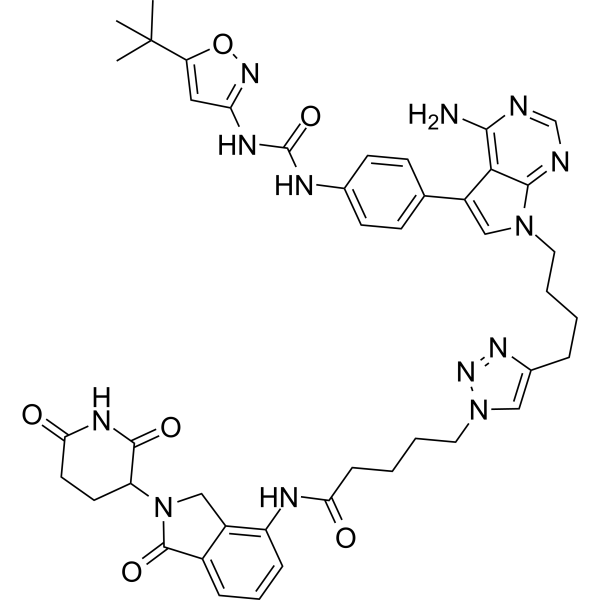
PF15 is an orally active FLT3-ITD PROTAC degrader with a DC50 of 76.7 nM and an IC50 of 36 nM against FLT3-ITD. PF15 induces FLT3-ITD protein degradation, thereby downregulating its phosphorylation level. PF15 inhibits the proliferation of FLT3-ITD-positive cells and reduces the phosphorylation level of STAT5, a downstream molecule of FLT3-ITD. PF15 exhibits efficacy in in vivo xenograft models of acute myeloid leukemia and prolongs survival. PF15 can be used for the research of acute myeloid leukemia.
(Pink: FLT3 Target protein ligand; Blue: Cereblon ligand (HY-A0003); Black: linker).
For research use only. We do not sell to patients.
- CAS No.: 2892631-70-6
- Formula: C44H49N13O6
- Molecular Weight:855.94
-
Storage:
Please store the product under the recommended conditions in the Certificate of Analysis.

To place orders, for customer services and technical support, please contact: MedChemExpress USA
Tel: 609-228-6898 E-mail: [email protected] [email protected]


-
 Biological Activity
-
Chemical Information
-
Solvent & Solubility
- Protocols
- Purity & Documentation
- References
-
 Help & FAQs


All PROTACs Isoforms
More

Biological Activity
Description
IC50 & Target
[1]|
STAT5 |
Cellular Effect
|
Cell Line

|
Type | Value | Description | References |
|---|---|---|---|---|
| MV4-11 | IC50 |
4.83 nM
Compound: 6; PF15
|
Antiproliferative activity against human MV4-11 cells assessed as reduction in cell viability measured after 48 hrs by CellTiter-Glo assay
Antiproliferative activity against human MV4-11 cells assessed as reduction in cell viability measured after 48 hrs by CellTiter-Glo assay
|
[PMID: 39094274] |
In Vitro
PF15 potently and selectively inhibits FLT3 kinase with an IC50 of 36 nM, and its inhibitory potency against c-Kit kinase is over 35-fold lower; it exhibits high selectivity for FLT3 among a panel of 93 tumor-related kinases[1].
PF15 (1-2000 nM; 1-24 h) induces proteasome-dependent degradation of FLT3 protein in BaF3-FLT3-ITD cells, with a DC50 of 76.7 nM, and prolonged incubation achieves complete degradation of the protein[1].
PF15 (10-1000 nM; 2 h) upregulates FLT3 mRNA levels in BaF3-FLT3-ITD cells at low concentrations (10 nM, 30 nM)[1].
PF15 (72 h) potently inhibits the proliferation of MV4-11 FLT3-ITD-positive AML cells with an IC50 of 4.83 nM; potently inhibits the proliferation of Molm-13 FLT3-ITD-positive AML cells with an IC50 of 4.01 nM; potently inhibits the proliferation of BaF3-FLT3-ITD transformed cells with an IC50 of 7.85 nM; inhibits the proliferation of drug-resistant BaF3-FLT3-ITD-D835V transformed cells with an IC50 of 120.1 nM; inhibits the proliferation of drug-resistant BaF3-FLT3-ITD-F691L transformed cells with an IC50 of 116.6 nM; and exhibits only extremely low antiproliferative activity against FLT3 wild-type cancer cells (THP-1, K562, Daudi, HEL, Jurkat, RS4;11)[1].
PF15 (10-1000 nM; 6 h) downregulates the phosphorylation levels of FLT3 and STAT5 in BaF3-FLT3-ITD, BaF3-FLT3-ITD-D835V, and BaF3-FLT3-ITD-F691L cells at a concentration of 100 nM after 6 h of treatment, whereas a higher concentration is required for FLT3 degradation[1].
MedChemExpress (MCE) has not independently confirmed the accuracy of these methods. They are for reference only.
-
Cell Line:FLT3 wild-type cancer cells (THP-1, K562, Daudi, HEL, Jurkat, RS4;11)
-
Concentration:40 μM
-
Incubation Time:72 h
-
Result:Hardly inhibited proliferation of all tested FLT3 wild-type cell lines even at the maximum tested concentration of 40 μM.
-
Cell Line:BaF3-FLT3-ITD cells
-
Concentration:1, 3, 10, 30, 100, 300, 1000 nM (6 h incubation)
100 nM
15.6, 31.2, 62.5, 250, 500, 1000, 2000 nM (24 h incubation)
1000 nM (6 h incubation, with 1 h MG132 (HY-13259) pre-treatment) -
Incubation Time:6 h
1, 3, 6, 12, 24 h
24 h
6 h (with 1 h MG132 pre-treatment) -
Result:Induced dose-dependent FLT3 degradation with a DC50 of 76.7 nM after 24 h of treatment, and achieves complete degradation with extended incubation.
Achieved complete degradation after 24 h of treatment at sufficient concentrations.
Pre-treatment with proteasome inhibitor MG132 completely blocked PF15-induced FLT3 degradation.
-
Cell Line:BaF3-FLT3-ITD cells
-
Concentration:10, 30, 100, 300, 1000 nM
-
Incubation Time:6 h
-
Result:Dramatically inhibited phosphorylation of FLT3 and STAT5 in a dose-dependent manner.
Downregulated p-FLT3 more pronouncedly than p-STAT5.
-
Cell Line:BaF3-FLT3-ITD-D835V cells
-
Concentration:10, 30, 100, 300, 1000 nM
-
Incubation Time:6 h
-
Result:Sharply downregulated phosphorylation of FLT3 and STAT5 at 100 nM.
Required high concentrations to induce FLT3 protein degradation.
-
Cell Line:BaF3-FLT3-ITD-F691L cells
-
Concentration:10, 30, 100, 300, 1000 nM
-
Incubation Time:6 h
-
Result:Sharply downregulated phosphorylation of FLT3 and STAT5 at 100 nM.
Required high concentrations to induce FLT3 protein degradation.
In Vivo
PF15 (20-40 mg/kg; p.o.; twice daily; 12 days; i.p.; daily; 12 days) significantly extends survival in an AML in situ xenograft model, with the 20 mg/kg twice-daily p.o. dose increasing median survival from 11 days to 15 days[1].
MedChemExpress (MCE) has not independently confirmed the accuracy of these methods. They are for reference only.
-
Animal Model:NOD/SCID (female; subcutaneous xenograft model via implantation of 107 BaF3-FLT3-ITD cells)[1]
-
Dosage:10 mg/kg; 20 mg/kg
-
Administration:i.p.; daily; 10 days
-
Result:Achieved a tumor growth inhibition rate of 58.4% at 10 mg/kg.
Achieved a higher tumor growth inhibition rate at 20 mg/kg.
Showed no significant changes in serum AST, urea, and CK-MB levels at both doses.
-
Animal Model:BALB/c nude (female; in situ xenograft model via tail vein injection of 1×10⁶ BaF3-FLT3-ITD cells)[1]
-
Dosage:20 mg/kg; 40 mg/kg
-
Administration:p.o.; twice daily; 12 days; i.p.; daily; 12 days
-
Result:Prolonged median survival to 15 days at 20 mg/kg twice-daily dose.
Resulted in median survival equivalent to the 20 mg/kg twice-daily dose at 40 mg/kg daily dose.
- Kinase activity and phosphorylation assays
- Western Blot
- Patient-Derived Xenograft (PDX)
- Splenic/Portal-Vein Liver Metastasis Xenograft
- Protocol for Kinase activity and phosphorylation assays
- Subcutaneous Cell-Line-Derived Xenograft
- Orthotopic Cell-Line Xenograft
- Cell Viability Determination by MTT Colorimetric Assay
- Intraperitoneal/Peritoneal Dissemination Xenograft


Chemical Information
-
CAS No. 2892631-70-6
-
Molecular Weight 855.94
-
Formula C44H49N13O6
-
SMILES
CC(C)(C1=CC(NC(NC2=CC=C(C=C2)C3=CN(C4=NC=NC(N)=C34)CCCCC5=CN(N=N5)CCCCC(NC6=C7CN(C(C7=CC=C6)=O)C8CCC(NC8=O)=O)=O)=O)=NO1)C
-
Shipping
Room temperature in continental US; may vary elsewhere.
-
Storage
Please store the product under the recommended conditions in the Certificate of Analysis.


Solvent & Solubility
In Vitro:
DMSO : 100 mg/mL (116.83 mM; Need ultrasonic; Hygroscopic DMSO has a significant impact on the solubility of product, please use newly opened DMSO)
Concentration (start) × Volume (start) = Concentration (final) × Volume (final)
In Vivo:
Select the appropriate dissolution method based on your experimental animal and administration route.
- For the following dissolution methods, please ensure to first prepare a clear stock solution using an In Vitro approach and then sequentially add co-solvents:
- To ensure reliable experimental results, the clarified stock solution can be appropriately stored based on storage conditions. As for the working solution for In Vivo experiments, it is recommended to prepare freshly and use it on the same day.
- The percentages shown for the solvents indicate their volumetric ratio in the final prepared solution. If precipitation or phase separation occurs during preparation, heat and/or sonication can be used to aid dissolution.
Add each solvent one by one: 10% DMSO 40% PEG300 5% Tween-80 45% Saline
Solubility: ≥ 2.5 mg/mL (2.92 mM); Clear solution
This protocol yields a clear solution of ≥ 2.5 mg/mL (saturation unknown).
Taking 1 mL working solution as an example, add 100 μL DMSO stock solution (25.0 mg/mL) to 400 μL PEG300, and mix evenly; then add 50 μL Tween-80 and mix evenly; then add 450 μL Saline to adjust the volume to 1 mL.
Preparation of Saline: Dissolve 0.9 g sodium chloride in ddH₂O and dilute to 100 mL to obtain a clear Saline solution.
In Vivo Dissolution Calculator
Please enter the basic information of animal experiments:
-
-
-
-
Recommended: Prepare an additional quantity of animals to account for potential losses during experiments.
Please enter your animal formula composition:
-
%DMSO +
Recommended: Keep the proportion of DMSO in working solution below 2% if your animal is weak.
-
%+
-
+%Tween-80 + +
-
%Saline +
The co-solvents required include: DMSO, . All of co-solvents are available by MedChemExpress (MCE). , Tween 80. All of co-solvents are available by MedChemExpress (MCE).
Working solution concentration: 0.22 mg/mL
Method for preparing stock solution: mg drug dissolved in μL DMSO. Stock solution concentration: mg/mL.
1. Take μL DMSO stock solution;
2. Add μL .
μL , mix evenly;
3. Then add μL Tween 80, mix evenly;
4. Then add μL
Please ensure that the stock solution in the first step is dissolved to a clear state, and add co-solvents in sequence. You can use ultrasonic heating (ultrasonic cleaner, recommended frequency 20-40 kHz), vortexing, etc. to assist dissolution.


Purity & Documentation
References


Complete Stock Solution Preparation Table
| Optional Solvent | Concentration Solvent Mass | 1 mg | 5 mg | 10 mg | 25 mg |
|---|---|---|---|---|---|
| DMSO | 1 mM | 1.1683 mL | 5.8415 mL | 11.6831 mL | 29.2077 mL |
| 5 mM | 0.2337 mL | 1.1683 mL | 2.3366 mL | 5.8415 mL | |
| 10 mM | 0.1168 mL | 0.5842 mL | 1.1683 mL | 2.9208 mL | |
| 15 mM | 0.0779 mL | 0.3894 mL | 0.7789 mL | 1.9472 mL | |
| 20 mM | 0.0584 mL | 0.2921 mL | 0.5842 mL | 1.4604 mL | |
| 25 mM | 0.0467 mL | 0.2337 mL | 0.4673 mL | 1.1683 mL | |
| 30 mM | 0.0389 mL | 0.1947 mL | 0.3894 mL | 0.9736 mL | |
| 40 mM | 0.0292 mL | 0.1460 mL | 0.2921 mL | 0.7302 mL | |
| 50 mM | 0.0234 mL | 0.1168 mL | 0.2337 mL | 0.5842 mL | |
| 60 mM | 0.0195 mL | 0.0974 mL | 0.1947 mL | 0.4868 mL | |
| 80 mM | 0.0146 mL | 0.0730 mL | 0.1460 mL | 0.3651 mL | |
| 100 mM | 0.0117 mL | 0.0584 mL | 0.1168 mL | 0.2921 mL |


PF15 Related Classifications
HY-143286 Related Classifications
 Powered by Bioz