



Flutriafol

Based on 1 Customer Validation
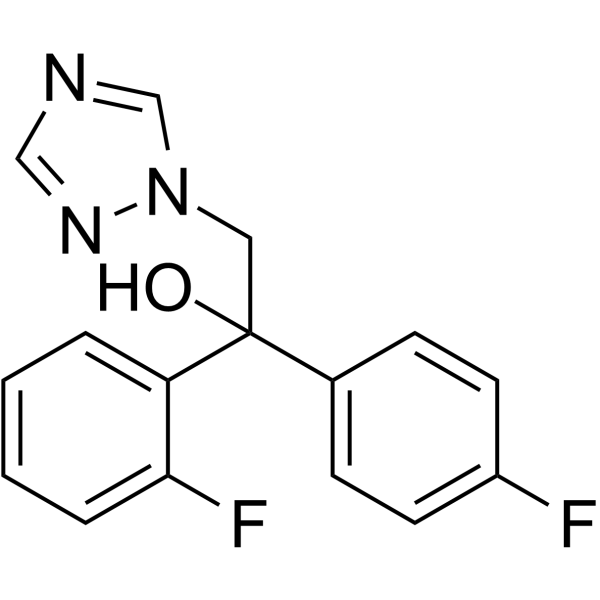
Flutriafol is an orally active triazole fungicide. Flutriafol blocks the biosynthesis of ergosterol, cholesterol, and steroids by inhibiting CYP51, thereby inhibiting fungal cell membrane formation and exhibiting antifungal activity. Flutriafol induces oxidative stress, mitochondrial depolarization, and apoptosis in hepatocellular carcinoma cells. Flutriafol also modulates dopamine release and reduces plasma cholesterol, triglycerides, and carotenoid eye ring pigmentation. Flutriafol can be used in research related to fungal infections and non-alcoholic fatty liver disease.
For research use only. We do not sell to patients.
- Purity : 98.02%
- CAS No.: 76674-21-0
- Formula: C16H13F2N3O
- Molecular Weight:301.29
-
Storage:Powder -20°C, 3 years , 4°C, 2 years ; In solvent -80°C, 6 months , -20°C, 1 month

To place orders, for customer services and technical support, please contact: MedChemExpress USA
Tel: 609-228-6898 E-mail: [email protected] [email protected]


-
 Biological Activity
-
Chemical Information
-
Solvent & Solubility
- Protocols
- Purity & Documentation
- References
-
 Help & FAQs




Biological Activity
Description
In Vitro
Flutriafol (40-640 µM; 24 h) induces cytotoxicity in HepG2 cells[1].
Flutriafol (80-160 µM; 24 h) upregulates the mRNA expression of CYP1A2, CYP2C9, CYP2C19, CYP3A4, CYP51A1, and CYP2E1 in HepG2 cells[1].
Flutriafol (320 µM; 24 h) induces apoptosis in HepG2 cells and increases the early and late apoptotic cell populations[1].
Flutriafol (80-320 µM; 24 h) promotes lipid accumulation in HepG2 cells[1].
Flutriafol (0.5-2.0 wt%) inhibits Coriolus versicolor, Gloeophyllum trabeum, and Aspergillus niger in a concentration-dependent manner, but has no antifungal effect on Trichoderma viride[5].
Flutriafol (160 µM; 24 h) activates Nrf2 nuclear translocation and the expression of antioxidant enzyme genes (NQO1, NQO2, GSTP1, GSTO2) in HepG2 cells[1].
Flutriafol (80-160 µM; 24 h) induces oxidative stress and alters mitochondrial membrane potential in HepG2 cells, increasing ROS levels[1].
MedChemExpress (MCE) has not independently confirmed the accuracy of these methods. They are for reference only.
-
Cell Line:HepG2 cells
-
Concentration:0, 80, 160, 320, and 640 μM
-
Incubation Time:24 h
-
Result:Treatment at 320 and 640 μM significantly reduced cell viability to 83% and 65%, respectively; the 640 μM group also showed markedly higher LDH release, demonstrating cell membrane damage, so concentrations no higher than 320 μM were selected for subsequent experiments.
-
Cell Line:HepG2 cells
-
Concentration:80 and 160 µM
-
Incubation Time:24 h
-
Result:The cells exposed to this compound (80 and 160 µM, for 24 h) had significantly higher mRNA expression of CYP1A2, CYP2C9, CYP2C19, CYP3A4, CYP51A1, and CYP2E1 than control cells.
However, the cells exposed to NAC (5 mM, for 1 h) had significantly lower mRNA expression of CYPs than those exposed to this compound alone.
-
Cell Line:HepG2 cells
-
Concentration:320 µM
-
Incubation Time:24 h
-
Result:HepG2 cells exposed to this compound showed significantly lower cell viability than control cells.
NAC (5 mM, for 1 h)-preincubated cells had significantly higher cell viability than cells exposed to this compound.
Flow cytometry data displayed that the apoptotic ratio (early apoptotic and late apoptotic cells) increased after exposure to 320 µM this compound for 24 h.
This apoptotic ratio decreased to the control level in the cells preincubated with NAC, compared with cells exposed only to this compound.
Quadrant percentages: this compound 0 µM: Q1 0.71%, Q2 4.53%, Q3 88.28%, Q4 6.47%;this compound 320 µM: Q1 1.37%, Q2 7.32%, Q3 83.82%, Q4 7.49%; this compound 320 µM + NAC: Q1 1.69%, Q2 5.96%, Q3 88.63%, Q4 3.72%.
In Vivo
Flutriafol (0.25-150 mg/kg bw/day; oral gavage; once daily; 28 days) induces dose-dependent hepatic steatosis, CYP enzyme activation, Nrf2 depletion, and apoptosis in female Sprague Dawley rats[1].
MedChemExpress (MCE) has not independently confirmed the accuracy of these methods. They are for reference only.
-
Animal Model:Sprague Dawley (SD) (female; 8 weeks old; 220-250 g at start)[1]
-
Dosage:0.25, 2.5, 25, 75, and 150 mg/kg bw/day; 0 mg/kg bw/day
-
Administration:p.o. (oral gavage) in corn oil; once daily; 28 days
-
Result:At 2.5 mg/kg bw/day, body weight was significantly higher than control at 1 and 2 weeks.
No significant body-weight difference among dose groups from 3 weeks.
At 150 mg/kg bw/day, feed intake was significantly lower than control in the first week.
At 75 and 150 mg/kg bw/day, liver weight/body weight ratio and kidney weight/body weight ratio were significantly increased compared with control.
Plasma AST, ALT, ALP, and ALB showed no significant differences between this compound-exposed and control rats at 0-150 mg/kg bw/day.
At 150 mg/kg bw/day, plasma BUN was significantly lower and plasma TP was significantly higher than control.
Liver histology: 0.25 mg/kg bw/day showed normal liver architecture.
2.5-150 mg/kg bw/day induced fatty infiltration/steatosis, with severity increased at 75 and 150 mg/kg bw/day.
Liver CYP1A2 and CYP3A2 mRNA expression was higher in this compound-exposed rats than in control rats.
CYP3A2 expression was markedly higher than CYP1A2.
Liver Nrf2 protein level was significantly lower in rats receiving 2.5-150 mg/kg bw/day than in control rats.
Apoptosis-related proteins: Caspase3 and cleaved Caspase3 were increased in livers of rats receiving 75 and 150 mg/kg bw/day.
Bcl-2 protein was lower and Bax protein was higher in this compound-exposed livers.
-
Animal Model:Sprague-Dawley (female, adult, 240-260 g)[3]
-
Dosage:6 mM (approximately 7.65 nmol)
-
Administration:Intrastriatal infusion via dialysis probe at 1.5 μl/min for 60 min; MK-801, CNQX, L-NARG, or 7-NI infused for 1 h then mixed with flutriafol during the third hour
-
Result:Intrastriatal infusion of 6 mM this compound alone increased extracellular dopamine to 984% of basal levels and DOPAC to 172.4% of basal levels; HVA levels were not significantly changed.
With 200 μM MK-801 pre-exposure, 6 mM this compound increased striatal dopamine to 895% of basal levels, not significantly different from this compound alone.
With 500 μM MK-801 pre-exposure, 6 mM this compound increased striatal dopamine to 489% of basal levels, a 50% smaller increase than with flutriafol alone.
With 500 μM CNQX pre-exposure, 6 mM this compound increased striatal dopamine to 477% of basal levels, a 51.5% smaller increase than with this compound alone.
With 1 mM L-NARG pre-exposure, 6 mM this compound increased striatal dopamine to 400% of basal levels; the increase was 51.3% smaller in the Results text and 59.3% smaller in the Abstract/Discussion.
With 100 μM 7-NI pre-exposure, 6 mM this compound increased striatal dopamine to 479% of basal levels; the increase was ~60% smaller in the Results text and 51% smaller in the Abstract/Discussion.
Infusion of this compound in MK-801- or CNQX-pre-exposed animals produced no change in DOPAC or HVA levels; coinfusion of this compound with NOS inhibitors also did not produce any change in DOPAC or HVA levels.
- Mitochondrial membrane-potential fluorescent assay
- Detection of Apoptosis
- TUNEL staining for apoptotic DNA fragmentation
- Annexin V plus membrane-impermeant dye apoptosis staining
- ROS/oxidative-stress fluorescent staining
- Apoptosis Solutions
- Liver Cancer Modeling
- Research Protocol for Metabolic Diseases


Chemical Information
-
CAS No. 76674-21-0
-
Appearance Solid
-
Molecular Weight 301.29
-
Formula C16H13F2N3O
-
Color White to light yellow
-
SMILES
OC(C1=CC=C(F)C=C1)(C2=CC=CC=C2F)CN3N=CN=C3
-
Shipping
Room temperature in continental US; may vary elsewhere.
-
Storage
Powder -20°C 3 years 4°C 2 years In solvent -80°C 6 months -20°C 1 month


Solvent & Solubility
In Vitro:
DMSO : 250 mg/mL (829.77 mM; Need ultrasonic; Hygroscopic DMSO has a significant impact on the solubility of product, please use newly opened DMSO)
Please refer to the solubility information to select the appropriate solvent. Once prepared, please aliquot and store the solution to prevent product inactivation from repeated freeze-thaw cycles.
Storage method and period of stock solution: -80°C, 6 months; -20°C, 1 month. When stored at -80°C, please use it within 6 months. When stored at -20°C, please use it within 1 month.
Please refer to the solubility information to select the appropriate solvent. Once prepared, please aliquot and store the solution to prevent product inactivation from repeated freeze-thaw cycles.
Storage method and period of stock solution: -80°C, 6 months; -20°C, 1 month. When stored at -80°C, please use it within 6 months. When stored at -20°C, please use it within 1 month.
Concentration (start) × Volume (start) = Concentration (final) × Volume (final)


Purity & Documentation
-
Data Sheet (303 KB)
-
SDS (536 KB)
- English - EN (536 KB)
- Français - FR (536 KB)
- Deutsch - DE (536 KB)
- Norwegian - NO (536 KB)
- Español - ES (536 KB)
- Swedish - SV (536 KB)
- Italian - IT (536 KB)
- Korean - KR (536 KB)
- Portuguese - PT (536 KB)
-
Handling Instructions (2659 KB)
References


Complete Stock Solution Preparation Table
Please refer to the solubility information to select the appropriate solvent. Once prepared, please aliquot and store the solution to prevent product inactivation from repeated freeze-thaw cycles.
Storage method and period of stock solution: -80°C, 6 months; -20°C, 1 month. When stored at -80°C, please use it within 6 months. When stored at -20°C, please use it within 1 month.
| Optional Solvent | Concentration Solvent Mass | 1 mg | 5 mg | 10 mg | 25 mg |
|---|---|---|---|---|---|
| DMSO | 1 mM | 3.3191 mL | 16.5953 mL | 33.1906 mL | 82.9765 mL |
| 5 mM | 0.6638 mL | 3.3191 mL | 6.6381 mL | 16.5953 mL | |
| 10 mM | 0.3319 mL | 1.6595 mL | 3.3191 mL | 8.2977 mL | |
| 15 mM | 0.2213 mL | 1.1064 mL | 2.2127 mL | 5.5318 mL | |
| 20 mM | 0.1660 mL | 0.8298 mL | 1.6595 mL | 4.1488 mL | |
| 25 mM | 0.1328 mL | 0.6638 mL | 1.3276 mL | 3.3191 mL | |
| 30 mM | 0.1106 mL | 0.5532 mL | 1.1064 mL | 2.7659 mL | |
| 40 mM | 0.0830 mL | 0.4149 mL | 0.8298 mL | 2.0744 mL | |
| 50 mM | 0.0664 mL | 0.3319 mL | 0.6638 mL | 1.6595 mL | |
| 60 mM | 0.0553 mL | 0.2766 mL | 0.5532 mL | 1.3829 mL | |
| 80 mM | 0.0415 mL | 0.2074 mL | 0.4149 mL | 1.0372 mL | |
| 100 mM | 0.0332 mL | 0.1660 mL | 0.3319 mL | 0.8298 mL |


Flutriafol Related Classifications
HY-W019852 Related Classifications
 Powered by Bioz