



Ipriflavone
Based on 2 publication(s) in Google Scholar
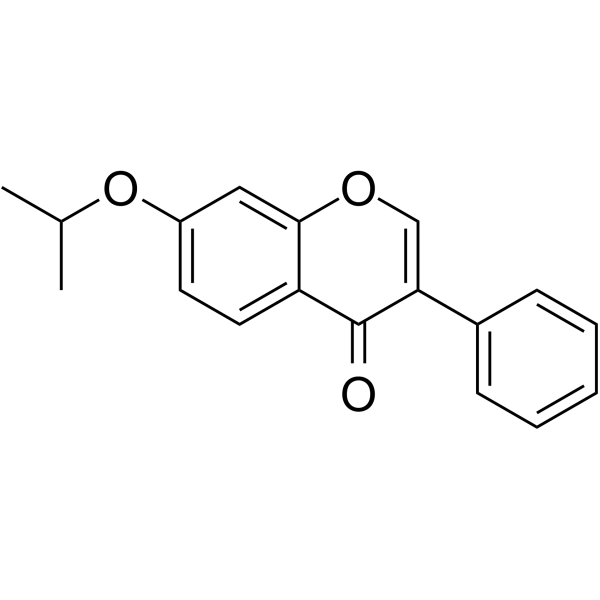
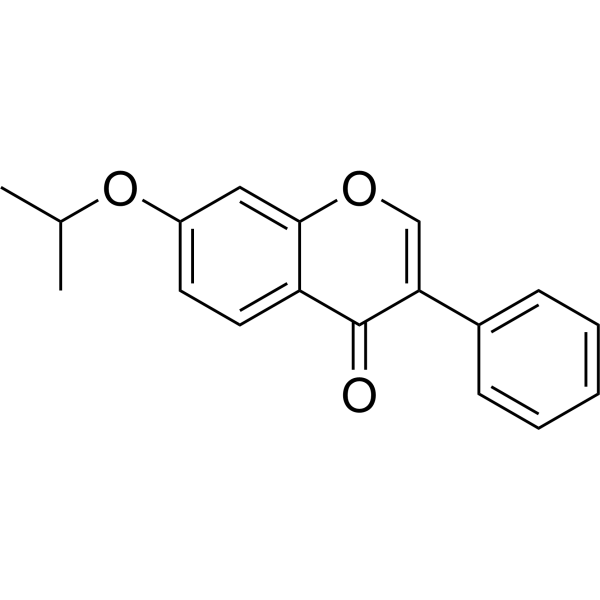
Ipriflavone is a synthetic isoflavone derivative used to suppress bone resorption.
연구목적의 판매만을 진행합니다. 환자를 대상으로 한 판매는 하지 않습니다.
- Purity : 99.89%
- CAS No.: 35212-22-7
- 화학식: C18H16O3
- 분자량:280.32
-
보관:Powder -20°C, 3 years , 4°C, 2 years ; In solvent -80°C, 2 years , -20°C, 1 year

To place orders, for customer services and technical support, please contact: MedChemExpress USA
Tel: 609-228-6898 E-mail: [email protected] [email protected]


-
 Biological Activity
-
Chemical Information
-
용액&용해도
- Protocol
- 순도&문서
- References
-
 Help & FAQs


Publications Citing Use of MedChemExpress (MCE) Ipriflavone
More

Biological Activity
제품 설명
Cellular Effect
|
Cell Line

|
Type | Value | Description | References |
|---|---|---|---|---|
| Bone marrow cell | IC50 |
17.2 μM
Compound: Ipriflavone
|
Inhibition of RANKL-induced osteoclast differentiation in ICR mouse bone marrow cells after 48 hrs by TRAP assay
Inhibition of RANKL-induced osteoclast differentiation in ICR mouse bone marrow cells after 48 hrs by TRAP assay
|
[PMID: 26923696] |
In Vitro
Ipriflavone inhibits the proliferation and DNA synthesis of MDA-231 cells and blocks the ligand-induced phosphorylation of Tyr(845) of the EGFR. Ipriflavone does not promote apoptosis of MDA-231 cells[1]. Ipriflavone also promotes the deposition of calcium and the formation of mineralized nodules by newborn rat calvarial osteoblast-like cells as well as the activity of alkaline phosphatase[2].
MedChemExpress (MCE) has not independently confirmed the accuracy of these methods. They are for reference only.
In Vivo
MedChemExpress (MCE) has not independently confirmed the accuracy of these methods. They are for reference only.


Chemical Information
-
CAS No. 35212-22-7
-
Appearance Solid
-
분자량 280.32
-
화학식 C18H16O3
-
Color White to off-white
-
SMILES
O=C1C(C2=CC=CC=C2)=COC3=CC(OC(C)C)=CC=C13
-
선적
Room temperature in continental US; may vary elsewhere.
-
보관
Powder -20°C 3 years 4°C 2 years In solvent -80°C 2 years -20°C 1 year


Publications (2)
-
Journal Impact Factor
-
Most Recent
-
Acta Pharm Sin B
Chrysin serves as a novel inhibitor of DGK α/FAK interaction to suppress the malignancy of esophageal squamous cell carcinoma (ESCC). [Abstract]2021 Jan;11(1):143-155. PMID: 33532186 -
J Clin Periodontol
Ipriflavone suppresses NLRP3 inflammasome activation in host response to biomaterials and promotes early bone healing. [Abstract]2022 Aug;49(8):814-827. PMID: 35569032


용액&용해도
In Vitro:
DMSO : 33.33 mg/mL (118.90 mM; Need ultrasonic; Hygroscopic DMSO has a significant impact on the solubility of product, please use newly opened DMSO)
H2O : < 0.1 mg/mL (insoluble)
Please refer to the solubility information to select the appropriate solvent. Once prepared, please aliquot and store the solution to prevent product inactivation from repeated freeze-thaw cycles.
Storage method and period of stock solution: -80°C, 2 years; -20°C, 1 year. When stored at -80°C, please use it within 2 years. When stored at -20°C, please use it within 1 year.
Please refer to the solubility information to select the appropriate solvent. Once prepared, please aliquot and store the solution to prevent product inactivation from repeated freeze-thaw cycles.
Storage method and period of stock solution: -80°C, 2 years; -20°C, 1 year. When stored at -80°C, please use it within 2 years. When stored at -20°C, please use it within 1 year.
Concentration (start) × Volume (start) = Concentration (final) × Volume (final)
In Vivo:
Select the appropriate dissolution method based on your experimental animal and administration route.
- For the following dissolution methods, please ensure to first prepare a clear stock solution using an In Vitro approach and then sequentially add co-solvents:
- To ensure reliable experimental results, the clarified stock solution can be appropriately stored based on storage conditions. As for the working solution for In Vivo experiments, it is recommended to prepare freshly and use it on the same day.
- The percentages shown for the solvents indicate their volumetric ratio in the final prepared solution. If precipitation or phase separation occurs during preparation, heat and/or sonication can be used to aid dissolution.
In Vivo Dissolution Calculator
Please enter the basic information of animal experiments:
-
-
-
-
Recommended: Prepare an additional quantity of animals to account for potential losses during experiments.
Please enter your animal formula composition:
-
%DMSO +
Recommended: Keep the proportion of DMSO in working solution below 2% if your animal is weak.
-
%+
-
+%Tween-80 + +
-
%Saline +
The co-solvents required include: DMSO, . All of co-solvents are available by MedChemExpress (MCE). , Tween 80. All of co-solvents are available by MedChemExpress (MCE).
Working solution concentration: 0.22 mg/mL
Method for preparing stock solution: mg drug dissolved in μL DMSO. Stock solution concentration: mg/mL.
1. Take μL DMSO stock solution;
2. Add μL .
μL , mix evenly;
3. Then add μL Tween 80, mix evenly;
4. Then add μL
Please ensure that the stock solution in the first step is dissolved to a clear state, and add co-solvents in sequence. You can use ultrasonic heating (ultrasonic cleaner, recommended frequency 20-40 kHz), vortexing, etc. to assist dissolution.


순도&문서
-
Data Sheet (283 KB)
-
SDS (394 KB)
- English - EN (394 KB)
- Français - FR (394 KB)
- Deutsch - DE (394 KB)
- Norwegian - NO (394 KB)
- Español - ES (394 KB)
- Swedish - SV (394 KB)
- Italian - IT (394 KB)
- Korean - KR (394 KB)
- Portuguese - PT (394 KB)
-
Handling Instructions (2659 KB)
References
[1]. Monostory K, et al. Ipriflavone as an inhibitor of human cytochrome P450 enzymes. Br J Pharmacol. 1998 Feb;123(4):605-10. [Content Brief]
[2]. Iisaki T, et al. Ipriflavone inhibits osteolytic bone metastasis of human breast cancer cells in a nude mouse model. Int J Cancer. 2002 Aug 1;100(4):381-7. [Content Brief]
[3]. Hagiwara H, et al. Ipriflavone down-regulates endothelin receptor levels during differentiation of rat calvarial osteoblast-like cells. J Biochem. 1999 Jul;126(1):168-73. [Content Brief]
[4]. Civitelli R, et al. Ipriflavone improves bone density and biomechanical properties of adult male rat bones. Calcif Tissue Int. 1995 Mar;56(3):215-9. [Content Brief]


Complete Stock Solution Preparation Table
Please refer to the solubility information to select the appropriate solvent. Once prepared, please aliquot and store the solution to prevent product inactivation from repeated freeze-thaw cycles.
Storage method and period of stock solution: -80°C, 2 years; -20°C, 1 year. When stored at -80°C, please use it within 2 years. When stored at -20°C, please use it within 1 year.
| Optional Solvent | Concentration Solvent Mass | 1 mg | 5 mg | 10 mg | 25 mg |
|---|---|---|---|---|---|
| DMSO | 1 mM | 3.5674 mL | 17.8368 mL | 35.6735 mL | 89.1838 mL |
| 5 mM | 0.7135 mL | 3.5674 mL | 7.1347 mL | 17.8368 mL | |
| 10 mM | 0.3567 mL | 1.7837 mL | 3.5674 mL | 8.9184 mL | |
| 15 mM | 0.2378 mL | 1.1891 mL | 2.3782 mL | 5.9456 mL | |
| 20 mM | 0.1784 mL | 0.8918 mL | 1.7837 mL | 4.4592 mL | |
| 25 mM | 0.1427 mL | 0.7135 mL | 1.4269 mL | 3.5674 mL | |
| 30 mM | 0.1189 mL | 0.5946 mL | 1.1891 mL | 2.9728 mL | |
| 40 mM | 0.0892 mL | 0.4459 mL | 0.8918 mL | 2.2296 mL | |
| 50 mM | 0.0713 mL | 0.3567 mL | 0.7135 mL | 1.7837 mL | |
| 60 mM | 0.0595 mL | 0.2973 mL | 0.5946 mL | 1.4864 mL | |
| 80 mM | 0.0446 mL | 0.2230 mL | 0.4459 mL | 1.1148 mL | |
| 100 mM | 0.0357 mL | 0.1784 mL | 0.3567 mL | 0.8918 mL |


Ipriflavone Related Classifications
HY-N0094 Related Classifications
 Powered by Bioz