



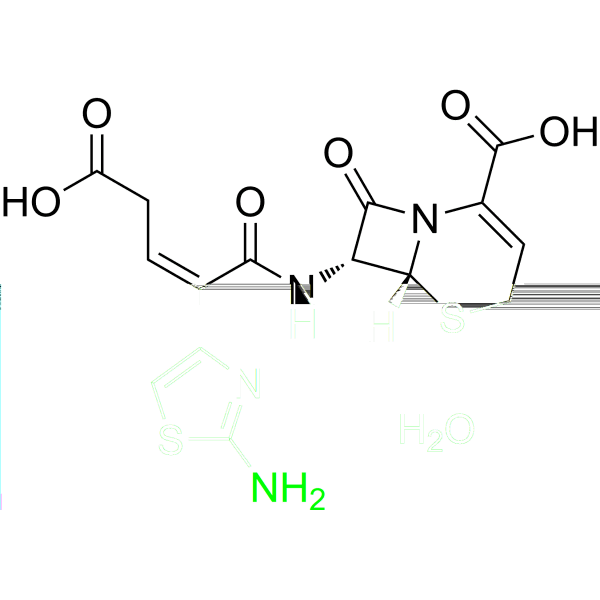
Ceftibuten monohydrate
Based on 2 publication(s) in Google Scholar
Ceftibuten (Sch39720) monohydrate, an antibiotic, is an orally active cephalosporin, possesses potent activity in vitro against a wide range of gram-negative and certain gram-positive pathogens.
연구목적의 판매만을 진행합니다. 환자를 대상으로 한 판매는 하지 않습니다.
- CAS No.: 1346153-47-6
- 화학식: C15H16N4O7S2
- 분자량:428.44
-
보관:
Please store the product under the recommended conditions in the Certificate of Analysis.

To place orders, for customer services and technical support, please contact: MedChemExpress USA
Tel: 609-228-6898 E-mail: [email protected] [email protected]


-
 Biological Activity
-
Chemical Information
- Protocol
- 순도&문서
- References
-
 Help & FAQs


Publications Citing Use of MedChemExpress (MCE) Ceftibuten monohydrate
MoreAll Beta-lactamase Isoforms
MoreAll Antibiotic Isoforms
More

Biological Activity
제품 설명
IC50 & Target
|
β-lactam |
In Vitro
Ceftibuten (Sch39720) monohydrate is highly active against Haemophilus influenza, Escherichia coli, Klebsiella sp., and Proteus sp. and moderately active against Serratia sp. and Streptococcus pyogenes. Ceftibuten hydrate is relatively inactive against enterococci and staphylococci and is only weakly active against Pseudomonas aeruginosa and obligate anaerobes. It is also stable in the presence of most β-lactamase-producing organisms except βBacteroides fragilis. Ceftibuten hydrate is very active against strains of the family Enterobacteriaceae (mean MIC for 90% of strains=0.25 μg/ml) but less active against Campylobacterjejuni (mean MIC for 90% of strains=16.0 μg/ml)[1].
MedChemExpress (MCE) has not independently confirmed the accuracy of these methods. They are for reference only. Further protocols information, click here.
In Vivo
MedChemExpress (MCE) has not independently confirmed the accuracy of these methods. They are for reference only.


Chemical Information
-
CAS No. 1346153-47-6
-
분자량 428.44
-
화학식 C15H16N4O7S2
-
SMILES
O=C(C(N12)=CCS[C@]2([H])[C@H](NC(/C(C3=CSC(N)=N3)=C\CC(O)=O)=O)C1=O)O.O
-
Synonyms
Sch 39720 monohydrate
-
선적
Room temperature in continental US; may vary elsewhere.
-
보관
Please store the product under the recommended conditions in the Certificate of Analysis.


Publications (2)
-
Journal Impact Factor
-
Most Recent
-
SLAS Discov
2020 Sep;25(8):895-905. PMID: 32567455 -

Protocol
-
Gram Staining of Tissue Sections
Gram staining of tissue sections is a histochemical technique used to differentiate Gram-positive and Gram-negative bacteria within histological specimens based on differences in bacterial cell wall structure and dye retention, adapted from classical bacteriological Gram staining into tissue-compatible “histological Gram stain” variants. In tissue applications, modifications of the Brown-Hopps and Brown-Brenn methods are commonly used to improve differentiation of microorganisms embedded within host connective tissue and to reduce overstaining or loss of Gram-negative signal, which are known limitations of earlier approaches. The principle relies on crystal violet-iodine complex retention in Gram-positive organisms and subsequent decolorization and counterstaining steps that allow contrast visualization of Gram-negative organisms against tissue background.


순도&문서
References
[1]. Kearns GL, et al. Single-dose pharmacokinetics of ceftibuten (SCH 39720) in infants and children. Antimicrob Agents Chemother. 1991;35(10):2078-2084. [Content Brief]
[2]. Shawar R, et al. Comparative in vitro activity of ceftibuten (Sch 39720) against bacterial enteropathogens. Antimicrob Agents Chemother. 1989;33(5):781-784. [Content Brief]
[3]. Tamai I, et al. Functional expression of intestinal dipeptide/beta-lactam antibiotic transporter in Xenopus laevis oocytes. Biochem Pharmacol. 1994;48(5):881-888. [Content Brief]

Calculators
Concentration (start) × Volume (start) = Concentration (final) × Volume (final)


Ceftibuten monohydrate Related Classifications
HY-B0698B Related Classifications
 Powered by Bioz