



MS15
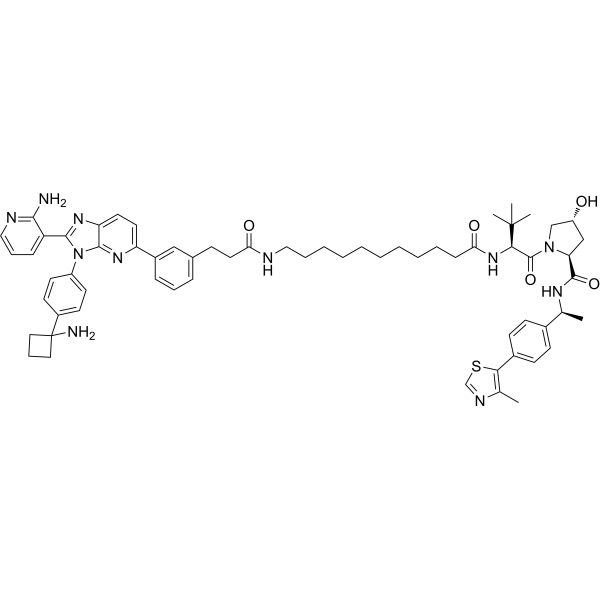
MS15 is a potent and selective AKT PROTAC degrader. MS15 inhibits the AKT1, -2, and -3 activities, with IC50 values of 798 nM, 90 nM, and 544 nM, respectively.
(Pink: Akt ligand (HY-19719); Blue: VHL ligand (HY-112078); Black: linker (HY-128421)).
연구목적의 판매만을 진행합니다. 환자를 대상으로 한 판매는 하지 않습니다.
- CAS No.: 3035638-40-2
- 화학식: C64H79N11O5S
- 분자량:1114.45
-
보관:
Please store the product under the recommended conditions in the Certificate of Analysis.

To place orders, for customer services and technical support, please contact: MedChemExpress USA
Tel: 609-228-6898 E-mail: [email protected] [email protected]


-
 Biological Activity
-
Chemical Information
- 순도&문서
- References
-
 Help & FAQs


All PROTACs Isoforms
More

Biological Activity
제품 설명
IC50 & Target
|
Akt2 90 ± 2.8 nM (IC50) |
Akt3 544 ± 2.9 nM (IC50) |
Akt1 798 ± 190 nM (IC50) |
Cellular Effect
|
Cell Line

|
Type | Value | Description | References |
|---|---|---|---|---|
| SW-620 | GI50 |
3.1 μM
Compound: 62; MS15
|
Antiproliferative activity against human SW620 cells harboring KRAS mutant assessed as inhibition of cell growth incubated for 5 days by IncuCyte live-cell imaging analysis
Antiproliferative activity against human SW620 cells harboring KRAS mutant assessed as inhibition of cell growth incubated for 5 days by IncuCyte live-cell imaging analysis
|
[PMID: 36197750] |
In Vitro
MS15 (0-10 μM, 24 h) potently induces AKT degradation in SW620 cells and MS21-resistant KRAS/BRAF mutant cells[1].
MS15 (0-10 μM, 5 days) inhibits the proliferation of KRAS mutant SW620 cells[1].
MS15 (1 μM, 1-24 h) mediates AKT degradation in a time- and UPS-dependent manner[1].
MedChemExpress (MCE) has not independently confirmed the accuracy of these methods. They are for reference only.
-
Cell Line:SW620 cells, Colo205, HT-29, SKMEL 239, and PANC-1 cells
-
Concentration:1 nM, 3 nM, 10 nM, 30 nM, 100 nM, 300 nM, 1 μM, 3 μM, 10 μM
-
Incubation Time:24 h
-
Result:Effectively induced T-AKT degradation in a concentration-dependent manner, with a DC50 value of 23 ± 16 nM in SW620 cells. Nearly complete AKT degradation was achieved at a concentration of 100 nM in SW620 cells and PANC-1 cells. Induced AKT degradation at 1 μM in BRAF mutant cell lines, such as Colo205, HT-29, and SKMEL 239 cells.
-
Cell Line:SW620 cells
-
Concentration:0 nM, 30 nM, 100 nM, 1 μM, 3 μM, 10 μM
-
Incubation Time:5 days
-
Result:Displayed slightly better antiproliferative activity than Miransertib (HY-19719), with a GI50 of 3.1 ± 0.3 μM.
In Vivo
MedChemExpress (MCE) has not independently confirmed the accuracy of these methods. They are for reference only.
-
Animal Model:Male Swiss albino mice[1]
-
Dosage:75 mg/kg
-
Administration:IP, once (Pharmacokinetic Analysis)
-
Result:The maximum plasma concentration (Cmax = 1 μM) was achieved at 0.5 h post-treatment, and plasma concentrations were maintained above 100 nM for at least 12 h.Could achieve enough plasma exposure for effective AKT degradation.


Chemical Information
-
CAS No. 3035638-40-2
-
분자량 1114.45
-
화학식 C64H79N11O5S
-
SMILES
NC1(CCC1)C(C=C2)=CC=C2N3C4=NC(C5=CC(CCC(NCCCCCCCCCCC(N[C@H](C(N6C[C@@H](C[C@H]6C(N[C@@H](C)C7=CC=C(C=C7)C8=C(N=CS8)C)=O)O)=O)C(C)(C)C)=O)=O)=CC=C5)=CC=C4N=C3C9=CC=CN=C9N
-
선적
Room temperature in continental US; may vary elsewhere.
-
보관
Please store the product under the recommended conditions in the Certificate of Analysis.


순도&문서
References

Calculators
Concentration (start) × Volume (start) = Concentration (final) × Volume (final)


MS15 Related Classifications
HY-151613 Related Classifications
 Powered by Bioz