



OK2

Based on 1 Customer Validation
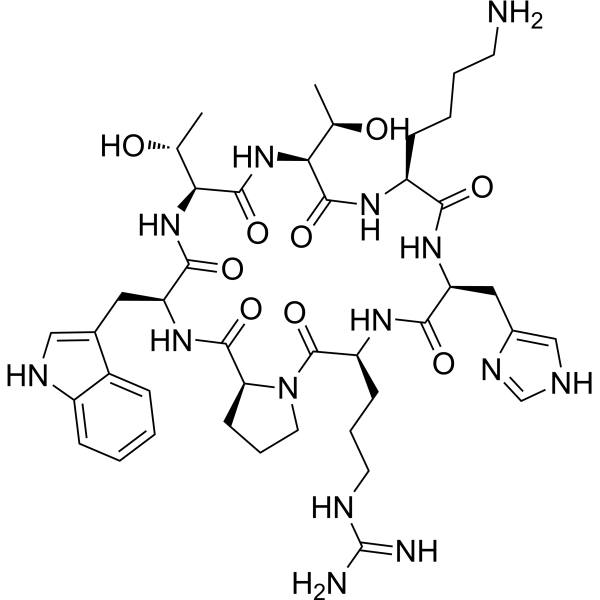
OK2, a specific inhibitor of the CCN2/EGFR interaction, efficiently blocks CCN2/EGFR interaction through binding to the CT domain of CCN2. OK2 can be used for kidney fibrosis and chronic kidney disease research.
연구목적의 판매만을 진행합니다. 환자를 대상으로 한 판매는 하지 않습니다.
- Purity : 99.13%
- CAS No.: 2983020-14-8
- 화학식: C42H62N14O9
- 분자량:907.03
-
보관:
Sealed storage, away from moisture.
Powder -80°C, 2 years , -20°C, 1 year* In solvent : -80°C, 6 months; -20°C, 1 month (sealed storage, away from moisture)

To place orders, for customer services and technical support, please contact: MedChemExpress USA
Tel: 609-228-6898 E-mail: [email protected] [email protected]


-
 Biological Activity
-
Chemical Information
-
용액&용해도
- Protocol
- 순도&문서
- References
-
 Help & FAQs


All EGFR Isoforms
More

Biological Activity
제품 설명
IC50 & Target
|
p-STAT3 |
In Vitro
OK2 (0-100 μM; 24 hours) inhibits EGFR activation, STAT3 phosphorylation, and ECM protein synthesis in HK-2 cells[1].
MedChemExpress (MCE) has not independently confirmed the accuracy of these methods. They are for reference only.
-
Cell Line:HK-2 cells
-
Concentration:0, 4, 20, 100 μM
-
Incubation Time:24 hours
-
Result:Blocked thevastmajority ofEGFR activation in therenalfibrosis cell model, thereby preventing EGFRmediated STAT3 phosphorylation andECMprotein synthesis.
Inhibited EGFR-mediated ECM protein synthesis in a dose dependent manner and exhibited a significant blocking effect beginning at 20 μM.
In Vivo
OK2 (1 mg/kg, s.c.) shows a T1/2 of 0.9 h and Cmax of 1057.8 ng/mL in male Sprague Dawley rats[1].
Pharmacokinetic parameters for OK2 in male Sprague Dawley rats [1]
| Route | Dose (mg/kg) | Cmax (ng/mL) | Tmax (h) | T1/2 (h) | AUC0-t (h•ng/mL) |
| s.c. | 1 | 1057.8 | 1.0 | 0.9 | 3032.0 |
| Powder | -80°C | 2 years |
|---|---|---|
| -20°C | 1 year |
* In solvent : -80°C, 6 months; -20°C, 1 month (sealed storage, away from moisture)


용액&용해도
In Vitro:
DMSO : 100 mg/mL (110.25 mM; Need ultrasonic; Hygroscopic DMSO has a significant impact on the solubility of product, please use newly opened DMSO)
Please refer to the solubility information to select the appropriate solvent. Once prepared, please aliquot and store the solution to prevent product inactivation from repeated freeze-thaw cycles.
Storage method and period of stock solution: -80°C, 6 months; -20°C, 1 month (sealed storage, away from moisture). When stored at -80°C, please use it within 6 months. When stored at -20°C, please use it within 1 month.
Please refer to the solubility information to select the appropriate solvent. Once prepared, please aliquot and store the solution to prevent product inactivation from repeated freeze-thaw cycles.
Storage method and period of stock solution: -80°C, 6 months; -20°C, 1 month (sealed storage, away from moisture). When stored at -80°C, please use it within 6 months. When stored at -20°C, please use it within 1 month.
Concentration (start) × Volume (start) = Concentration (final) × Volume (final)


순도&문서
-
Data Sheet (286 KB)
-
SDS (252 KB)
- English - EN (252 KB)
- Français - FR (252 KB)
- Deutsch - DE (252 KB)
- Norwegian - NO (252 KB)
- Español - ES (252 KB)
- Swedish - SV (252 KB)
- Italian - IT (252 KB)
- Korean - KR (252 KB)
- Portuguese - PT (252 KB)
-
Handling Instructions (2659 KB)


References


Complete Stock Solution Preparation Table
Please refer to the solubility information to select the appropriate solvent. Once prepared, please aliquot and store the solution to prevent product inactivation from repeated freeze-thaw cycles.
Storage method and period of stock solution: -80°C, 6 months; -20°C, 1 month (sealed storage, away from moisture). When stored at -80°C, please use it within 6 months. When stored at -20°C, please use it within 1 month.
| Optional Solvent | Concentration Solvent Mass | 1 mg | 5 mg | 10 mg | 25 mg |
|---|---|---|---|---|---|
| DMSO | 1 mM | 1.1025 mL | 5.5125 mL | 11.0250 mL | 27.5625 mL |
| 5 mM | 0.2205 mL | 1.1025 mL | 2.2050 mL | 5.5125 mL | |
| 10 mM | 0.1102 mL | 0.5512 mL | 1.1025 mL | 2.7562 mL | |
| 15 mM | 0.0735 mL | 0.3675 mL | 0.7350 mL | 1.8375 mL | |
| 20 mM | 0.0551 mL | 0.2756 mL | 0.5512 mL | 1.3781 mL | |
| 25 mM | 0.0441 mL | 0.2205 mL | 0.4410 mL | 1.1025 mL | |
| 30 mM | 0.0367 mL | 0.1837 mL | 0.3675 mL | 0.9187 mL | |
| 40 mM | 0.0276 mL | 0.1378 mL | 0.2756 mL | 0.6891 mL | |
| 50 mM | 0.0220 mL | 0.1102 mL | 0.2205 mL | 0.5512 mL | |
| 60 mM | 0.0184 mL | 0.0919 mL | 0.1837 mL | 0.4594 mL | |
| 80 mM | 0.0138 mL | 0.0689 mL | 0.1378 mL | 0.3445 mL | |
| 100 mM | 0.0110 mL | 0.0551 mL | 0.1102 mL | 0.2756 mL |


OK2 Related Classifications
HY-P5314 Related Classifications
 Powered by Bioz
Keywords