



Uridine 5'-diphosphate
Based on 2 publication(s) in Google Scholar
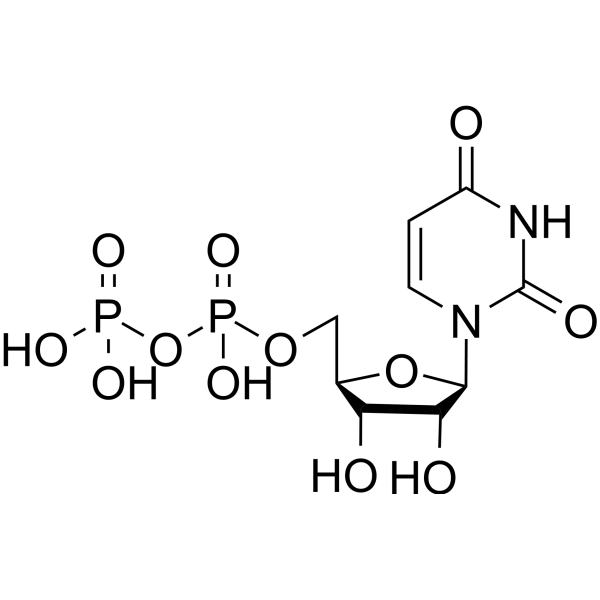
Uridine-5'-diphosphate (UDP) is an important nucleotide made of uracil, ribose, and a pyrophosphate group. Uridine-5'-diphosphate is a potent, selective human P2Y6 receptor native agonist (EC50 = 300 nM; pEC50 = 6.52). Uridine-5'-diphosphate disodium salt, an endogenous metabolite, catalyzes the glucuronidation of a wide array of substrates and is used in nucleic acid (RNA) biosynthesis.
연구목적의 판매만을 진행합니다. 환자를 대상으로 한 판매는 하지 않습니다.
- CAS No.: 58-98-0
- 화학식: C9H14N2O12P2
- 분자량:404.16
-
보관:
Please store the product under the recommended conditions in the Certificate of Analysis.

To place orders, for customer services and technical support, please contact: MedChemExpress USA
Tel: 609-228-6898 E-mail: [email protected] [email protected]


-
 Biological Activity
-
Chemical Information
- 순도&문서
- References
-
 Help & FAQs


-

HY-113044R
Uridine 5′-diphosphoglucose (Standard)Standard of Uridine 5′-diphosphoglucose -
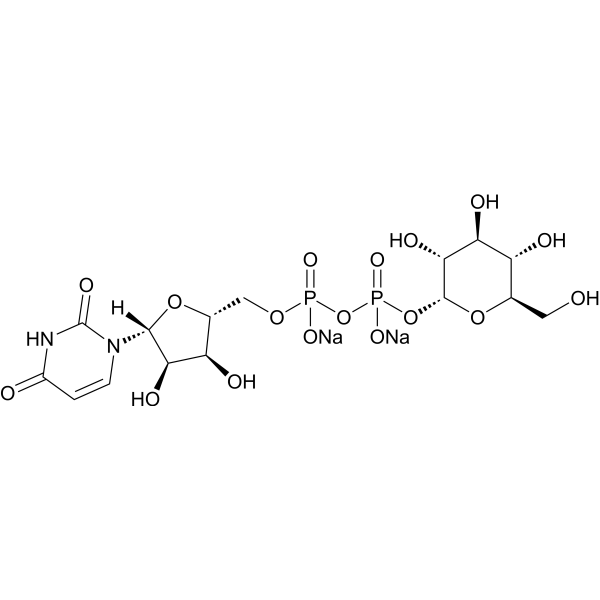
HY-N7032
Uridine 5′-diphosphoglucose disodiumP2Y14 Agonist -
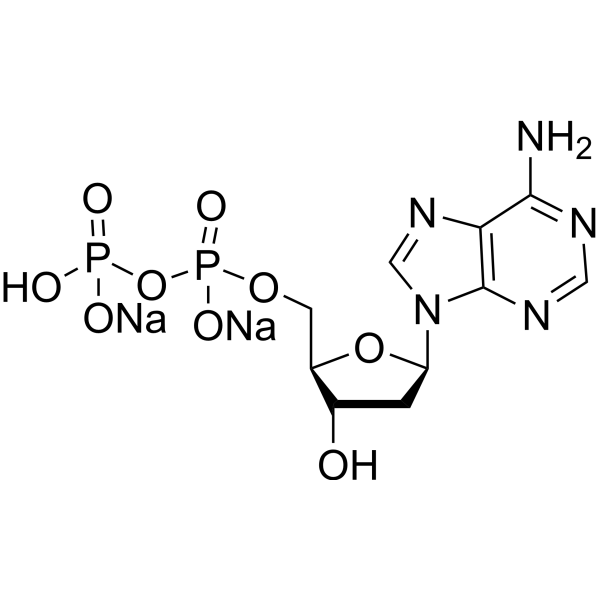
HY-W010854
2'-Deoxyadenosine 5'-di-phos-phate disodiumPolynucleotide Phosphorylase Inhibitor, Poly(A) Polymerase Inhibitor -
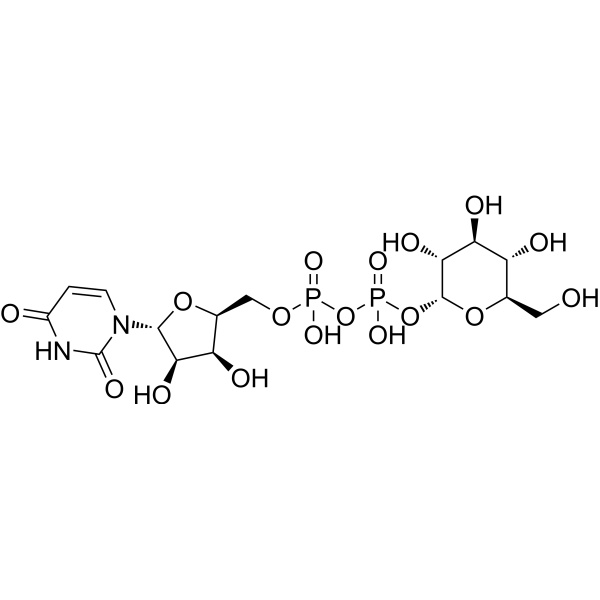
HY-113044
Uridine 5′-diphosphoglucoseP2Y14 Receptor Agonist
Publications Citing Use of MedChemExpress (MCE) Uridine 5'-diphosphate
More Customer Validation & Images

-
WB

-
Others

All P2Y Receptor Isoforms
MoreAll Endogenous Metabolite Isoforms
More

Biological Activity
제품 설명
IC50 & Target
[1]|
P2Y6 Receptor 0.013 μM (EC50) |
Human Endogenous Metabolite |
Cellular Effect
|
Cell Line

|
Type | Value | Description | References |
|---|---|---|---|---|
| COS-7 | EC50 |
160 μM
Compound: 2, UDP
|
Agonist activity at recombinant human P2Y14 receptor expressed in African green monkey COS7 cells co-transfected with Galphaqi assessed as stimulation of phospholipase Cbeta
Agonist activity at recombinant human P2Y14 receptor expressed in African green monkey COS7 cells co-transfected with Galphaqi assessed as stimulation of phospholipase Cbeta
|
[PMID: 25868749] |
| HEK293 | EC50 |
0.16 μM
Compound: 1, UDP
|
Agonist activity at human recombinant P2Y14 receptor expressed in HEK293 cells assessed as [3H]inositol phosphate production by scintillation proximity assay
Agonist activity at human recombinant P2Y14 receptor expressed in HEK293 cells assessed as [3H]inositol phosphate production by scintillation proximity assay
|
[PMID: 20446735] |
| HEK293 | EC50 |
160 nM
Compound: 3
|
Agonist activity at human P2Y14 receptor expressed in HEK293 cells coexpressing phospholipase C-activating Gi protein cells assessed as inhibition of forskolin induced [3H]cAMP production
Agonist activity at human P2Y14 receptor expressed in HEK293 cells coexpressing phospholipase C-activating Gi protein cells assessed as inhibition of forskolin induced [3H]cAMP production
|
[PMID: 19902968] |
In Vitro
Uridine-5'-diphosphate (100 μM; 15 min) significantly induces microglial CCL2 and CCL3 mRNA expression[2].
Uridine-5'-diphosphate (100 μM; 3 h) induces chemokine expression in microglia[2].
Uridine-5'-diphosphate (100 μM; 0.5-12 h) induces expression of mRNA encoding CCL2 and CCL3 within 30 min, and such expression reaches maximal levels at 1 h, returning to basal levels at 3-12 h[2].
Uridine-5'-diphosphate (10-1000 μM; 3 h) induces a concentration-dependent increase in the expression of chemokines at both the mRNA and protein level[2].
Uridine-5'-diphosphate (10-1000 μM; 3 h) induces activation of NFATc1 and NFATc2 in microglia[2].
MedChemExpress (MCE) has not independently confirmed the accuracy of these methods. They are for reference only. .
-
Cell Line:Primary microglia
-
Concentration:100 μM
-
Incubation Time:For 15 min
-
Result:Significantly induced microglial CCL2 and CCL3 mRNA expression.


Chemical Information
-
CAS No. 58-98-0
-
분자량 404.16
-
화학식 C9H14N2O12P2
-
SMILES
O=C(C=CN1[C@H]2[C@H](O)[C@H](O)[C@@H](COP(OP(O)(O)=O)(O)=O)O2)NC1=O
-
Synonyms
UDP
-
Structure Classification
-
Initial Source
-
선적
Room temperature in continental US; may vary elsewhere.
-
보관
Please store the product under the recommended conditions in the Certificate of Analysis.


Publications (2)
-
Journal Impact Factor
-
Most Recent
-
Free Radic Biol Med
P2Y6 receptor blockade promotes depression-like symptoms through oxidative stress and impaired autophagy. [Abstract]2025 Oct 17:242:203-219. PMID: 41110517
Uridine 5'-diphosphate purchased from MedChemExpress. Usage Cited in: Free Radic Biol Med. 2025 Oct 17:242:203-219. [Abstract]
UDP (Uridine-5'-diphosphate disodium salt) agonism elicited distinct signaling responses, enhancing CaMKII, p-PKC, and SOD2, while suppressing Nrf2 and HO-1, without altering p62, VPS34, LC3B, AMPKα, or mTOR. In contrast, MRS treatment selectively increased HO-1 phosphorylation, while leaving other pathways unaffected.
Uridine 5'-diphosphate purchased from MedChemExpress. Usage Cited in: Free Radic Biol Med. 2025 Oct 17:242:203-219. [Abstract]
Schematic representing the relationship between MRS2578, P2Y6, UDP (Uridine-5'-diphosphate disodium salt), and MRS2693.
-
Int Immunopharmacol
Inhibition of P2Y6 receptor expression in Kupffer cells alleviates alcoholic steatohepatitis in mice. [Abstract]2022 Aug:109:108909. PMID: 35700583


순도&문서
References
[1]. Besada P, et al. Structure-activity relationships of uridine 5'-diphosphate analogues at the human P2Y6 receptor. J Med Chem. 2006 Sep 7;49(18):5532-43. [Content Brief]
[2]. Pâris A, et al. Simultaneous one-pot multienzymatic synthesis and purification of Uridine-5'-Diphosphate-α-D-glucuronide and Uridine-5'-Diphosphate-α-d-xylose. Carbohydr Res. 2025 Aug;554:109516. [Content Brief]

Calculators
Concentration (start) × Volume (start) = Concentration (final) × Volume (final)


Uridine 5'-diphosphate Related Classifications
HY-113359 Related Classifications
 Powered by Bioz