



Liarozole hydrochloride
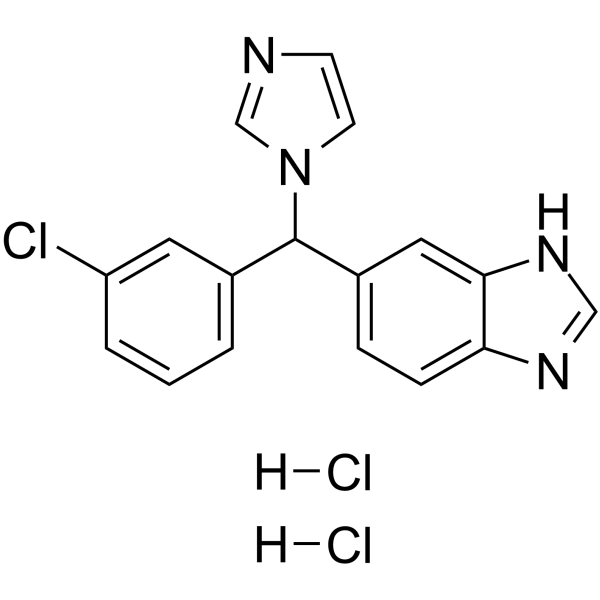
Liarozole hydrochloride is an imidazole derivative and orally active retinoic acid (RA) metabolism-blocking agent (RAMBA). Liarozole hydrochloride inhibits the cytochrome P450 (CYP26)-dependent 4-hydroxylation of retinoic acid (IC50=7 μM), resulting in increased tissue levels of retinoic acid. Liarozole hydrochloride shows antitumoral properties.
For research use only. We do not sell to patients.
- CAS No.: 145858-50-0
- Formula: C17H14Cl2N4
- Molecular Weight:345.23
-
Storage:
Please store the product under the recommended conditions in the Certificate of Analysis.


To place orders, for customer services and technical support, please contact: MedChemExpress USA
Tel: 609-228-6898 E-mail: [email protected] [email protected]


-
 Biological Activity
-
Chemical Information
- Purity & Documentation
- References
-
 Help & FAQs




Biological Activity
Description
IC50 & Target
IC50: 7 μM (P450)[1]
In Vitro
Liarozole (0.01~10 μM; 9 days; MCF-7 cells) inhibits cells proliferation[3].
Liarozole (1 μM; 4 days; mesenchymal cells) completely inhibits chondrogenesis[4].
MedChemExpress (MCE) has not independently confirmed the accuracy of these methods. They are for reference only. .
-
Cell Line:Mesenchymal cells
-
Concentration:1 μM
-
Incubation Time:4 days
-
Result:Completely inhibited chondrogenesis.
-
Cell Line:MCF-7 cells
-
Concentration:0.01~10 μM
-
Incubation Time:9 days
-
Result:Had an effect of 35% inhibition at 10 μM on cell proliferation.
In Vivo
Clinical Trial
| NCT Number | Sponsor | Condition | Start Date |
Phase

|
|---|---|---|---|---|
| NCT01329991 | Plexxikon| | 2011-05 | PHASE1 |


Chemical Information
-
CAS No. 145858-50-0
-
Molecular Weight 345.23
-
Formula C17H14Cl2N4
-
SMILES
ClC1=CC(C(C2=CC=C3N=CNC3=C2)N4C=CN=C4)=CC=C1.Cl
-
Synonyms
R75251 hydrochloride
-
Shipping
Room temperature in continental US; may vary elsewhere.
-
Storage
Please store the product under the recommended conditions in the Certificate of Analysis.


Purity & Documentation
References
[1]. Kuijpers AL, et al. The effects of oral liarozole on epidermal proliferation and differentiation in severe plaque psoriasis are comparable with those of acitretin. Br J Dermatol. 1998;139(3):380-389. [Content Brief]
[2]. Lucker GP, et al. Oral treatment of ichthyosis by the cytochrome P-450 inhibitor liarozole. Br J Dermatol. 1997;136(1):71-75. [Content Brief]
[3]. Wouters W, et al. Effects of liarozole, a new antitumoral compound, on retinoic acid-induced inhibition of cell growth and on retinoic acid metabolism in MCF-7 human breast cancer cells. Cancer Res. 1992;52(10):2841-2846. [Content Brief]
[4]. Pignatello MA, et al. Liarozole markedly increases all trans-retinoic acid toxicity in mouse limb bud cell cultures: a model to explain the potency of the aromatic retinoid (E)-4-[2-(5,6,7,8-tetrahydro-5,5,8,8-tetramethyl-2-naphthylenyl)-1-propenyl] benzoic acid. Toxicol Appl Pharmacol. 2002; 178(3):186-194. [Content Brief]
[5]. Van Wauwe J, et al. Liarozole, an inhibitor of retinoic acid metabolism, exerts retinoid-mimetic effects in vivo. J Pharmacol Exp Ther. 1992;261(2):773-779. [Content Brief]
[6]. Stearns ME, et al. Liarozole and 13-cis-retinoic acid anti-prostatic tumor activity [published correction appears in Cancer Res 1993 Dec 1;53(23):5831]. Cancer Res. 1993;53(13):3073-3077. [Content Brief]

Calculators
Concentration (start) × Volume (start) = Concentration (final) × Volume (final)


Liarozole hydrochloride Related Classifications
HY-106019A Related Classifications
 Powered by Bioz