



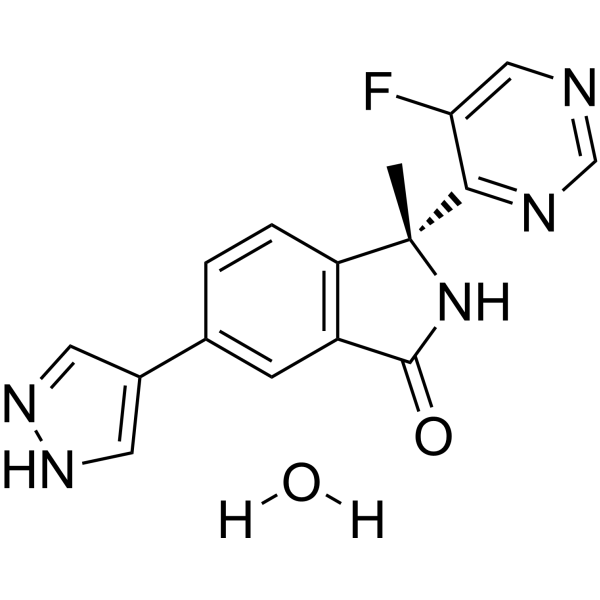
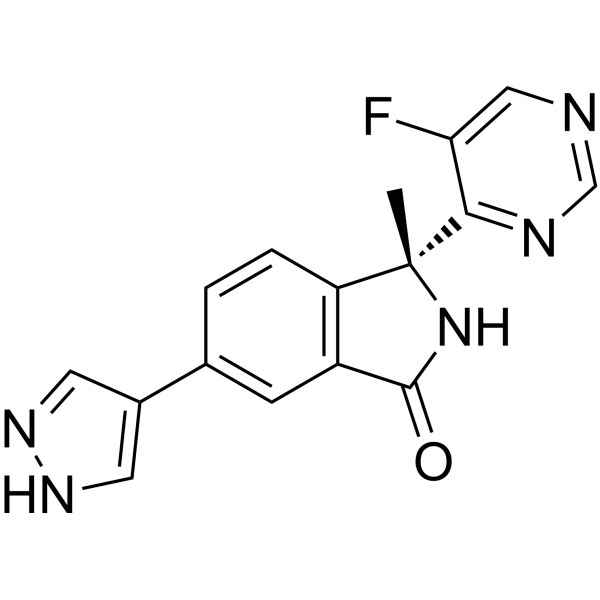
LY3177833 monhydrate
LY3177833 (Example 4) monhydrate is an orally active CDC7 and pMCM2 inhibitor with IC50 values of 3.3 nM and 290 nM, respectively. LY3177833 monhydrate is a senescence inducer.
For research use only. We do not sell to patients.
- CAS No.: 1627696-53-0
- Formula: C16H14FN5O2
- Molecular Weight:327.31
-
Storage:
4°C, sealed storage, away from moisture
* In solvent : -80°C, 6 months; -20°C, 1 month (sealed storage, away from moisture)

To place orders, for customer services and technical support, please contact: MedChemExpress USA
Tel: 609-228-6898 E-mail: [email protected] [email protected]


-
 Biological Activity
-
Chemical Information
- Protocols
- Purity & Documentation
- References
-
 Help & FAQs




Biological Activity
Description
IC50 & Target
[1]|
Cdc7 3.3 nM (IC50) |
pMCM2 290 nM (IC50) |
In Vitro
LY3177833 (10 μM; 4 days) increases SA-β-gal content in Hep3B cells[2].
MedChemExpress (MCE) has not independently confirmed the accuracy of these methods. They are for reference only.
-
Cell Line:Hep3B cells
-
Concentration:10 μM
-
Incubation Time:4 days
-
Result:Increased the expression of human SA-β-gal.
In Vivo
MedChemExpress (MCE) has not independently confirmed the accuracy of these methods. They are for reference only.
-
Animal Model:Female athymic Balb/c nude mice (5-6 weeks old) with SW620 cells[1]
-
Dosage:10.4 mg/kg, 20.8 mg/kg and 31.2 mg/kg
-
Administration:Oral gavage; twice a day for 2 weeks
-
Result:Showed dose dependent antitumor activity in SW620 mouse xenograft tumor model.


Chemical Information
-
CAS No. 1627696-53-0
-
Appearance Solid
-
Molecular Weight 327.31
-
Formula C16H14FN5O2
-
Color White to off-white
-
SMILES
O=C1N[C@@](C)(C2=NC=NC=C2F)C3=C1C=C(C4=CNN=C4)C=C3.[H]O[H]
-
Shipping
Room temperature in continental US; may vary elsewhere.
-
Storage
4°C, sealed storage, away from moisture
* In solvent : -80°C, 6 months; -20°C, 1 month (sealed storage, away from moisture)


Purity & Documentation
-
Data Sheet (278 KB)
-
SDS (252 KB)
- English - EN (252 KB)
- Français - FR (252 KB)
- Deutsch - DE (252 KB)
- Norwegian - NO (252 KB)
- Español - ES (252 KB)
- Swedish - SV (252 KB)
- Italian - IT (252 KB)
- Korean - KR (252 KB)
- Portuguese - PT (252 KB)
-
Handling Instructions (2659 KB)
References

Calculators
Concentration (start) × Volume (start) = Concentration (final) × Volume (final)


LY3177833 monhydrate Related Classifications
HY-100023A Related Classifications
 Powered by Bioz