107 Results for "

fluorescent indicator

" in MedChemExpress (MCE) Product Catalog:
Products (107)

107 Results for "fluorescent indicator" in MCE Product Catalog:

Cat. No.: HY-D1447
CAS No.: 348079-14-1
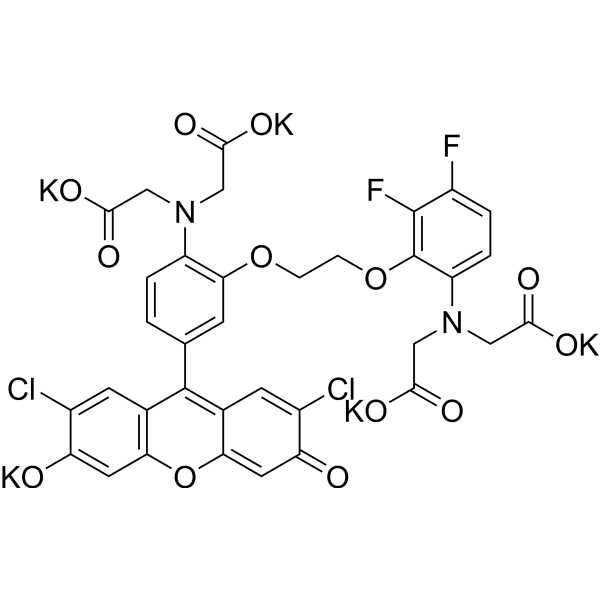
Fluo-3FF pentapotassium is a cell-impermeant fluorescent calcium indicator. Fluo-3FF is a di-fluorinated analog of Fluo-3 with a 100-fold lower affinity than Fluo-3 for calcium (Kds=42 and 0.4 μM, respectively). For its low affinity, Fluo-3FF is used for studying compartments with high concentrations of calcium, such as endoplasmic reticulum, where high affinity dyes will be insensitive to luminal fluctuations.
loading...
    loading...
Cat. No.: HY-D1551
CAS No.: 886212-86-8
Target:  

Fluorescent Dye

Research Areas:  

Others

10-(4-(Bis(2-hydroxyethyl)amino)phenyl)-5,5-difluoro-1,3,7,9-tetramethyl-5H-dipyrrolo[1,2-c:2',1'-f][1,3,2]diazaborinin-4-ium-5-uide, a BODIPY derivative, is a fluorescent indicator for detecting Pb 2+ (Ex=504 nM, Em=510 nM) .
loading...
    loading...
Cat. No.: HY-D0121A
CAS No.: 132319-56-3
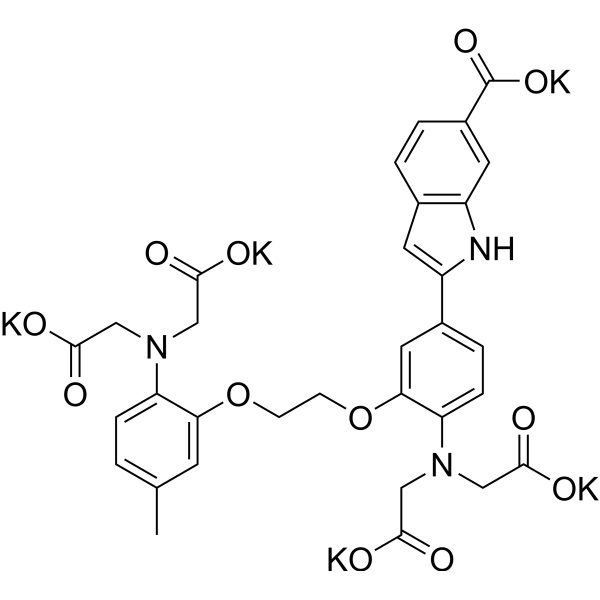
INDO 1 pentapotassium is a cell-impermeable, dual-emission ratiometric fluorescent calcium indicator with a KD·β value of 0.44 μM. INDO 1 pentapotassium binds to intracellular free calcium ions and undergoes wavelength-dependent fluorescence changes. In the unbound state (free form) without Ca 2+, its fluorescence emission peak is at 485 nm upon excitation with ultraviolet light (350 nm). When INDO 1 pentasodium binds to Ca 2+ (bound state), the emission peak shifts to 405 nm (Ex = 350 nm; dual emission at Em= 405/485 nm) .
loading...
    loading...
Cat. No.: HY-D0121B
INDO 1 pentasodium is a cell-impermeable, dual-emission ratiometric fluorescent calcium indicator with a KD·β value of 0.44 μM. INDO 1 pentasodium binds to intracellular free calcium ions and undergoes wavelength-dependent fluorescence changes. In the unbound state (free form) without Ca 2+, its fluorescence emission peak is at 485 nm upon excitation with ultraviolet light (350 nm). When INDO 1 pentasodium binds to Ca 2+ (bound state), the emission peak shifts to 405 nm (Ex = 350 nm; dual emission at Em= 405/485 nm) .
loading...
    loading...
Cat. No.: HY-111391AR
CAS No.: 62758-13-8
Synonyms: Diazoresorcinol sodium, indicator (Standard)
Research Areas:  

Others

Resazurin (sodium), indicator (Standard) is the analytical standard of Resazurin (sodium), indicator (HY-111391A). This product is intended for research and analytical applications. Resazurin (Diazoresorcinol) sodium, indicator is a non-toxic, stable, membrane-permeable blue non-fluorescent dye (faintly fluorescent). Resazurin sodium, indicator is used as a redox indicator, can be reduced to pink, highly fluorescent Resorufin (Ex=530-560 nm, Em=590 nm) in living cells. Resazurin sodium, indicator can be used for the detection of cell viability, toxicity, proliferation, migration and invasion in cells (human, plant and animal, bacterial and fungal) .
loading...
    loading...
Cat. No.: HY-D3151
CAS No.: 1698054-83-9
RHBCu is a rhodamine-based azophenol derivative and a fluorescent indicator for Cu 2+. RHBCu exhibits high selectivity for Cu 2+ ions and enables fluorescent imaging of Cu 2+ in cancer cells .
loading...
    loading...
Cat. No.: HY-126821B
Target:  

Fluorescent Dye

Research Areas:  

Others

Fluo-3 sodium is a cell-impermeable calcium ion (Ca 2+) indicator. Fluo-3 sodium itself is not fluorescent, but it becomes fluorescent after binding to calcium ions (Ex/Em = 488/525 nm) .
loading...
    loading...
Cat. No.: HY-D3227
CAS No.: 2677830-11-2
HOTN is a hypochlorous acid (HClO) Fluorescent indicator. HOTN is oxidized by HClO, causing cleavage of its Py +-N + moiety and a change in hydrophobicity, which in turn triggers aggregation-induced emission to generate a strong fluorescent signal. HOTN is used for in vivo imaging of inflammation and hepatocellular carcinoma, as these diseases typically result in high levels of HClO .
loading...
    loading...
Cat. No.: HY-D3376
CAS No.: 247044-02-6
Synonyms: 6-Carboxy-2',7'-dichlorodihydrofluorescein
6-Carboxy-H2DCFDA (6-Carboxy-2',7'-dichlorodihydrofluorescein) is a non-fluorescent, cell-permeable intracellular ROS indicator. 6-Carboxy-H2DCFDA undergoes oxidation to highly fluorescent carboxy-dichlorofluorescein (Ex/Em = 488/520 nm) .
loading...
    loading...
Cat. No.: HY-101894R
CAS No.: 109244-58-8
Synonyms: DHR 123 (Standard)
Research Areas:  

Others

Dihydrorhodamine 123 (Standard) is the analytical standard of Dihydrorhodamine 123 (HY-101894). This product is intended for research and analytical applications. Dihydrorhodamine 123 (DHR 123) is a non-fluorescent reactive oxygen species (ROS) indicator. Dihydrorhodamine 123 is oxidized to fluorescent Rhodamine 123 (HY-D0816) within cells in the presence of reactive oxygen species and it localizes in mitochondria (Ex/Em = 515/536 nm).
loading...
    loading...
Cat. No.: HY-101887R
CAS No.: 54375-47-2
Calcein Blue (Standard) is the analytical standard of Calcein Blue (HY-101887). This product is intended for research and analytical applications. Calcein Blue, a membrane-impermeant fluorescent dye, is a coumarin derivative that contains an iminodiacetic acid structure. Calcein Blue is also a metallofluorochromic indicator .
loading...
    loading...
Cat. No.: HY-D3447
CAS No.: 3092823-52-1
Research Areas:  

Others

LPd peroxida probe-2 (Compound I-1) is a lipid peroxidation fluorescent indicator (Ex = 488 nm, Em = 535 nm). LPd peroxida probe-2 undergoes fluorescence spectral changes in response to lipid hydroperoxides and can be used for Ferroptosis detection and cell imaging.
loading...
    loading...
Cat. No.: HY-D3152
CAS No.: 2361979-91-9
NRh-Cu is a highly sensitive near-infrared fluorescence turn-on indicator and Cu 2+-selective probe (λex=680 nm, λem=740 nm). When NRh-Cu interacts with Cu 2+, it undergoes a structural transition from a non-fluorescent spirocyclic state to a fluorescent ring-opened state, which drives the enhancement of fluorescence emission. NRh-Cu can be used for Cu 2+ imaging in live cells and in vivo .
loading...
    loading...
Cat. No.: HY-167255
CAS No.: 5563-28-0
JC-10 is a lipophilic mitochondrial membrane potential indicator and is a fluorescent dye. JC-10 accumulates and aggregates in healthy mitochondria to emit red fluorescence; exists as a monomer emitting green fluorescence in the cytosol or apoptotic cells with collapsed mitochondrial membrane potential, enabling measurement of mitochondrial depolarization via the green/red fluorescence ratio .
loading...
    loading...
Cat. No.: HY-DY1091
CAS No.: 1461-15-0
Synonyms: Fluorexon (solution)
Calcein (solution) (Fluorexon (solution)) is a fluorescent dye and self-quenching probe, used as an indicator of lipid vesicle leakage, and also as a complexometric indicator for titration of calcium ions with EDTA, and for fluorometric determination of calcium. Calcein cannot directly cross the intact cell membrane of a living cell, unlike Calcein-AM (HY-D0041) which is cell-permeable. Calcein can also be used as a model drug for evaluating efficiency and bioavailability of drug delivery systems .
Solvent and concentration: DMSO: 2 mM
The 1 mL volume is defined as the base specification. All larger sizes correspond to incremental volumes of this base.
loading...
    loading...
Cat. No.: HY-175146
Research Areas:  

Others

Fura-2 leakage resistant AM (Fura-PE3) is a new ratiometric calcium indicator. Fura-2 leakage resistant AM has calcium-binding characteristics (Kd = 146 nM) and fluorescent properties (emission: 510 nm; alternating excitation: 340 nm and 380 nm). Fura-2 leakage resistant AM monitors calcium concentration in platelet .
loading...
    loading...
Cat. No.: HY-D3240
CAS No.: 2375541-43-6
Photoactive NTR probe (Compound 1) is a covalent crosslinker and Fluorescent indicator targeting Nitroreductase. The Photoactive NTR probe undergoes a sequential activation process: it is first activated via nitroreductase-mediated nitro-to-amino conversion, and then forms a fluorescent product upon photoactivation. The Photoactive NTR probe can form covalent adducts with the side chains of cysteine, tyrosine, lysine and histidine in adjacent proteins to reduce fluorophore diffusion. The Photoactive NTR probe enables super-resolution (STORM) imaging of active mitochondrial nitroreductase microdomains in living cells .
loading...
    loading...
Cat. No.: HY-DY1101
CAS No.: 108964-32-5
Synonyms: Fura-2 Acetoxymethyl ester (solution)
Fura-2 AM (solution) (Fura-2 Acetoxymethyl ester (solution)) is a membrane permeable, intracellular, UV light-excitable and ratiometric fluorescent Ca 2+ (calcium ion) indicator. Fura-2 AM crosses cell membranes and is converted to Fura-2 (HY-D0110A) via cellular esterases. Fura-2 AM can be used to detect calcium in cells.
Solvent and concentration: DMSO: 1 mM
loading...
    loading...
Cat. No.: HY-D3222
CAS No.: 2413264-79-4
NIR-PN1 is a blood-brain barrier-permeable near-infrared fluorescent indicator targeting peroxynitrite anion (ONOO −) (Ex/Em = 510 nm/670 nm). NIR-PN1 reacts with ONOO − to trigger a strong near-infrared fluorescence enhancement, enabling the detection of ONOO − flux. NIR-PN1 allows the imaging of ONOO − flux in various Parkinson's disease models. NIR-PN1 is applicable to Parkinson's disease-related research .
loading...
    loading...
Cat. No.: HY-D3480
BeRST voltage sensitive dye is a silicon-rhodamine-based voltage-sensitive dye that serves as a membrane potential indicator, featuring fast response kinetics, high sensitivity, photostability, and excellent signal-to-noise ratio. BeRST voltage sensitive dye relies on the photoinduced electron transfer (PeT) mechanism to report changes in neuronal membrane potential via fluorescent signals. BeRST voltage sensitive dye localizes to the extracellular surface of neuronal plasma membranes, including cell bodies and neurites. BeRST voltage sensitive dye can be used in studies related to Alzheimer's disease (Ex/Em = 658/683 nm) .
loading...
    loading...