177 Results for "

Bacillus subtilis

" in MedChemExpress (MCE) Product Catalog:
Products (177)

177 Results for "Bacillus subtilis" in MCE Product Catalog:

Cat. No.: HY-N16400
CAS No.: 1392495-06-5
Target:  

Bacterial

Aspergillumarin A is a dihydroisocoumarin derivative with various biological activity. Aspergillumarin A inhibits cell proliferation by inducing G0/G1 phase arrest in HepG2 hepatocellular carcinoma cells.. Aspergillumarin A exhibits weak antibacterial activity against Staphylococcus aureus and Bacillus subtilis. Aspergillumarin A can be used for the study of hepatocellular carcinoma (HCC)
loading...
    loading...
Cat. No.: HY-W541015
CAS No.: 89-48-5
(±)-Menthyl acetate is a menthol acyl derivative (monoterpene ester) and antibacterial agent found in the essential oil of Mentha arvensis L.. (±)-Menthyl acetate inhibits growth of Gram-positive bacterial strains including Streptococcus mutans, Mycobacterium smegmatis, Enterococcus faecalis, Staphylococcus aureus, and Bacillus subtilis. (±)-Menthyl acetate is inactive against tested fungal strains. (±)-Menthyl acetate can be used in the research of Gram-positive bacterial infections .
loading...
    loading...
Cat. No.: HY-125042
CAS No.: 130756-15-9
Target:  

Bacterial

Research Areas:  

Infection

Sarothralin G is an antibacterial compound isolated from Hypericum japonicum Thunb. (Japanese spurfle). The structure of Sarothralin G contains phenolic and aromatic acid moieties and shows excellent antibacterial activity against Gram-positive bacteria such as Staphylococcus aureus, Bacillus subtilis and Nocardia spp., which is stronger than Sarothralen A, B and Saroaspidin A, B, C. Sarothralin G exhibits significant antibacterial potential.
loading...
    loading...
Cat. No.: HY-125620
CAS No.: 274913-71-2
Rubiginone D2 is an antibiotic, which exhibits antimicrobial activities against Bacillus subtilis, Staphylococcus aureus and Escherichia coli. Rubiginone D2 exhibits antitumor efficacy, inhibits proliferations of cancer cells HM02, Kato III, HepG2 and MCF7, with GI50s of 0.1, 0.7, <0.1 and 7.5 μM, respectively .
loading...
    loading...
Cat. No.: HY-158987
CAS No.: 1050202-63-5
Synonyms: APBADP
Target:  

Endogenous Metabolite

Research Areas:  

Metabolic Disease

Adenosine phosphonobutyric, 2'(3'), 5'-diposphate (APBADP) is an adenylosuccinate lyase substrate analog and competitive inhibitor. Adenosine phosphonobutyric, 2'(3'), 5'-diposphate binds to the tetramers of *Bacillus subtilis* adenylosuccinate lyase and wild-type human adenylosuccinate lyase. Adenosine phosphonobutyric, 2'(3'), 5'-diposphate can be used for research on adenylosuccinate lyase deficiency .
loading...
    loading...
Cat. No.: HY-N15479
Nanangenine F is a drimane sesquiterpenoid with weak antibacterial and anticancer activities. Nanangenine F inhibits Bacillus subtilis (ATCC 6633) with an IC50 of 78 µg/mL. Nanangenine F inhibits NS-1, DU-145, MCF-7 and human fibroblast NFF cells with IC50s of 49 µg/mL, 95 µg/mL, 49 µg/mL, and 84 µg/mL, respectively .
loading...
    loading...
Cat. No.: HY-N15640
CAS No.: 62311-75-5
Synonyms: (-)-Filiformin
Filiformin ((-)-Filiformin) is a sesquiterpene compound that can be isolated from Laurencia filiformis forma heteroclada. Filiformin exhibits certain cytotoxicity against P388 and BSC-1 cells. Filiformin has antimicrobial activity against Bacillus subtilis, Trichophyton mentagrophytes and Candida albicans. In addition, Filiformin can inhibit oxygen uptake in isolated rat liver mitochondria at a concentration of 150 μM .
loading...
    loading...
Cat. No.: HY-N18530S
N-Myristoyl-D-asparagine-d2 is the deuterium labeled N-Myristoyl-D-asparagine (HY-N18530). N-Myristoyl-D-asparagine is a key metabolic marker in the biosynthesis and maturation of colibactin. N-Myristoyl-D-asparagine acts as a biomarker for detecting colibactin. N-Myristoyl-D-asparagine exhibits mild growth inhibitory activity against Bacillus subtilis NCIB 3610.
loading...
    loading...
Cat. No.: HY-P10281
CAS No.: 359632-11-4
Target:  

Bacterial

Research Areas:  

Infection Cardiovascular Disease

RW3 (MP196) is a small cationic antimicrobial hexapeptide. RW3 targets the bacterial cytoplasmic membrane and inhibits cellular respiration and cell wall synthesis. RW3 exhibits high bioactivity against Gram-positive bacteria such as Bacillus subtilis 168 (MIC of 2 µg/mL). RW3 causes shrinking of murine erythrocytes. RW3 can be used in antimicrobial and antifungal research .
loading...
    loading...
Cat. No.: HY-121382R
CAS No.: 639-14-5
Cinosulfuron (Standard) is the analytical standard of Cinosulfuron. This product is intended for research and analytical applications. Gypsogenin is a selective mixed-type BChE inhibitor (Ki=19.99 μM) that also exhibits significant cytotoxicity against various human cancer cell lines. Gypsogenin inhibits tumor growth by inducing cell cycle arrest and triggering apoptosis. Gypsogenin displays antibacterial activity against bacteria such as Bacillus subtilis and Bacillus thuringiensis, and often serves as a key parent nucleus for the synthesis of anticancer compounds. Gypsogenin is widely used in research on Alzheimer's disease and various cancers including colon cancer, melanoma, and leukemia .
loading...
    loading...
Cat. No.: HY-130596
CAS No.: 94448-15-4
DC-86-M is an antibiotic, which can be isolated from Streptomyces luteogriseus. DC-86-M exhibits antibacterial activities against Bacillus subtilis, Staphylococcus aureus, Enterococcus faecalis, Vibrio anguillarum, and Proteus vulgaris, with MIC <1 μg/mL. DC-86-M exhibits antitumor activity against mouse sarcoma 180 with LD50 of 25 mg/kg .
loading...
    loading...
Cat. No.: HY-144728
Target:  

Bacterial

Research Areas:  

Infection

MraY-IN-1 (compound 12a) is a potent  MraY inhibitor with an IC50 value of 140 μM. MraY-IN-1 has antimicrobial activity against Escherichia coli K12, Bacillus subtilis W23 and Pseudomonas fluorescens Pf-5 with MIC50s of 7 µg/mL, 12 µg/mL and 46 µg/mL, respectively. MraY-IN-1 can be used for researching anti-bacteria .
loading...
    loading...
Cat. No.: HY-N14237
CAS No.: 175448-31-4
Epoxyquinomicin A is an antibiotic that can be isolated from Amycolatopsis sp. Epoxyquinomicin A exhibits inhibitory activity against Micrococcus luteus, Bacillus subtilis, Pasteurella piscicida and Staphylococcus aureus with a MIC of 3-12.5 µg/mL. Epoxyquinomicin A exhibits cytotoxicity in cancer cell L1210, B16 and S180 with IC50 of 2-8 µg/mL. Epoxyquinomicin A exhibits anti-inflammatory effects against collagen-induced arthritis .
loading...
    loading...
Cat. No.: HY-N14238
CAS No.: 175448-32-5
Epoxyquinomicin B is an antibiotic that can be isolated from Amycolatopsis sp. Epoxyquinomicin B exhibits inhibitory activity against Micrococcus luteus, Bacillus subtilis, Pasteurella piscicida and Staphylococcus aureus with a MIC of 6.25-12.5 µg/mL. Epoxyquinomicin B exhibits cytotoxicity in cancer cell L1210 with IC50 of 16.3 µg/mL. Epoxyquinomicin B exhibits anti-inflammatory effects against collagen-induced arthritis .
loading...
    loading...
Cat. No.: HY-P0135
CAS No.: 19431-21-1
Target:  

Bacterial

Research Areas:  

Infection

Penta lysine is an antimicrobial peptide. Penta lysine inhibits the growth of Gram-positive bacteria (including methicillin-resistant Staphylococcus aureus and Bacillus subtilis) as well as Gram-negative bacteria (including Escherichia coli, Acinetobacter baumannii and Pseudomonas aeruginosa). Penta lysine induces hemolysis in human red blood cells. Penta lysine can be used in the research of bacterial infections (including MRSA and Pseudomonas aeruginosa infections) .
loading...
    loading...
Cat. No.: HY-P11783
CAS No.: 86711-55-9
Target:  

Fungal

Research Areas:  

Infection

Surfactin C2 is a lipopeptide produced by Bacillus subtilis A18 with antifungal activity. Surfactin C2 acts against Heterobasidion annosum and Heterobasidion parviporum. Surfactin C2 exerts its activity mainly through membrane‑active effects to disrupt fungal cell structures and inhibit mycelial growth. Surfactin C2 can be used for the research of butt rot and root rot of conifers .
loading...
    loading...
Cat. No.: HY-W743767
CAS No.: 62025-48-3
Synonyms: MZR-P
Mizoribine 5'-monophosphate (MZR-P) is the active metabolite of Mizoribine (HY-17470). Mizoribine 5'-monophosphate is an inhibitor of inosine-5'-monophosphate dehydrogenase (IMPDH), and its Ki values for IMPDH of Trypanosoma brucei, Bacillus subtilis and Oceanobacillus iheyensis are 3.3, 72 and 157 nM respectively. Mizoribine 5'-monophosphate can be used in anti-trypanosomiasis and immunosuppression research .
loading...
    loading...
Cat. No.: HY-34439
CAS No.: 123-32-0
Synonyms: NSC 49139
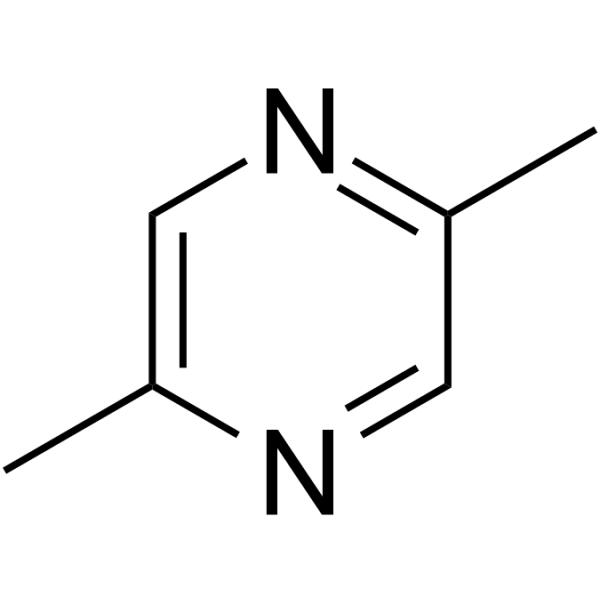
2,5-Dimethylpyrazine (NSC 49139) is a flavor compound. 2,5-Dimethylpyrazine forms in baked foods. It can also be produced by Bacillus subtilis via microbial mechanisms. 2,5-Dimethylpyrazine imparts baking, nutty, earthy, and cocoa-like aroma characteristics to heated foods. In fully fired oolong tea, 2,5-Dimethylpyrazine exhibits a roasted peanut flavor .
loading...
    loading...
Cat. No.: HY-N16374
CAS No.: 68373-95-5
Mazethramycin B (Compound II) is an antitumor antibiotic. Mazethramycin B can be isolated from the Streptomyces thioluteusM ME561-L4. Mazethramycin B has a broad-spectrum antimicrobial activity (such as MICs of 1.56 and 6.25 μg/mL for the bacteria Bacillus subtilis PCI 219 and the fungus Candida pseudotropicalis, resepectively). Mazethramycin B significantly increases survival in L1210 leukemia mice model .
loading...
    loading...
Cat. No.: HY-E71543
Research Areas:  

Others

2-Hydroxy-3-keto-5-methylthiopentenyl-1-phosphate phosphatase (EC 3.1.3.87) participates in the methionine salvage pathway in Bacillus subtilis.In some species a single bifunctional enzyme, EC 3.1.3.77, acireductone synthase, catalyses both this reaction and EC 5.3.2.5, 2,3-diketo-5-methylthiopentyl-1-phosphate enolase.
loading...
    loading...

