17 Results for "

Nile Red

" in MedChemExpress (MCE) Product Catalog:
Products (17)

17 Results for "Nile Red" in MCE Product Catalog:

132
132 Cited Publications
Cat. No.: HY-D0718
CAS No.: 7385-67-3
Synonyms: Nile Blue A oxazone; Phenoxazone 9
Target:  

Fluorescent Dye

Research Areas:  

Others

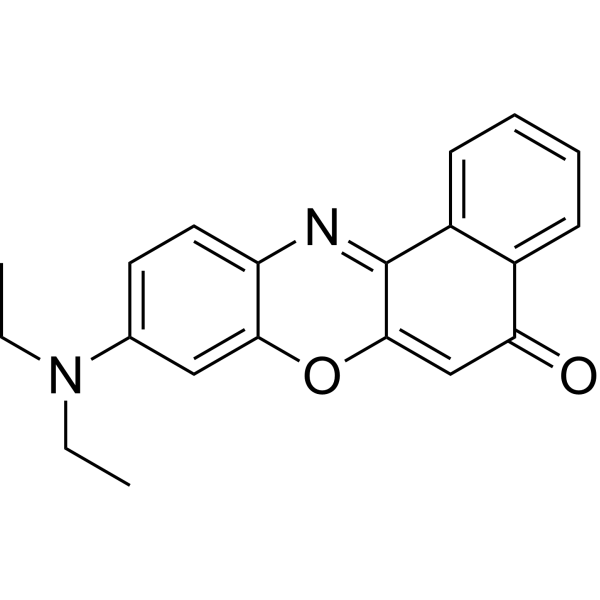
Nile red (Nile blue oxazone) is a lipophilic stain. Nile red has environment-sensitive fluorescence. Nile red is intensely fluorescent in a lipid-rich environment while it has minimal fluorescence in aqueous media. Nile red is an excellent vital stain for the detection of intracellular lipid droplets by fluorescence microscopy and flow cytof uorometry. Nile red stains intracellular lipid droplets red. The fluorescence wavelength is 543/598 nm .
loading...
    loading...
Cat. No.: HY-B2235B
CAS No.: 8002-43-5
Synonyms: L-α-Phosphatidylcholine (egg yolk, Type XVI-E), 99%, lyophilized powder; 1,2-Diacyl-sn-glycero-3-phosphocholine (egg yolk, Type XVI-E), 99%; egg yolk Lecithins, Type XVI-E, 99%
L-α-Lecithin (egg yolk, Type XVI-E), 99% (L-α-Phosphatidylcholine (egg yolk, Type XVI-E), 99%) is an active biomaterial. L-α-Lecithin (egg yolk, Type XVI-E), 99% forms liposomes with compounds (PF or BA). L-α-Lecithin (egg yolk, Type XVI-E), 99% increases membrane fluidity and affects microemulsion stability and fluorescence intensity stained with Nile red (HY-D0718). L-α-Lecithin (egg yolk, Type XVI-E), 99% It can be used for cell membrane structure research, biological membrane potential research, and liposome research .
loading...
    loading...
Cat. No.: HY-DY1008
CAS No.: 7385-67-3
Nile Red (solution) is a lipophilic stain. Nile red has environment-sensitive fluorescence. Nile red is intensely fluorescent in a lipid-rich environment while it has minimal fluorescence in aqueous media. Nile red is an excellent vital stain for the detection of intracellular lipid droplets by fluorescence microscopy and flow cytof uorometry. Nile red stains intracellular lipid droplets red. The fluorescence wavelength is 559/635 nm .
Solvent and concentration: DMSO: 1 mM
loading...
    loading...
Cat. No.: HY-D1254
CAS No.: 2368978-96-3
Synonyms: NBL-SS perchlorate
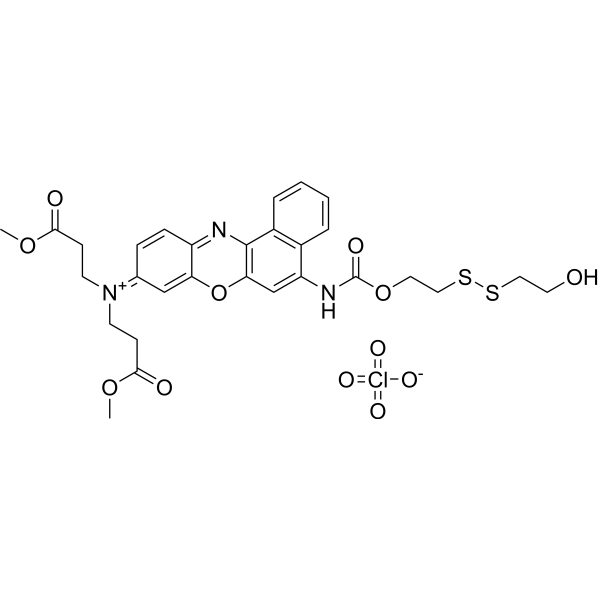
Trx-red (NBL-SS perchlorate) is a red-emitting fluorescent probe derivatized from the nile blue fluorophore. Trx-red is used for selectively imaging thioredoxin (Trx) in live cells and in vivo (λex=615 nm, λem=661 nm) .
loading...
    loading...
Cat. No.: HY-149812
CAS No.: 2890177-95-2
Target:  

Bacterial Parasite

Research Areas:  

Infection

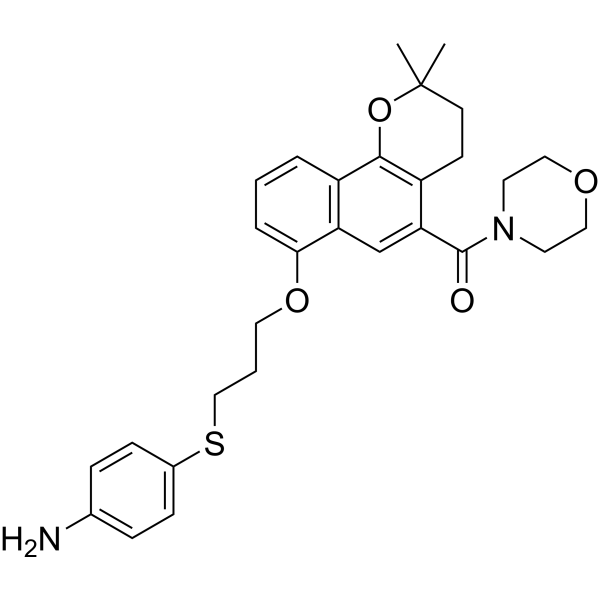
Efflux pump-IN-4 is an AcrB efflux pump inhibitor, with ability to potentiate the effect of antibiotics. Efflux pump-IN-4 inhibits Nile Red (a known substrate of AcrB) efflux. Efflux pump-IN-4 does not disrupts the bacterial outer membrane nor display toxicity in a nematode model .
loading...
    loading...
Cat. No.: HY-168322
CAS No.: 888327-74-0
Target:  

Fluorescent Dye

Research Areas:  

Others

2-Hydroxy nile red trifluoromethanesulfonate is a fluorescent probe, that enters into oligodeoxyribonucleic acid as a nucleotide replacement. 2-Hydroxy nile red trifluoromethanesulfonate can be used as a DNA probe for detecting the polar changes in tumor microenvironments .
loading...
    loading...
Cat. No.: HY-164801
CAS No.: 1108750-62-4
Target:  

Drug Intermediate

Research Areas:  

Others

Nile Red phenoxyacetic acid (Compound 4) is a pharmaceutical intermediate that can be used for the synthesis of GPR84 fluorescent probes .
loading...
    loading...
Cat. No.: HY-149810
CAS No.: 2890177-90-7
Target:  

Bacterial Parasite

Research Areas:  

Infection

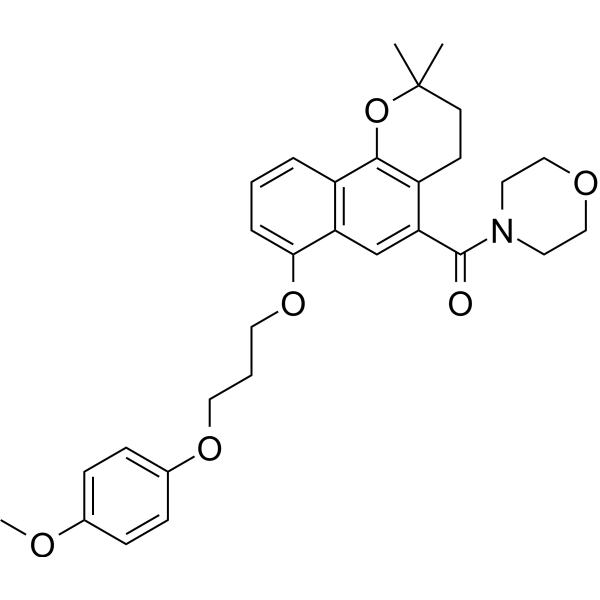
AcrB-IN-2 is an AcrB efflux pump inhibitor, with ability to potentiate the effect of antibiotics. AcrB-IN-22 inhibits Nile Red (a known substrate of AcrB) efflux.AcrB-IN-2 does not disrupts the bacterial outer membrane nor display toxicity in a nematode model .
loading...
    loading...
Cat. No.: HY-149811
CAS No.: 2890177-94-1
Target:  

Bacterial Parasite

Research Areas:  

Infection

Efflux pump-IN-3 is an AcrB efflux pump inhibitor, with ability to potentiate the effect of antibiotics. Efflux pump-IN-3 inhibits Nile Red (a known substrate of AcrB) efflux. Efflux pump-IN-3 does not disrupts the bacterial outer membrane nor display toxicity in a nematode model .
loading...
    loading...
Cat. No.: HY-D3101
Target:  

Fluorescent Dye

Research Areas:  

Others

Nile-TPA is a fluorescent probe for polarity detection, which can be used for lipid droplet targeting, cell polarity analysis, in vivo polarity imaging, and blood polarity monitoring in circulating tumor mouse models. The detection mechanism of Nile-TPA relies on the dual intramolecular charge transfer (ICT) effect generated by the electron-donating triphenylamine and Nile Red moieties and the electron-withdrawing carbonyl group; this probe emits strong red fluorescence in a low-polarity environment, and as polarity increases, the fluorescence intensity decreases and a red shift occurs due to changes in the excited-state dipole moment. In spectral tests, its excitation wavelength is 540 nm, and the emission wavelength varies in the range of 550-800 nm depending on solvent polarity; for cell, zebrafish and mouse imaging, Ex/Em = 561/570-620 nm, and for in vivo mouse imaging, Ex/Em = 560/620 nm .
loading...
    loading...
Cat. No.: HY-D3090
CAS No.: 2757682-04-3
Target:  

Fluorescent Dye

Research Areas:  

Others

NRLD is a lipid droplet-targeting solvatochromic fluorescent probe developed based on Nile Red (HY-D0718), which can target lipid droplets and sense the non-polar lipid microenvironment inside lipid droplets. NRLD exhibits superior lipid droplet-targeting selectivity compared to the parent Nile Red dye in HeLa cell imaging. NRLD achieves detection relying on the solvatochromic effect generated by excited-state charge transfer, and its emission wavelength shifts according to the local polarity changes of the microenvironment it locates in: the more compact and ordered the lipid packing and the lower the environmental polarity, the more blue-shifted the emission; the looser the lipid packing or the stronger the hydration and the higher the environmental polarity, the more red-shifted the emission. NRLD shows blue shift in the non-polar oil core of lipid droplets and red shift in high-polarity environments such as phosphate buffer .
loading...
    loading...
Cat. No.: HY-D3100
CAS No.: 2412201-40-0
Target:  

Fluorescent Dye

Research Areas:  

Others

NRTP is a fluorescent probe used for mitochondrial polarity detection and photothermal sensitization. NRTP targets mitochondria via a positively charged triphenylphosphonium moiety, which is attracted by the negative mitochondrial membrane potential; meanwhile, its polarity-sensitive Nile red fluorophore enables it to perceive changes in environmental polarity. NRTP reduces cell viability when used as a photothermal sensitizer. The excitation wavelength is 561 nm, and emission light is collected in two channels: 570-620 nm (red channel) and 665-735 nm (deep red channel). NRTP can reveal the downregulation of mitochondrial polarity during light-induced cell death, as well as polarity changes triggered by exposure to cholesterol .
loading...
    loading...
Cat. No.: HY-D3110
CAS No.: 2757682-03-2
NRGolgi is a Nile Red-based solvatochromic fluorescent probe targeted to the Golgi apparatus. NRGolgi localizes selectively to the Golgi membrane via its myristic acid group, and leverages the property of its emission wavelength undergoing blue/red shift with local polarity to quantitatively detect the lipid order of the Golgi membrane in living cells using dual-emission ratiometric imaging (550-600 nm / 600-650 nm). NRGolgi is suitable for real-time monitoring of Golgi lipid order under conditions of oxidative stress, mechanical stress, and altered cholesterol metabolism .
loading...
    loading...
Cat. No.: HY-D3091
CAS No.: 2757681-99-3
Target:  

Fluorescent Dye

Research Areas:  

Others

NRLyso is a lysosome-targeted solvatochromic fluorescent probe derived from Nile Red (HY-D0718). It can localize to lysosomes and is applicable for imaging lysosomal lipid order and polarity. The excitation wavelength of NRLyso is 520 nm, and its emission maximum varies with the environment. NRLyso partitions well into lipid membranes: it exhibits fluorescence enhancement and emission blue-shift in low-polarity, tightly packed lipid environments, while shows emission red-shift in more polar, disordered lipid environments. NRLyso maintains organelle specificity under oxidative and hyperosmotic stress conditions, and can detect changes in lysosomal lipid order and polarity in response to these stresses, cholesterol extraction, and cholesterol enrichment .
loading...
    loading...
Cat. No.: HY-D3092
CAS No.: 2757682-01-0
Target:  

Fluorescent Dye

Research Areas:  

Others

NRERf is an endoplasmic reticulum (ER)-targeted solvatochromic fluorescent probe based on Nile Red (HY-D0718). It possesses ER-targeting capability and can sense changes in local polarity and lipid order of biological membranes. NRERf undergoes excited-state charge transfer, with its emission color changing according to local polarity: the tightly packed, low-polarity liquid-ordered phase (Lo) induces a blue-shifted emission, while the high-polarity liquid-disordered phase (Ld) induces a red-shifted emission. The emission wavelength of NRERf varies with the environment. NRERf can be used to detect changes in lipid order and polarity induced in the ER by cholesterol extraction/enrichment, oxidative stress, and hyperosmotic shock .
loading...
    loading...
Cat. No.: HY-D3111
CAS No.: 1240465-12-6
Target:  

Fluorescent Dye

Research Areas:  

Neurological Disease

DBHA is a long-wavelength polarity-sensitive fluorescent probe based on Nile Red. Under the catalysis of Pd (OAc)2/TPPTS, DBHA site-selectively labels protein tyrosine residues via a π-allyl palladium complex intermediate. Utilizing the property that its maximum emission wavelength blue-shifts with decreasing local polarity (650 nm in aqueous solution → 584-608 nm in hydrophobic domains), it detects changes in local polarity and conformation of protein tyrosine domains under acid/thermal denaturation conditions. DBHA can be used in studies related to SOD1-associated oxidative stress neurodegenerative diseases .
loading...
    loading...
Cat. No.: HY-D3112
Target:  

Fluorescent Dye

Research Areas:  

Neurological Disease

P2-Aggregate is a polarity-sensitive fluorescent probe for protein aggregation, which is based on the Nile Red scaffold and modified with a morpholine ring to enhance water solubility. P2-Aggregate improves anti-precipitation ability in aqueous phase via morpholine ring modification, and enables site-specific labeling of target proteins by combining with HaloTag technology. Utilizing the property that its emission wavelength blue-shifts with decreasing local polarity (excited at 543 nm), P2-Aggregate quantitatively detects changes in local polarity during protein aggregation and polarity heterogeneity inside aggregates in living cells. P2-Aggregate can be used in the research of diseases associated with the aggregation of Htt-110Q and SOD1 proteins, such as Huntington's disease and amyotrophic lateral sclerosis .
loading...
    loading...
  • 1

