



TMPyP tetrachloride
Based on 12 publication(s) in Google Scholar
TMPyP tetrachloride is a quadruplex-specific ligand. TMPyP tetrachloride inhibits the interaction between G-quadruplexes and IGF-1. TMPyP tetrachloride is a telomerase inhibitor and inhibits cancer cells proliferation. TMPyP tetrachloride is also a stabilizer of nucleic acid secondary structure and an acetylcholinesterase inhibitor. Besides, TMPyP tetrachloride has antiviral activity against SARS-CoV-2.
For research use only. We do not sell to patients.
- Purity : 98.30%
- CAS No.: 92739-63-4
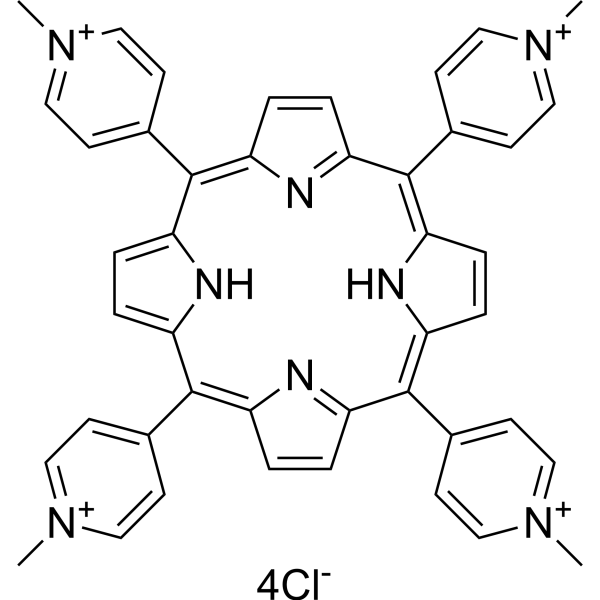
- Formula: C44H38Cl4N8
- Molecular Weight:820.64
-
Storage:
4°C, sealed storage, away from moisture
* In solvent : -80°C, 6 months; -20°C, 1 month (sealed storage, away from moisture)

To place orders, for customer services and technical support, please contact: MedChemExpress USA
Tel: 609-228-6898 E-mail: [email protected] [email protected]


-
 Biological Activity
-
Chemical Information
-
Solvent & Solubility
- Protocols
- Purity & Documentation
- References
-
 Help & FAQs


Publications Citing Use of MedChemExpress (MCE) TMPyP tetrachloride
More- Nat Commun. 2026 Feb 23;17(1):3076. [Abstract]
- Nat Commun. 2024 Oct 4;15(1):8602. [Abstract]
- Mol Cell. 2024 Jun 6;84(11):2070-2086.e20. [Abstract]
- Nucleic Acids Res. 2026 Jan 14;54(2):gkaf1481. [Abstract]
- Cell Death Dis. 2024 Nov 11;15(11):816. [Abstract]
- Int J Biol Macromol. 2025 Mar:296:139582. [Abstract]
- Anal Chem. 2025 Jun 10;97(22):11617-11626. [Abstract]
- Anal Chim Acta. 2026 Nov 8:1422:346110.
- Microbiol Spectr. 2022 Apr 21;e0046022. [Abstract]
- Biochemistry. 2024 Oct 15;63(20):2609-2620. [Abstract]
- Transbound Emerg Dis. 2026;2026(1):e5088147.
- Virology. 2025 Feb:603:110378. [Abstract]
 Customer Validation & Images

-
Bio/Physico-chemical Assay
-
Bio/Physico-chemical Assay
-
Bio/Physico-chemical Assay
-
Flow Cytometry
-
In Vivo Efficacy Study


Biological Activity
Description
In Vitro
TMPyP (50 µM, 96 h) tetrachloride inhibits telomerase activity in telomerase positive HOS cells[2].
TMPyP (50 µM, 48 or 96 h) tetrachloride inhibits the growth of HOS cells[2].
TMPyP (50 µM, 96 h) tetrachloride induces cell apoptosis in HOS, Saos-2, MG-63, and U2OS cell lines[2].
TMPyP4 (100 µM, 24 or 48 h) tetrachloride increases cell cycle regulatory proteins and MAPKs in K562 cells[4].
MedChemExpress (MCE) has not independently confirmed the accuracy of these methods. They are for reference only. Further protocols information, click here.
-
Cell Line:HOS cells
-
Concentration:50 µM
-
Incubation Time:48 or 96 h
-
Result:Time-dependently inhibited cell viability.
-
Cell Line:K562 cells
-
Concentration:100 µM
-
Incubation Time:24 or 48 h
-
Result:Increased the expression of p21CIP1 protein and p57KIP2 protein.
In Vivo
TMPyP (15 mg/kg or 30 mg/kg, i.n.) tetrachloride decreases the mean viral loads in SARS-CoV-2-infected hamster[6].
TMPyP (30 mg/kg, i.n., hamsters) tetrachloride shows a Cmax of 17.88 μg/mL at 1 h, and a half-life (T1/2) of 6.36 h[6].
MedChemExpress (MCE) has not independently confirmed the accuracy of these methods. They are for reference only.
-
Animal Model:MX-1 mammary chemoadjuvant model[5]
-
Dosage:10 and 20 mg/kg
-
Administration:Intraperitoneal injection (i.p.), twice weekly.
-
Result:Inhibited tumor growth and prolonged mice survival.
-
Animal Model:SARS-CoV-2-infected hamster[6]
-
Dosage:15 mg/kg or 30 mg/kg
-
Administration:i.n., starting at 1 h prior to virus inoculation and continuing until 3 days post infection
-
Result:Decreased the mean viral loads in the nasal wash, nasal turbinate and lung tissues.


Chemical Information
-
CAS No. 92739-63-4
-
Appearance Solid
-
Molecular Weight 820.64
-
Formula C44H38Cl4N8
-
Color Dark purple to black
-
SMILES
C[N+](C=C1)=CC=C1/C(C2=CC=C(/C(C3=CC=[N+](C)C=C3)=C4N=C(/C(C5=CC=[N+](C)C=C5)=C6C=C/C(N/6)=C7\C8=CC=[N+](C)C=C8)C=C\4)N2)=C9C=CC7=N\9.[4Cl-]
-
Shipping
Room temperature in continental US; may vary elsewhere.
-
Storage
4°C, sealed storage, away from moisture
* In solvent : -80°C, 6 months; -20°C, 1 month (sealed storage, away from moisture)


Publications (12)
-
Journal Impact Factor
-
Most Recent
-
Nat Commun
2026 Feb 23;17(1):3076. PMID: 41730904 -
Nat Commun
The G4 resolvase Dhx36 modulates cardiomyocyte differentiation and ventricular conduction system development. [Abstract]2024 Oct 4;15(1):8602. PMID: 39366945
TMPyP tetrachloride purchased from MedChemExpress. Usage Cited in: Nat Commun. 2024 Oct 4;15(1):8602. [Abstract]
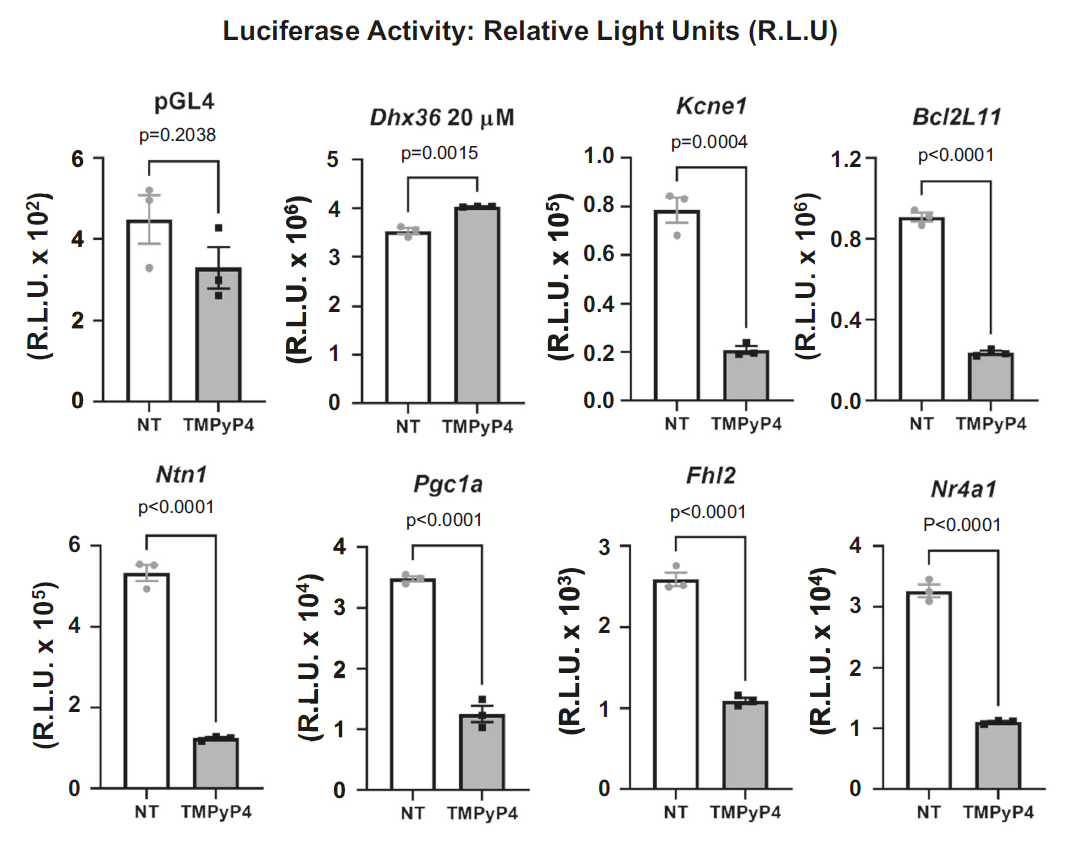
Luciferase transcriptional activation assays in HeLa cells of promoter regions of Dhx36, Kcne1, Bcl2l11, Ntn1, Ppargc1a (Pgc1a), Fhl2, and Nr4a1 cloned in pGL4.25 luciferase expressing vector. The luciferase activity, measured in Relative light units (R.L.U.) of the different constructs, are shown in the presence or absence of the G4 stabilization drug TMPyP4 tosylate (20 μM; 24 h).
-
Mol Cell
The MYCN oncoprotein is an RNA-binding accessory factor of the nuclear exosome targeting complex. [Abstract]2024 Jun 6;84(11):2070-2086.e20. PMID: 38703770 -
Nucleic Acids Res
RNA G-quadruplexes promote codon repeat-associated ribosomal frameshifting in human genes. [Abstract]2026 Jan 14;54(2):gkaf1481. PMID: 41543171
TMPyP tetrachloride purchased from MedChemExpress. Usage Cited in: Nucleic Acids Res. 2026 Jan 14;54(2):gkaf1481. [Abstract]
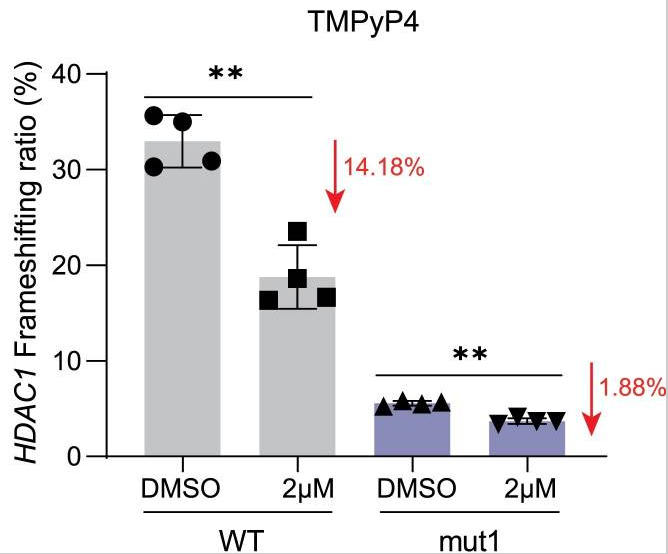
Treatment with TMPyP4 tosylate (2 μM; 26 h) resulted in a 14.18% reduction in the HDAC1 frameshifting ratio in HEK293T cells, whereas the mut1 rG4 mutant exhibited only a minimal reduction (1.88%) compared with the control group.
TMPyP tetrachloride purchased from MedChemExpress. Usage Cited in: Nucleic Acids Res. 2026 Jan 14;54(2):gkaf1481. [Abstract]
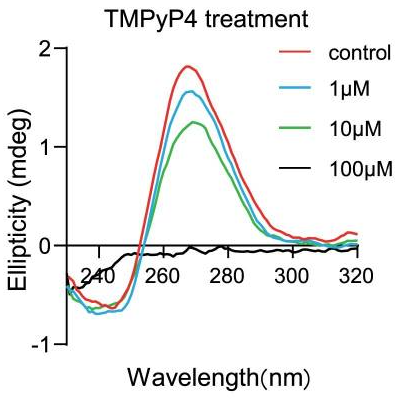
The G4-destabilizing porphyrin TMPyP4 tosylate (1-100 μM) induced a concentration-dependent shift in the spectral peak, indicating a transition of the higher order HDAC1 RNA structure to a linear form. Moreover, the high concentration (100 μM) of TMPyP4 disrupted the standard CD spectrum of the G4 structure.
-
Cell Death Dis
Targeting G-quadruplex by TMPyP4 for inhibition of colorectal cancer through cell cycle arrest and boosting anti-tumor immunity. [Abstract]2024 Nov 11;15(11):816. PMID: 39528472
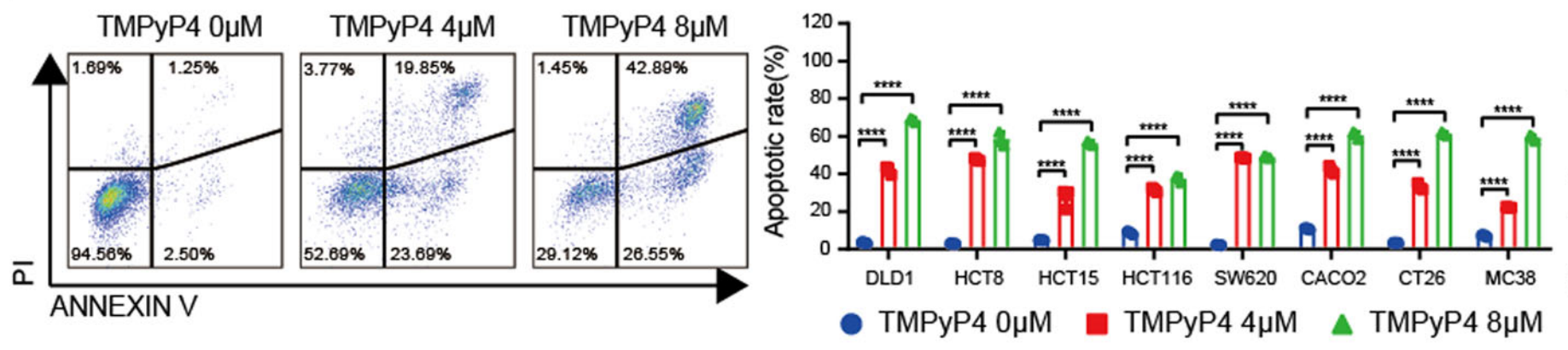
TMPyP tetrachloride purchased from MedChemExpress. Usage Cited in: Cell Death Dis. 2024 Nov 11;15(11):816. [Abstract]
TMPyP4 tosylate (4-8 μM; 48 h) induced a significant increase in apoptosis in CRC cell lines.
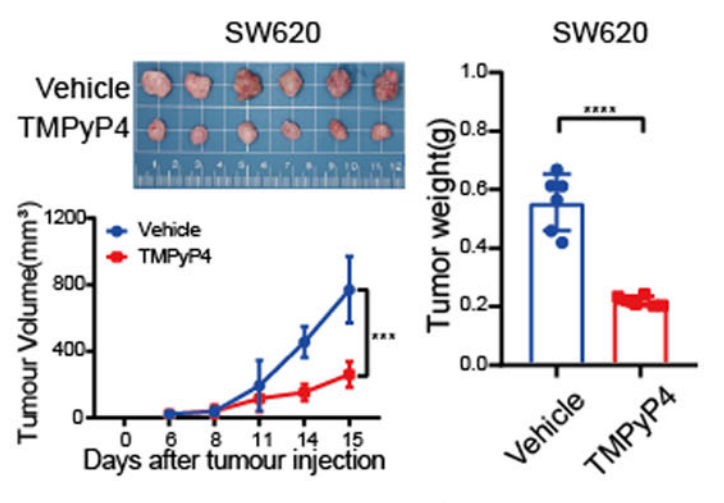
TMPyP tetrachloride purchased from MedChemExpress. Usage Cited in: Cell Death Dis. 2024 Nov 11;15(11):816. [Abstract]
TMPyP4 tosylate (30 mg/kg; i.p.; three times a week) markedly decreased tumor weights and volumes of BALB/c nude mice bearing SW620 colorectal tumors.
-
Int J Biol Macromol
2025 Mar:296:139582. PMID: 39798757 -
Anal Chem
2025 Jun 10;97(22):11617-11626. PMID: 40408126 -
-
Microbiol Spectr
Characterization of G-Quadruplexes in Enterovirus A71 Genome and Their Interaction with G-Quadruplex Ligands. [Abstract]2022 Apr 21;e0046022. PMID: 35446122 -
Biochemistry
G-Quadruplex-Mediated Transcriptional Regulation of SYT7: Implications for Tumor Progression and Therapeutic Strategies. [Abstract]2024 Oct 15;63(20):2609-2620. PMID: 39320967 -
-
Virology
The UP1 domain is essential for the facilitation effect of HnRNP A1 on PRRSV-2 replication. [Abstract]2025 Feb:603:110378. PMID: 39731905


Solvent & Solubility
In Vitro:
H2O : 50 mg/mL (60.93 mM; Need ultrasonic)
Please refer to the solubility information to select the appropriate solvent. Once prepared, please aliquot and store the solution to prevent product inactivation from repeated freeze-thaw cycles.
Storage method and period of stock solution: -80°C, 6 months; -20°C, 1 month (sealed storage, away from moisture). When stored at -80°C, please use it within 6 months. When stored at -20°C, please use it within 1 month.
* Note: If you choose water as the stock solution, please dilute it to the working solution, then filter and sterilize it with a 0.22 μm filter before use.
Please refer to the solubility information to select the appropriate solvent. Once prepared, please aliquot and store the solution to prevent product inactivation from repeated freeze-thaw cycles.
Storage method and period of stock solution: -80°C, 6 months; -20°C, 1 month (sealed storage, away from moisture). When stored at -80°C, please use it within 6 months. When stored at -20°C, please use it within 1 month.
* Note: If you choose water as the stock solution, please dilute it to the working solution, then filter and sterilize it with a 0.22 μm filter before use.
Concentration (start) × Volume (start) = Concentration (final) × Volume (final)

Protocols
-
Research Protocol for Infectious Diseases
Infectious-disease experiments test how pathogens interact with host barriers, innate immune receptors, inflammatory signaling, pathogen replication, and tissue injury; pattern-recognition receptors such as TLRs, RIG-I-like receptors, NOD-like receptors, and inflammasomes detect microbial molecules and activate NF-κB, interferon, and cytokine responses. The central hypothesis is that infection severity reflects the balance between pathogen burden and host response: protective inflammation restricts pathogen growth, whereas excessive or mislocalized inflammation contributes to tissue damage and disease phenotype. Unresolved questions include which host pathways are protective versus pathogenic, why some infection models fail to translate to human disease, and which combined readouts best predict clinically relevant infection outcomes.
-
Cell Viability Determination by MTT Colorimetric Assay
The following protocol uses the MTT colorimetric assay as a classic literature-established method for assessing cell viability/metabolic activity in cultured mammalian cells. MTT[3-(4,5-dimethylthiazol-2-yl)-2,5-diphenyltetrazolium bromide] is reduced by metabolically active cells to a colored formazan product; the amount of formazan is quantified spectrophotometrically and provides an indirect measure of metabolically active viable cells. Importantly, MTT reduction reflects cellular oxidoreductase/metabolic activity rather than an absolute direct count of living cells, so changes in cellular metabolism can alter the signal independently of cell number.


Purity & Documentation
-
Data Sheet (292 KB)
-
SDS (394 KB)
- English - EN (394 KB)
- Français - FR (394 KB)
- Deutsch - DE (394 KB)
- Norwegian - NO (394 KB)
- Español - ES (394 KB)
- Swedish - SV (394 KB)
- Italian - IT (394 KB)
- Korean - KR (394 KB)
- Portuguese - PT (394 KB)
-
Handling Instructions (2659 KB)
References
[1]. Chen H, et al. Insuline-like growth factor type I selectively binds to G-quadruplex structures. Biochim Biophys Acta Gen Subj. 2019 Jan;1863(1):31-38. [Content Brief]
[2]. Fujimori J, et al. Antitumor effects of telomerase inhibitor TMPyP4 in osteosarcoma cell lines. J Orthop Res. 2011 Nov;29(11):1707-11. [Content Brief]
[3]. Fujiwara N, et al. a Stabilizer of Nucleic Acid Secondary Structure, Is a Novel Acetylcholinesterase Inhibitor. PLoS One. 2015 Sep 24;10(9):e0139167. [Content Brief]
[4]. Mikami-Terao Y, et al. Antitumor activity of G-quadruplex-interactive agent TMPyP4 in K562 leukemic cells. Cancer Lett. 2008 Mar 18;261(2):226-34. [Content Brief]
[5]. Grand CL, et al. The cationic porphyrin TMPyP4 down-regulates c-MYC and human telomerase reverse transcriptase expression and inhibits tumor growth in vivo. Mol Cancer Ther. 2002 Jun;1(8):565-73. Erratum in: Mol Cancer Ther.2003 Feb;2(2):208. [Content Brief]
[6]. Qin G, et al. RNA G-quadruplex formed in SARS-CoV-2 used for COVID-19 treatment in animal models. Cell Discov. 2022 Sep 6;8(1):86. [Content Brief]


Complete Stock Solution Preparation Table
Please refer to the solubility information to select the appropriate solvent. Once prepared, please aliquot and store the solution to prevent product inactivation from repeated freeze-thaw cycles.
Storage method and period of stock solution: -80°C, 6 months; -20°C, 1 month (sealed storage, away from moisture). When stored at -80°C, please use it within 6 months. When stored at -20°C, please use it within 1 month.
| Optional Solvent | Concentration Solvent Mass | 1 mg | 5 mg | 10 mg | 25 mg |
|---|---|---|---|---|---|
| H2O | 1 mM | 1.2186 mL | 6.0928 mL | 12.1856 mL | 30.4640 mL |
| 5 mM | 0.2437 mL | 1.2186 mL | 2.4371 mL | 6.0928 mL | |
| 10 mM | 0.1219 mL | 0.6093 mL | 1.2186 mL | 3.0464 mL | |
| 15 mM | 0.0812 mL | 0.4062 mL | 0.8124 mL | 2.0309 mL | |
| 20 mM | 0.0609 mL | 0.3046 mL | 0.6093 mL | 1.5232 mL | |
| 25 mM | 0.0487 mL | 0.2437 mL | 0.4874 mL | 1.2186 mL | |
| 30 mM | 0.0406 mL | 0.2031 mL | 0.4062 mL | 1.0155 mL | |
| 40 mM | 0.0305 mL | 0.1523 mL | 0.3046 mL | 0.7616 mL | |
| 50 mM | 0.0244 mL | 0.1219 mL | 0.2437 mL | 0.6093 mL | |
| 60 mM | 0.0203 mL | 0.1015 mL | 0.2031 mL | 0.5077 mL |
* Note: If you choose water as the stock solution, please dilute it to the working solution, then filter and sterilize it with a 0.22 μm filter before use.


TMPyP tetrachloride Related Classifications
HY-W112938 Related Classifications
 Powered by Bioz