



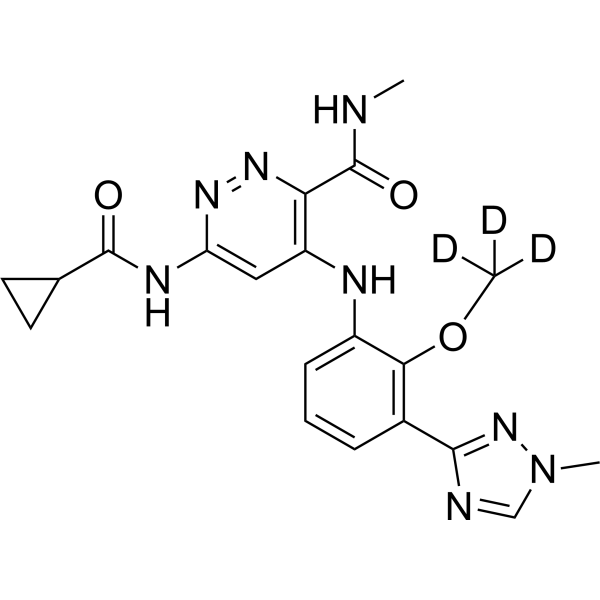
Fadeucravacitinib

Based on 1 Customer Validation
Fadeucravacitinib (Tyk2-IN-8) is an orally active selective TYK2 inhibitor with an IC50 of 5.7 nM against the JH2 pseudokinase domain. Fadeucravacitinib specifically binds to the TYK2 JH2 domain to exert allosteric inhibition, reduces JH1 kinase activity, and thereby blocks the TYK2/STAT pathway and pro-inflammatory signaling cascades. Fadeucravacitinib can be used in research related to inflammatory bowel disease.
For research use only. We do not sell to patients.
- Purity : 98.04%
- CAS No.: 2704587-24-4
- Formula: C20H19D3N8O3
- Molecular Weight:425.46
-
Storage:Powder -20°C, 3 years , 4°C, 2 years ; In solvent -80°C, 6 months , -20°C, 1 month

To place orders, for customer services and technical support, please contact: MedChemExpress USA
Tel: 609-228-6898 E-mail: [email protected] [email protected]


-
 Biological Activity
-
Chemical Information
-
Solvent & Solubility
- Protocols
- Purity & Documentation
- References
-
 Help & FAQs




Biological Activity
Description
IC50 & Target
[1]|
Tyk2 JH2 5.7 nM (IC50) |
IL-12 |
In Vitro
Fadeucravacitinib (0.31 μM-2.5 mM; 24 h) inhibits IL-12-induced IFN-γ secretion in NK92 cells[1].
Fadeucravacitinib (Compound 3) (61 nM - 1 mM; pre-incubated with JAK2 kinase for 15 minutes and with substrate for 30 minutes) inhibits the enzymatic activity of the recombinant human JAK2 kinase domain (JH1), with an IC50 of 3.0 μM[1].
Fadeucravacitinib exhibits extremely low inhibitory activity against the recombinant human TYK2 kinase domain (JH1) at concentrations ranging from 61 nM to 1 mM, with a pre-incubation time of 15 minutes with TYK2 kinase and a 40-minute incubation with the substrate; its IC50 is greater than 10 μM[1].
Fadeucravacitinib (61 nM - 1 mM; 30 min) potently binds to the recombinant human TYK2 pseudokinase domain (JH2), with an IC50 value of 5.7 nM[1].
MedChemExpress (MCE) has not independently confirmed the accuracy of these methods. They are for reference only. Further protocols information, click here.
-
Cell Line:NK92 cells
-
Concentration:0.31 μM - 2.5 mM (serial 4-fold dilutions, incubated with NK92 cells and IL-12 for 24 hours)
-
Incubation Time:24 h
-
Result:Inhibited IL-12-induced IFN-γ secretion in NK92 cells.
In Vivo
MedChemExpress (MCE) has not independently confirmed the accuracy of these methods. They are for reference only.
-
Animal Model:CB17-Scid mice (female, 8-10 weeks old, 18-20 g) were subjected to a single intraperitoneal injection of 100 μg FGK4.5 anti-CD40 monoclonal antibody (dissolved in PBS) to induce intestinal inflammation (colitis model)[1]
-
Dosage:1.5 mg/kg, 5 mg/kg, 15 mg/kg
-
Administration:p.o.; twice daily; administered from Day 0 to Day 7, a total of 8 days of treatment.
-
Result:Effectively protected the mice with induced colitis, significantly alleviating and preventing the severe body weight loss caused by the disease.
Significantly prevented inflammation-induced spleen enlargement in the mice.
Application
1. This compound can be used as a tracer
2. This compound can be used as an internal standard for quantitative analysis by NMR, GC-MS, or LC-MS.


Chemical Information
-
CAS No. 2704587-24-4
-
Unlabeled CAS 2417137-50-7
-
Appearance Solid
-
Molecular Weight 425.46
-
Formula C20H19D3N8O3
-
Color Off-white to gray
-
SMILES
[2H]C([2H])([2H])OC1=C(C2=NN(C)C=N2)C=CC=C1NC3=C(N=NC(NC(C4CC4)=O)=C3)C(NC)=O
-
Synonyms
Tyk2-IN-8
-
Shipping
Room temperature in continental US; may vary elsewhere.
-
Storage
Powder -20°C 3 years 4°C 2 years In solvent -80°C 6 months -20°C 1 month


Solvent & Solubility
In Vitro:
DMSO : 100 mg/mL (235.04 mM; ultrasonic and warming and heat to 80°C; Hygroscopic DMSO has a significant impact on the solubility of product, please use newly opened DMSO)
Please refer to the solubility information to select the appropriate solvent. Once prepared, please aliquot and store the solution to prevent product inactivation from repeated freeze-thaw cycles.
Storage method and period of stock solution: -80°C, 6 months; -20°C, 1 month. When stored at -80°C, please use it within 6 months. When stored at -20°C, please use it within 1 month.
Please refer to the solubility information to select the appropriate solvent. Once prepared, please aliquot and store the solution to prevent product inactivation from repeated freeze-thaw cycles.
Storage method and period of stock solution: -80°C, 6 months; -20°C, 1 month. When stored at -80°C, please use it within 6 months. When stored at -20°C, please use it within 1 month.
Concentration (start) × Volume (start) = Concentration (final) × Volume (final)

Protocols
-
Kinase activity and phosphorylation assays
Kinase activity assays measure the ability of kinases to transfer phosphate groups from ATP to specific substrates, while phosphorylation assays detect the presence and levels of phosphorylated proteins. Common methods include radiolabeled ATP incorporation (e. g. ,), ADP release detection via bioluminescence (e. g. ,[3]), enzyme-linked immunosorbent assays (ELISA) for phospho-specific epitopes (e. g. ,[6]), and microtiter-based formats for high-throughput screening (e. g. ,[8]). The ADP-Glo assay quantifies kinase activity by measuring ADP produced during phosphorylation using a luciferase-based system. Radiometric assays involve autoradiography or scintillation counting after incorporation of 32P-labeled ATP into substrate proteins. ELISA-based approaches rely on phospho-specific antibodies to detect activated kinases in cell lysates or purified samples.
-
Cell Cytotoxicity Assay
Cytotoxicity assays are usually based on the assessment of cell membrane damage, which can also be indirectly detected by measuring cell viability. Detection methods include MTT assay, CKK-8 assay, LDH assay and ATP assay, etc.
-
DSS-Induced Colitis
Dextran sulfate sodium (DSS)-induced colitis is generated by administering DSS in mouse drinking water, producing epithelial injury, barrier disruption, weight loss, diarrhea, fecal blood, colon shortening, histologic mucosal damage, and inflammatory mediator changes; the model is mainly used to study acute or chronic intestinal inflammation resembling selected features of ulcerative colitis. DSS injury is interpreted through clinical and tissue readouts rather than a single molecular endpoint: daily body weight, stool consistency, and bleeding are combined into a disease activity index, while colon length, histology, cytokines, myeloperoxidase activity, intestinal permeability, and tight-junction markers provide complementary measures of inflammation and barrier damage.
-
TNBS-Induced Colitis
TNBS-induced colitis is produced by intrarectal delivery of 2,4,6-trinitrobenzene sulfonic acid in ethanol, where ethanol disrupts the mucosal barrier and TNBS haptenates colonic proteins, generating immune-mediated colonic inflammation with weight loss, diarrhea, ulceration, transmural injury, inflammatory-cell infiltration, and cytokine responses. The model is used as an experimental intestinal inflammation model with Crohn’s disease–like features, especially when Th1-type responses, IL-12–dependent inflammation, chronic relapsing inflammation, or fibrosis-related endpoints are studied.
-
Protocol for Kinase activity and phosphorylation assays
Kinase activity assays measure transfer of phosphate from ATP to a protein or peptide substrate, generating phosphorylated substrate, ADP, or incorporated radiolabeled phosphate as the readout; phosphorylation assays measure site-specific phosphorylation in cells or tissues as a proxy for kinase-pathway activation, inhibition, or substrate regulation. Phosphorylation can be detected by phospho-specific Western blot, immunoprecipitation kinase assay, phospho-immunofluorescence, phospho-flow cytometry, luminescent ADP detection, radiolabeled ATP incorporation, or reporter-based pathway assays, and these readouts can be applied to cancer cells, primary neurons, mouse tumors, organoids, inflammatory macrophages, ferroptosis studies, and mitophagy studies when the kinase target is biologically relevant.
-
Research Protocol for Inflammation-related Diseases
The NLRP3 inflammasome is a cytosolic innate immune signaling platform that integrates priming signals and danger-signal activation to promote caspase-1 activation, maturation of IL-1β and IL-18, and gasdermin D-mediated pyroptotic cell death. The core experimental logic is to determine whether inflammatory disease phenotypes are driven by increased NLRP3 expression, ASC-containing inflammasome assembly, caspase-1 cleavage, GSDMD cleavage, and extracellular release of IL-1β/IL-18 rather than by nonspecific cell injury alone. The pathway is strongly linked to inflammation-related disease phenotypes because monosodium urate crystals activate NALP3/NLRP3 inflammasome signaling in gout-like crystal inflammation, cholesterol crystals activate NLRP3 inflammasomes in atherogenesis models, and DSS-induced intestinal inflammation has been reported to involve NLRP3 inflammasome activity. However, experimental colitis studies also show context-dependent protective effects of NLRP3 inflammasome co


Purity & Documentation
-
Data Sheet (290 KB)
-
SDS (251 KB)
- English - EN (251 KB)
- Français - FR (251 KB)
- Deutsch - DE (251 KB)
- Norwegian - NO (251 KB)
- Español - ES (251 KB)
- Swedish - SV (251 KB)
- Italian - IT (251 KB)
- Korean - KR (251 KB)
- Portuguese - PT (251 KB)
-
Handling Instructions (2659 KB)
References
[2]. Zhou Y, et al. Novel Small Molecule Tyrosine Kinase 2 Pseudokinase Ligands Block Cytokine-Induced TYK2-Mediated Signaling Pathways. Frontiers in immunology. 2022;13:884399. [Content Brief]
[3]. Modak S, et al. B7H3-Directed Intraperitoneal Radioimmunotherapy With Radioiodinated Omburtamab for Desmoplastic Small Round Cell Tumor and Other Peritoneal Tumors: Results of a Phase I Study. Journal of clinical oncology : official journal of the American Society of Clinical Oncology. 2020 Dec 20;38(36):4283-4291. [Content Brief]


Complete Stock Solution Preparation Table
Please refer to the solubility information to select the appropriate solvent. Once prepared, please aliquot and store the solution to prevent product inactivation from repeated freeze-thaw cycles.
Storage method and period of stock solution: -80°C, 6 months; -20°C, 1 month. When stored at -80°C, please use it within 6 months. When stored at -20°C, please use it within 1 month.
| Optional Solvent | Concentration Solvent Mass | 1 mg | 5 mg | 10 mg | 25 mg |
|---|---|---|---|---|---|
| DMSO | 1 mM | 2.3504 mL | 11.7520 mL | 23.5040 mL | 58.7599 mL |
| 5 mM | 0.4701 mL | 2.3504 mL | 4.7008 mL | 11.7520 mL | |
| 10 mM | 0.2350 mL | 1.1752 mL | 2.3504 mL | 5.8760 mL | |
| 15 mM | 0.1567 mL | 0.7835 mL | 1.5669 mL | 3.9173 mL | |
| 20 mM | 0.1175 mL | 0.5876 mL | 1.1752 mL | 2.9380 mL | |
| 25 mM | 0.0940 mL | 0.4701 mL | 0.9402 mL | 2.3504 mL | |
| 30 mM | 0.0783 mL | 0.3917 mL | 0.7835 mL | 1.9587 mL | |
| 40 mM | 0.0588 mL | 0.2938 mL | 0.5876 mL | 1.4690 mL | |
| 50 mM | 0.0470 mL | 0.2350 mL | 0.4701 mL | 1.1752 mL | |
| 60 mM | 0.0392 mL | 0.1959 mL | 0.3917 mL | 0.9793 mL | |
| 80 mM | 0.0294 mL | 0.1469 mL | 0.2938 mL | 0.7345 mL | |
| 100 mM | 0.0235 mL | 0.1175 mL | 0.2350 mL | 0.5876 mL |


Fadeucravacitinib Related Classifications
HY-144031S Related Classifications
 Powered by Bioz