



UBX1325

Based on 1 Customer Validation
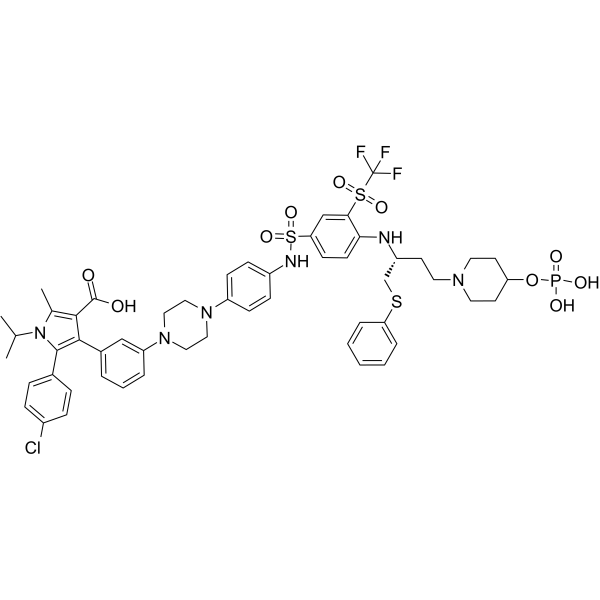
UBX1325 is an Bcl-xL inhibitor that promotes apoptosis in senescent cells. UBX1325 is a potent anti-aging agent that can be used in studies of age-related eye diseases such as diabetic macular oedema (DME), age-related macular degeneration (AMD) and diabetic retinopathy (DR).
Nur für Forschungszwecke. Wir verkaufen nicht an Patienten.
- Reinheit : 99.16%
- CAS. Nr.: 2271269-01-1
- Formel: C53H59ClF3N6O10PS3
- Molecular Weight:1159.69
-
Speicherung:
-20°C, sealed storage, away from moisture
* In solvent : -80°C, 6 months; -20°C, 1 month (sealed storage, away from moisture)

To place orders, for customer services and technical support, please contact: MedChemExpress USA
Tel: 609-228-6898 E-mail: [email protected] [email protected]


-
 Biologische Aktivität
-
Chemical Information
-
Lösungsmittel & Löslichkeit
- Protokoll
- Reinheit & Dokumentation
- Verweise
-
 Help & FAQs




Biologische Aktivität
Beschreibung
In Vitro
UBX1325 leads to a decrease in the anti-apoptotic Bcl-xL:Bim complex in retina by intravitreal (IVT) injection administration in oxygen induced retinopathy (OIR) C57BL/6 mice model[1].
UBX1325 can cause a decrease in retinal vascular permeability and promote retinal neovascularization in streptozotocin (STZ)-induced retinopathy mice model[1].
MedChemExpress (MCE) has not independently confirmed the accuracy of these methods. They are for reference only.
Clinical Trial
| NCT Number | Sponsor | Condition | Start Date |
Phase

|
|---|---|---|---|---|
| NCT01329991 | 2011-05 | PHASE1 |


Chemical Information
-
CAS. Nr. 2271269-01-1
-
Appearance Solid
-
Molecular Weight 1159.69
-
Formel C53H59ClF3N6O10PS3
-
Color White to light yellow
-
SMILES
CC1=C(C(C2=CC=CC(N3CCN(CC3)C4=CC=C(C=C4)NS(=O)(C5=CC=C(C(S(=O)(C(F)(F)F)=O)=C5)N[C@@H](CSC6=CC=CC=C6)CCN7CCC(CC7)OP(O)(O)=O)=O)=C2)=C(N1C(C)C)C8=CC=C(C=C8)Cl)C(O)=O
-
Versand
Room temperature in continental US; may vary elsewhere.
-
Speicherung
-20°C, sealed storage, away from moisture
* In solvent : -80°C, 6 months; -20°C, 1 month (sealed storage, away from moisture)


Lösungsmittel & Löslichkeit
In Vitro:
DMSO : 100 mg/mL (86.23 mM; Need ultrasonic; Hygroscopic DMSO has a significant impact on the solubility of product, please use newly opened DMSO)
Please refer to the solubility information to select the appropriate solvent. Once prepared, please aliquot and store the solution to prevent product inactivation from repeated freeze-thaw cycles.
Storage method and period of stock solution: -80°C, 6 months; -20°C, 1 month (sealed storage, away from moisture). When stored at -80°C, please use it within 6 months. When stored at -20°C, please use it within 1 month.
Please refer to the solubility information to select the appropriate solvent. Once prepared, please aliquot and store the solution to prevent product inactivation from repeated freeze-thaw cycles.
Storage method and period of stock solution: -80°C, 6 months; -20°C, 1 month (sealed storage, away from moisture). When stored at -80°C, please use it within 6 months. When stored at -20°C, please use it within 1 month.
Konzentration (Stammlösung) × Volumen (Stammlösung) = Konzentration (Ziellösung) × Volumen (Ziellösung)
In Vivo:
Select the appropriate dissolution method based on your experimental animal and administration route.
- For the following dissolution methods, please ensure to first prepare a clear stock solution using an In Vitro approach and then sequentially add co-solvents:
- To ensure reliable experimental results, the clarified stock solution can be appropriately stored based on storage conditions. As for the working solution for In Vivo experiments, it is recommended to prepare freshly and use it on the same day.
- The percentages shown for the solvents indicate their volumetric ratio in the final prepared solution. If precipitation or phase separation occurs during preparation, heat and/or sonication can be used to aid dissolution.
In Vivo Dissolution Calculator
Please enter the basic information of animal experiments:
-
-
-
-
Recommended: Prepare an additional quantity of animals to account for potential losses during experiments.
Please enter your animal formula composition:
-
%DMSO +
Recommended: Keep the proportion of DMSO in working solution below 2% if your animal is weak.
-
%+
-
+%Tween-80 + +
-
%Saline +
The co-solvents required include: DMSO, . All of co-solvents are available by MedChemExpress (MCE). , Tween 80. All of co-solvents are available by MedChemExpress (MCE).
Working solution concentration: 0.22 mg/mL
Method for preparing stock solution: mg drug dissolved in μL DMSO. Stock solution concentration: mg/mL. * In solvent : -80°C, 6 months; -20°C, 1 month (sealed storage, away from moisture)
1. Take μL DMSO stock solution;
2. Add μL .
μL , mix evenly;
3. Then add μL Tween 80, mix evenly;
4. Then add μL
Please ensure that the stock solution in the first step is dissolved to a clear state, and add co-solvents in sequence. You can use ultrasonic heating (ultrasonic cleaner, recommended frequency 20-40 kHz), vortexing, etc. to assist dissolution.


Reinheit & Dokumentation
-
Data Sheet (273 KB)
-
SDS (252 KB)
- English - EN (252 KB)
- Français - FR (252 KB)
- Deutsch - DE (252 KB)
- Norwegian - NO (252 KB)
- Español - ES (252 KB)
- Swedish - SV (252 KB)
- Italian - IT (252 KB)
- Korean - KR (252 KB)
- Portuguese - PT (252 KB)
-
Handling Instructions (2659 KB)
Verweise


Complete Stock Solution Preparation Table
Please refer to the solubility information to select the appropriate solvent. Once prepared, please aliquot and store the solution to prevent product inactivation from repeated freeze-thaw cycles.
Storage method and period of stock solution: -80°C, 6 months; -20°C, 1 month (sealed storage, away from moisture). When stored at -80°C, please use it within 6 months. When stored at -20°C, please use it within 1 month.
| Optional Solvent | Concentration Solvent Mass | 1 mg | 5 mg | 10 mg | 25 mg |
|---|---|---|---|---|---|
| DMSO | 1 mM | 0.8623 mL | 4.3115 mL | 8.6230 mL | 21.5575 mL |
| 5 mM | 0.1725 mL | 0.8623 mL | 1.7246 mL | 4.3115 mL | |
| 10 mM | 0.0862 mL | 0.4311 mL | 0.8623 mL | 2.1557 mL | |
| 15 mM | 0.0575 mL | 0.2874 mL | 0.5749 mL | 1.4372 mL | |
| 20 mM | 0.0431 mL | 0.2156 mL | 0.4311 mL | 1.0779 mL | |
| 25 mM | 0.0345 mL | 0.1725 mL | 0.3449 mL | 0.8623 mL | |
| 30 mM | 0.0287 mL | 0.1437 mL | 0.2874 mL | 0.7186 mL | |
| 40 mM | 0.0216 mL | 0.1078 mL | 0.2156 mL | 0.5389 mL | |
| 50 mM | 0.0172 mL | 0.0862 mL | 0.1725 mL | 0.4311 mL | |
| 60 mM | 0.0144 mL | 0.0719 mL | 0.1437 mL | 0.3593 mL | |
| 80 mM | 0.0108 mL | 0.0539 mL | 0.1078 mL | 0.2695 mL |


UBX1325 Related Classifications
HY-150069 Related Classifications
 Powered by Bioz