



UDP-GlcNAc
Based on 8 publication(s) in Google Scholar
UDP-GlcNAc (UDP-N-Acetyl-D-glucosamine) is an important component and precursor of bacterial peptidoglycan. UDP-GlcNAc is a nucleotide sugar used by Glycosyltransferases to synthesize glycoproteins, glycosaminoglycans, glycolipids, and glycoRNA. UDP-GlcNAc also serves as the donor substrate for forming O-GlcNAc, a dynamic intracellular protein modification involved in diverse signaling and disease processes. UDP-GlcNAc is the sugar nucleotide donor for the synthesis of O-GlcNAc modified proteins. UDP-GlcNAc also acts as a full agonist of the P2Y14 receptor and inhibits the formation of cAMP. UDP-GlcNAc can be used in studies related to bacterial infections.
연구목적의 판매만을 진행합니다. 환자를 대상으로 한 판매는 하지 않습니다.
- CAS No.: 528-04-1
- 화학식: C17H27N3O17P2
- 분자량:607.35
-
보관:
Please store the product under the recommended conditions in the Certificate of Analysis.


To place orders, for customer services and technical support, please contact: MedChemExpress USA
Tel: 609-228-6898 E-mail: [email protected] [email protected]


-
 Biological Activity
-
Chemical Information
- 순도&문서
- References
-
 Help & FAQs




Publications Citing Use of MedChemExpress (MCE) UDP-GlcNAc
More- Signal Transduct Target Ther. 2023 Feb 10;8(1):63. [Abstract]
- Cancer Res. 2025 Mar 14;85(6):1113-1129. [Abstract]
- Plant Cell. 2026 May 14:koag144. [Abstract]
- Int J Biol Sci. 2022 Jun 21;18(10):4135-4150. [Abstract]
- Dev Cell. 2025 Sep 3:S1534-5807(25)00530-1. [Abstract]
- Mol Med. 2024 Oct 18;30(1):180. [Abstract]
- PLoS Pathog. 2026 Jun 25;22(6):e1014301. [Abstract]
- Laurea Magistrale in Biomedical Engineering, Politecnico di Milano. 2019 Jun.
 Customer Validation & Images

-
Cell Proliferation/Viability Assay
-
Apoptosis Analysis
-
WB
All P2Y Receptor Isoforms
MoreAll Endogenous Metabolite Isoforms
More

Biological Activity
제품 설명
IC50 & Target
[1]|
P2Y14 Receptor |
In Vitro
UDP-GlcNAc acts as a full agonist of the hP2Y14 receptor in P2Y14-HEK293 cells, inhibiting Forskolin-stimulated cAMP accumulation with an EC50 of 919 nM and a maximum inhibition rate of 58%[2].
UDP-GlcNAc (at different concentrations; 15 min) acts as a full agonist of the hP2Y14 receptor in P2Y14-C6 rat glioma cells, inhibiting Forskolin-stimulated cAMP accumulation with an EC50 of 225 nM and a maximum inhibition rate of 74%[2].
MedChemExpress (MCE) has not independently confirmed the accuracy of these methods. They are for reference only.


Chemical Information
-
CAS No. 528-04-1
-
분자량 607.35
-
화학식 C17H27N3O17P2
-
SMILES
O[C@H]1[C@@H](O)[C@H](N2C(NC(C=C2)=O)=O)O[C@@H]1COP(OP(O[C@@H]3[C@@H]([C@H]([C@@H]([C@H](O3)CO)O)O)NC(C)=O)(O)=O)(O)=O
-
Synonyms
UDP-N-Acetyl-D-glucosamine; Uridine diphospho-N-acetylglucosamine; UDP-N-acetylglucosamine
-
Structure Classification
-
선적
Room temperature in continental US; may vary elsewhere.
-
보관
Please store the product under the recommended conditions in the Certificate of Analysis.


Publications (8)
-
Journal Impact Factor
-
Most Recent
-
Signal Transduct Target Ther
O-GlcNAcylation of YTHDF2 promotes HBV-related hepatocellular carcinoma progression in an N6-methyladenosine-dependent manner. [Abstract]2023 Feb 10;8(1):63. PMID: 36765030 -
Cancer Res
MTHFD2 Enhances cMYC O-GlcNAcylation to Promote Sunitinib Resistance in Renal Cell Carcinoma. [Abstract]2025 Mar 14;85(6):1113-1129. PMID: 39804969
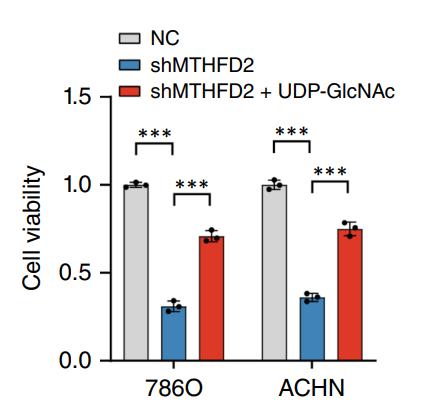
UDP-GlcNAc purchased from MedChemExpress. Usage Cited in: Cancer Res. 2025 Mar 14;85(6):1113-1129. [Abstract]
MTHFD2 knockdown cells and control cells were treated with sunitinib (10 μM) and UDP-GlcNAc (10 μM) for 48 hours. Cell viability (n = 3).
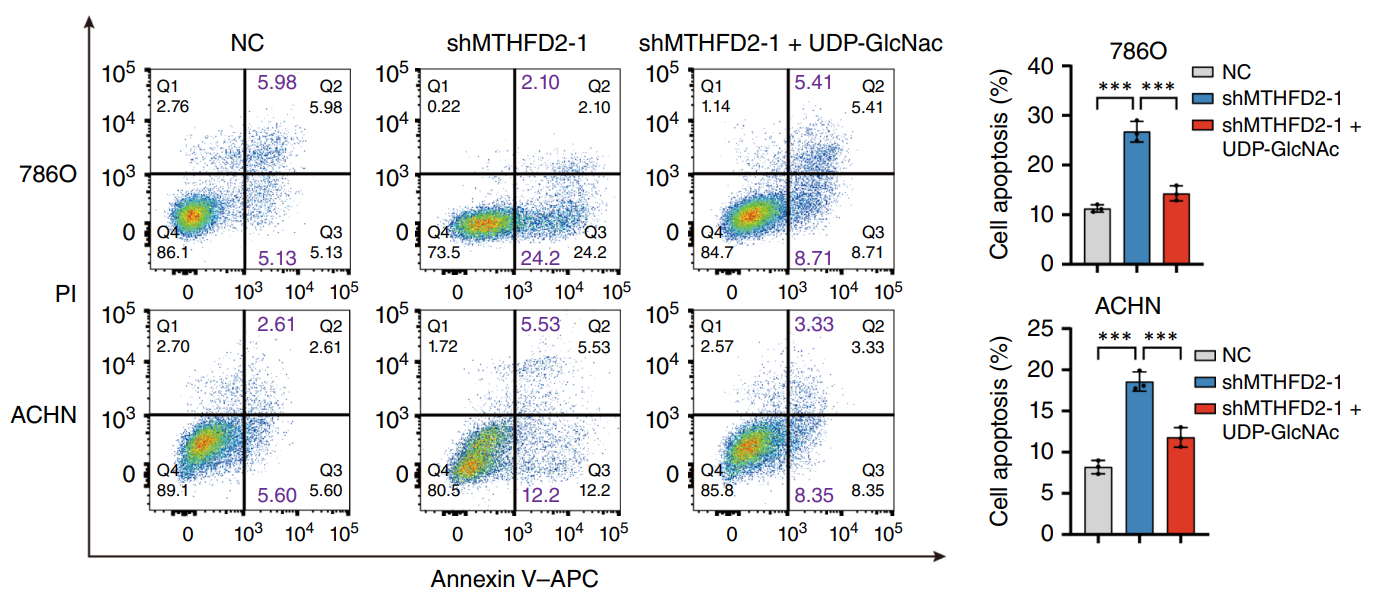
UDP-GlcNAc purchased from MedChemExpress. Usage Cited in: Cancer Res. 2025 Mar 14;85(6):1113-1129. [Abstract]
MTHFD2 knockdown cells and control cells were treated with sunitinib (10 μmol/L) and UDP-GlcNAc (10 μmol/L) for 48 hours. Cell apoptosis (n = 3) were used to assess the killing capacity of sunitinib. PI, propidium iodide. G, Relative levels of metabolites in MTHFD2 knockdown cells measured by untargeted metabolomics (n = 6). F6P, fructose-6-phosphate;
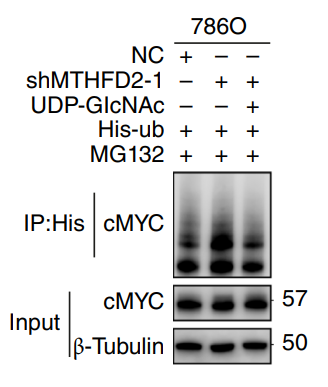
UDP-GlcNAc purchased from MedChemExpress. Usage Cited in: Cancer Res. 2025 Mar 14;85(6):1113-1129. [Abstract]
Immunoblotting analysis of whole cell lysate (input) and His pull-down products derived from 786O cells transfected with indicated constructs and treated with MG132 (10 μmol/L) for 6 hours after cells were treated with or without UDP-GlcNAc (10 μM) for 24 hours. NC, negative control. The results showed that UDP-GlcNAc could reverse the increased c-MYC ubiquitination resulting from the silencing of MTHFD2 expression.
-
Plant Cell
SlSEC1- and SlSPY-mediated O-glycosylation stabilizes the transcription factor SlNOR to promote tomato fruit ripening. [Abstract]2026 May 14:koag144. PMID: 42135064 -
Int J Biol Sci
2022 Jun 21;18(10):4135-4150. PMID: 35844792 -
Dev Cell
A pathological role of O-GlcNAcylation-driven TR11B production and function in lung adenocarcinoma. [Abstract]2025 Sep 3:S1534-5807(25)00530-1. PMID: 40930100 -
Mol Med
New perspectives on YTHDF2 O-GlcNAc modification in the pathogenesis of intervertebral disc degeneration. [Abstract]2024 Oct 18;30(1):180. PMID: 39425013 -
PLoS Pathog
2026 Jun 25;22(6):e1014301. PMID: 42348500 -


순도&문서
References
[1]. Wyllie JA, et al. Biosynthesis of uridine diphosphate N-Acetylglucosamine: An underexploited pathway in the search for novel antibiotics?. IUBMB Life. 2022;74(12):1232-1252. [Content Brief]
[2]. Fricks IP, et al. Gi-dependent cell signaling responses of the human P2Y14 receptor in model cell systems. J Pharmacol Exp Ther. 2009;330(1):162-168. [Content Brief]
[3]. Li Z, et al. Genetically Encoded Green Fluorescent Biosensors for Monitoring UDP-GlcNAc in Live Cells. ACS Cent Sci. 2021 Oct 27;7(10):1763-1770. [Content Brief]

Calculators
Concentration (start) × Volume (start) = Concentration (final) × Volume (final)


UDP-GlcNAc Related Classifications
HY-148596 Related Classifications
 Powered by Bioz
Keywords
- UDP-GlcNAc
- 528-04-1
- UDP-N-Acetyl-D-glucosamine
- Uridine diphospho-N-acetylglucosamine
- UDP-N-acetylglucosamine
- P2Y Receptor
- Glycosyltransferase
- Drug Intermediate
- Endogenous Metabolite
- human P2Y14 receptor
- lipopolysaccharides
- bacterial peptidoglycan
- kanamycin
- teichoic acid
- glycoproteins
- neomycin
- eukaryotic chitin
- P2Y14-HEK293 cells
- gentamycin
- Inhibitor
- inhibitor
- inhibit