



Vasicine hydrochloride
Based on 2 publication(s) in Google Scholar
Vasicine hydrochloride (peganine hydrochloride) is a quinazoline alkaloid isolated from Justicia adhatoda. Vasicine hydrochloride activates PI3K/Akt signaling pathway, exhibits antioxidant, anti-inflammatory and antibacterial activities.
Nur für Forschungszwecke. Wir verkaufen nicht an Patienten.
- Reinheit : 98.62%
- CAS. Nr.: 7174-27-8
- Formel: C11H13ClN2O
- Molecular Weight:224.69
-
Speicherung:
4°C, sealed storage, away from moisture
* In solvent : -80°C, 6 months; -20°C, 1 month (sealed storage, away from moisture)


To place orders, for customer services and technical support, please contact: MedChemExpress USA
Tel: 609-228-6898 E-mail: [email protected] [email protected]


-
 Biologische Aktivität
-
Chemical Information
-
Lösungsmittel & Löslichkeit
- Reinheit & Dokumentation
- Verweise
-
 Help & FAQs


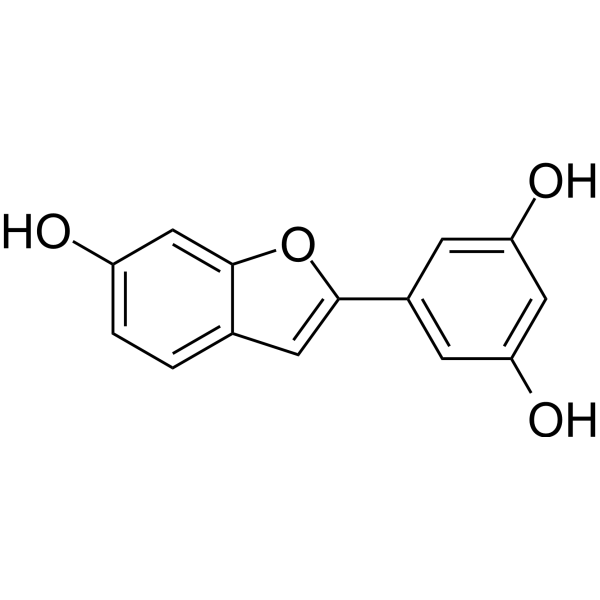

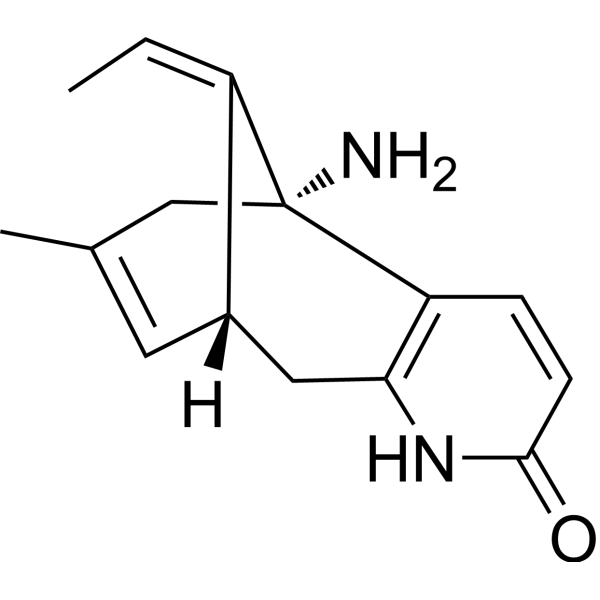
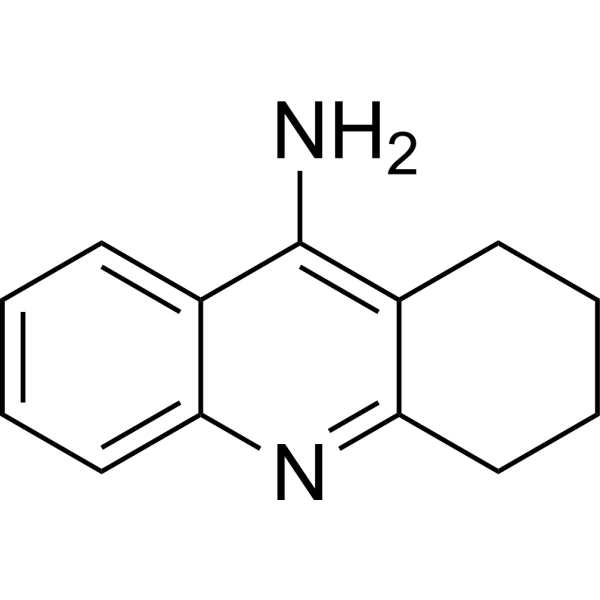
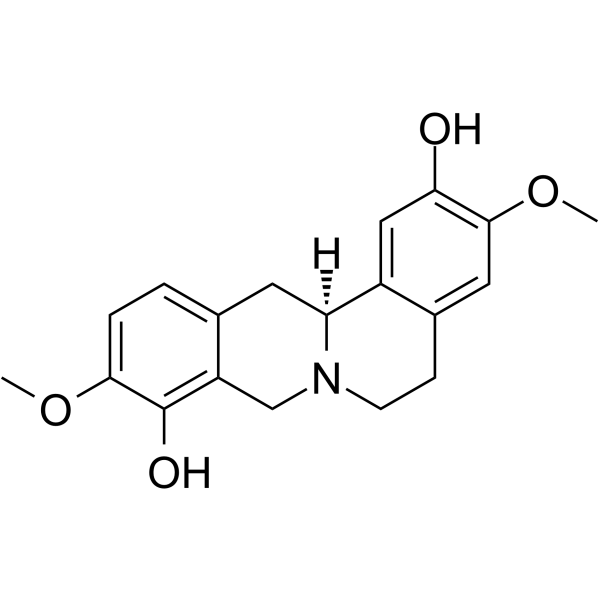

Publications Citing Use of MedChemExpress (MCE) Vasicine hydrochloride
More

Biologische Aktivität
Beschreibung
In Vitro
Vasicine hydrochloride (10-100 μg/mL, 10 min) exhibits a moderate inhibitory activity against H+/K+-ATPase (IC50=73.47 μg/mL), scavenges DPPH free radical (IC50=71.97 μg/mL), reduces gastric acid secretion and exhibits anti-ulcer effect[3].
MedChemExpress (MCE) has not independently confirmed the accuracy of these methods. They are for reference only.
In Vivo
MedChemExpress (MCE) has not independently confirmed the accuracy of these methods. They are for reference only.
-
Animal Model:Isoproterenol-induced rats myocardial infarction models[2]
-
Dosage:2.5-10 mg/kg
-
Administration:po, once daily for 7 days
-
Result:Reduced the levels of serum lactate dehydrogenase (LDH) and creatine kinase-MB (CK-MB).
Increased left ventricular systolic pressure (LVSP) and myocardial contractility, and reduced infarct size.
Reduced the levels of serum TNF-α and IL-6.
Increased the activities of SOD and glutathione peroxidase (GPx) in myocardial tissue, reduced the levels of MDA and MPO.
Increased the thickness of the left ventricular posterior wall and the left ventricular mass.
Inhibited myocardial cell apoptosis.


Chemical Information
-
CAS. Nr. 7174-27-8
-
Appearance Solid
-
Molecular Weight 224.69
-
Formel C11H13ClN2O
-
Color White to off-white
-
SMILES
O[C@H]1CCN2C1=NC3=C(C=CC=C3)C2.[H]Cl
-
Synonyms
Peganine hydrochloride
-
Structure Classification
-
Versand
Room temperature in continental US; may vary elsewhere.
-
Speicherung
4°C, sealed storage, away from moisture
* In solvent : -80°C, 6 months; -20°C, 1 month (sealed storage, away from moisture)


Publications (2)
-
Journal Impact Factor
-
Most Recent
-
Neuropharmacology
Novel mechanism of hypidone hydrochloride (YL-0919) in Parkinson's disease: inhibiting neuronal ferroptosis by targeting the Sigma1R-PI3K-AKT-ACSL4 axis. [Abstract]2026 Jul 1:292:110950. PMID: 41887568 -
Cell Signal
2026 Apr:140:112348. PMID: 41519217


Lösungsmittel & Löslichkeit
In Vitro:
DMSO : 100 mg/mL (445.06 mM; Need ultrasonic; Hygroscopic DMSO has a significant impact on the solubility of product, please use newly opened DMSO)
Please refer to the solubility information to select the appropriate solvent. Once prepared, please aliquot and store the solution to prevent product inactivation from repeated freeze-thaw cycles.
Storage method and period of stock solution: -80°C, 6 months; -20°C, 1 month (sealed storage, away from moisture). When stored at -80°C, please use it within 6 months. When stored at -20°C, please use it within 1 month.
Please refer to the solubility information to select the appropriate solvent. Once prepared, please aliquot and store the solution to prevent product inactivation from repeated freeze-thaw cycles.
Storage method and period of stock solution: -80°C, 6 months; -20°C, 1 month (sealed storage, away from moisture). When stored at -80°C, please use it within 6 months. When stored at -20°C, please use it within 1 month.
Konzentration (Stammlösung) × Volumen (Stammlösung) = Konzentration (Ziellösung) × Volumen (Ziellösung)
In Vivo:
Select the appropriate dissolution method based on your experimental animal and administration route.
- For the following dissolution methods, please ensure to first prepare a clear stock solution using an In Vitro approach and then sequentially add co-solvents:
- To ensure reliable experimental results, the clarified stock solution can be appropriately stored based on storage conditions. As for the working solution for In Vivo experiments, it is recommended to prepare freshly and use it on the same day.
- The percentages shown for the solvents indicate their volumetric ratio in the final prepared solution. If precipitation or phase separation occurs during preparation, heat and/or sonication can be used to aid dissolution.
Add each solvent one by one: 10% DMSO 40% PEG300 5% Tween-80 45% Saline
Solubility: ≥ 2.17 mg/mL (9.66 mM); Clear solution
This protocol yields a clear solution of ≥ 2.17 mg/mL (saturation unknown).
Taking 1 mL working solution as an example, add 100 μL DMSO stock solution (21.7 mg/mL) to 400 μL PEG300, and mix evenly; then add 50 μL Tween-80 and mix evenly; then add 450 μL Saline to adjust the volume to 1 mL.
Preparation of Saline: Dissolve 0.9 g sodium chloride in ddH₂O and dilute to 100 mL to obtain a clear Saline solution.
Add each solvent one by one: 10% DMSO 90% (20% SBE-β-CD in Saline)
Solubility: ≥ 2.17 mg/mL (9.66 mM); Clear solution
This protocol yields a clear solution of ≥ 2.17 mg/mL (saturation unknown).
Taking 1 mL working solution as an example, add 100 μL DMSO stock solution (21.7 mg/mL) to 900 μL 20% SBE-β-CD in Saline, and mix evenly.
Preparation of 20% SBE-β-CD in Saline (4°C, storage for one week): 2 g SBE-β-CD powder is dissolved in 10 mL Saline, completely dissolve until clear.
For the following dissolution methods, please prepare the working solution directly:
It is recommended to prepare fresh solutions and use them promptly within a short period of time.
The percentages shown for the solvents indicate their volumetric ratio in the final prepared solution. If precipitation or phase separation occurs during preparation, heat and/or sonication can be used to aid dissolution.
Add each solvent one by one: PBS
Solubility: 50 mg/mL (222.53 mM); Clear solution; Need ultrasonic
In Vivo Dissolution Calculator
Please enter the basic information of animal experiments:
-
-
-
-
Recommended: Prepare an additional quantity of animals to account for potential losses during experiments.
Please enter your animal formula composition:
-
%DMSO +
Recommended: Keep the proportion of DMSO in working solution below 2% if your animal is weak.
-
%+
-
+%Tween-80 + +
-
%Saline +
The co-solvents required include: DMSO, . All of co-solvents are available by MedChemExpress (MCE). , Tween 80. All of co-solvents are available by MedChemExpress (MCE).
Working solution concentration: 0.22 mg/mL
Method for preparing stock solution: mg drug dissolved in μL DMSO. Stock solution concentration: mg/mL. * In solvent : -80°C, 6 months; -20°C, 1 month (sealed storage, away from moisture)
1. Take μL DMSO stock solution;
2. Add μL .
μL , mix evenly;
3. Then add μL Tween 80, mix evenly;
4. Then add μL
Please ensure that the stock solution in the first step is dissolved to a clear state, and add co-solvents in sequence. You can use ultrasonic heating (ultrasonic cleaner, recommended frequency 20-40 kHz), vortexing, etc. to assist dissolution.


Reinheit & Dokumentation
-
Data Sheet (279 KB)
-
SDS (393 KB)
- English - EN (393 KB)
- Français - FR (393 KB)
- Deutsch - DE (393 KB)
- Norwegian - NO (393 KB)
- Español - ES (393 KB)
- Swedish - SV (393 KB)
- Italian - IT (393 KB)
- Korean - KR (393 KB)
- Portuguese - PT (393 KB)
-
Handling Instructions (2659 KB)
Verweise
[1]. Grange JM, et al. Activity of bromhexine and ambroxol, semi-synthetic derivatives of vasicine from the Indian shrub Adhatoda vasica, against Mycobacterium tuberculosis in vitro. J Ethnopharmacol. 1996 Jan;50(1):49-53. [Content Brief]
[2]. Jiang T, et al., Protective Effect Of Vasicine Against Myocardial Infarction In Rats Via Modulation Of Oxidative Stress, Inflammation, And The PI3K/Akt Pathway. Drug Des Devel Ther. 2019 Oct 31;13:3773-3784. [Content Brief]
[3]. Singh VK, et al., Anti-secretory and cyto-protective effects of peganine hydrochloride isolated from the seeds of Peganum harmala on gastric ulcers. Phytomedicine. 2013 Oct 15;20(13):1180-5. [Content Brief]


Complete Stock Solution Preparation Table
Please refer to the solubility information to select the appropriate solvent. Once prepared, please aliquot and store the solution to prevent product inactivation from repeated freeze-thaw cycles.
Storage method and period of stock solution: -80°C, 6 months; -20°C, 1 month (sealed storage, away from moisture). When stored at -80°C, please use it within 6 months. When stored at -20°C, please use it within 1 month.
| Optional Solvent | Concentration Solvent Mass | 1 mg | 5 mg | 10 mg | 25 mg |
|---|---|---|---|---|---|
| DMSO | 1 mM | 4.4506 mL | 22.2529 mL | 44.5058 mL | 111.2644 mL |
| 5 mM | 0.8901 mL | 4.4506 mL | 8.9012 mL | 22.2529 mL | |
| 10 mM | 0.4451 mL | 2.2253 mL | 4.4506 mL | 11.1264 mL | |
| 15 mM | 0.2967 mL | 1.4835 mL | 2.9671 mL | 7.4176 mL | |
| 20 mM | 0.2225 mL | 1.1126 mL | 2.2253 mL | 5.5632 mL | |
| 25 mM | 0.1780 mL | 0.8901 mL | 1.7802 mL | 4.4506 mL | |
| 30 mM | 0.1484 mL | 0.7418 mL | 1.4835 mL | 3.7088 mL | |
| 40 mM | 0.1113 mL | 0.5563 mL | 1.1126 mL | 2.7816 mL | |
| 50 mM | 0.0890 mL | 0.4451 mL | 0.8901 mL | 2.2253 mL | |
| 60 mM | 0.0742 mL | 0.3709 mL | 0.7418 mL | 1.8544 mL | |
| 80 mM | 0.0556 mL | 0.2782 mL | 0.5563 mL | 1.3908 mL | |
| 100 mM | 0.0445 mL | 0.2225 mL | 0.4451 mL | 1.1126 mL |


Vasicine hydrochloride Related Classifications
HY-N1103A Related Classifications
 Powered by Bioz