



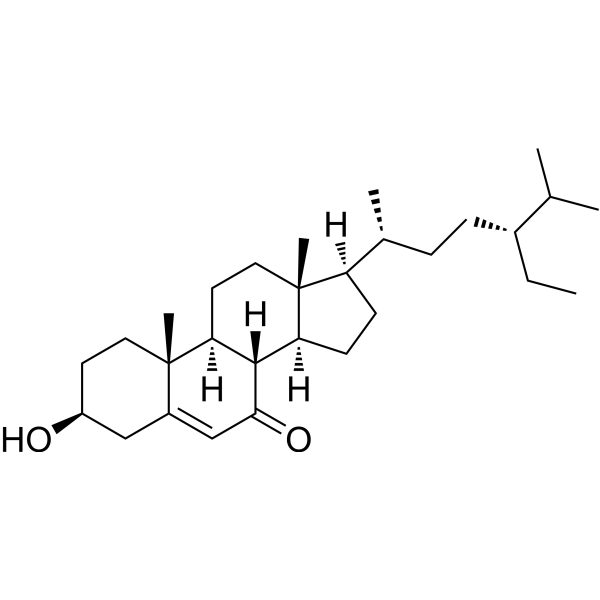
7-Ketositosterol

Based on 1 Customer Validation
7-Ketositosterol is an orally active inducer of apoptosis and ferroptosis. 7-Ketositosterol inhibits the phosphorylation of ERK1/2 and NF-κB, promotes the opening of the mitochondrial/apoptotic pathway, and induces ferroptosis in macrophages by increasing the levels of malondialdehyde, Fe2+ and ROS. 7-Ketositosterol upregulates the expression of gut microbiota-dependent PDLIM3, activates the p38MAPK/NF-κB signaling pathway, alters the composition of gut microbiota, increases the abundance of pathogenic bacteria, and exacerbates colitis in mice. 7-Ketositosterol can be used in studies related to breast cancer, liver cancer, and colitis.
For research use only. We do not sell to patients.
- Purity : 99.9%
- CAS No.: 2034-74-4
- Formula: C29H48O2
- Molecular Weight:428.69
-
Storage:Powder -20°C, 3 years ; In solvent -80°C, 6 months , -20°C, 1 month

To place orders, for customer services and technical support, please contact: MedChemExpress USA
Tel: 609-228-6898 E-mail: [email protected] [email protected]


-
 Biological Activity
-
Chemical Information
-
Solvent & Solubility
- Protocols
- Purity & Documentation
- References
-
 Help & FAQs




Biological Activity
Description
Cellular Effect
|
Cell Line

|
Type | Value | Description | References |
|---|---|---|---|---|
| A549 | IC50 |
>20 μg/mL
Compound: 8
|
Cytotoxicity against human A549 cells
Cytotoxicity against human A549 cells
|
[PMID: 23511021] |
| BV-2 | IC50 |
>100 μM
Compound: 36
|
Antineuroinflammatory activity in mouse BV2 cells assessed as inhibition of LPS-induced NO production after 24 hrs in presence of LPS by Griess reaction based assay
Antineuroinflammatory activity in mouse BV2 cells assessed as inhibition of LPS-induced NO production after 24 hrs in presence of LPS by Griess reaction based assay
|
[PMID: 28911817] |
| Hep 3B2 | IC50 |
>20 μg/mL
Compound: 8
|
Cytotoxicity against human Hep3B cells
Cytotoxicity against human Hep3B cells
|
[PMID: 23511021] |
| HepG2 | IC50 |
>20 μg/mL
Compound: 8
|
Cytotoxicity against human HepG2 cells
Cytotoxicity against human HepG2 cells
|
[PMID: 23511021] |
| HT-29 | IC50 |
48 μM
Compound: 29
|
Cytotoxicity against human HT-29 cells after 48 hrs by Alamar blue assay
Cytotoxicity against human HT-29 cells after 48 hrs by Alamar blue assay
|
[PMID: 20931970] |
| MCF7 | IC50 |
>20 μg/mL
Compound: 8
|
Cytotoxicity against human MCF7 cells
Cytotoxicity against human MCF7 cells
|
[PMID: 23511021] |
| MDA-MB-231 | IC50 |
>20 μg/mL
Compound: 8
|
Cytotoxicity against human MDA-MB-231 cells
Cytotoxicity against human MDA-MB-231 cells
|
[PMID: 23511021] |
In Vitro
7-Ketositosterol (30 µM; 24 h) reduces viability of human breast MCF-7 and liver HepG2 cancer cells by ~30% and ~25%, respectively, but does not affect viability of non-cancerous BJ fibroblasts[1].
7-Ketositosterol (30 µM; 24 h) significantly suppresses phosphorylation of ERK1/2 and NF-κB p65 (Ser536) in human breast MCF-7 and liver HepG2 cancer cells[1].
7-Ketositosterol (30 µM; 24 h) significantly suppresses PCNA protein levels in human breast MCF-7 and liver HepG2 cancer cells, indicating reduced cell proliferation[1].
7-Ketositosterol (30 µM; 24 h) significantly increases intracellular C18-C24 ceramide levels and reduces S1P levels in human breast MCF-7 and liver HepG2 cancer cells[1].
7-Ketositosterol (30 µM; 24 h) significantly induces apoptosis in human breast MCF-7 and liver HepG2 cancer cells, as measured by TUNEL staining and annexin V-FITC/PI flow cytometry[1].
7-Ketositosterol (1 µM; 24 h) induces M1 polarization and ferroptosis in RAW 264.7 macrophages by disrupting the ALKBH5-GCLM axis, reducing glutathione biosynthesis, and increasing oxidative stress and iron accumulation[2].
7-Ketositosterol does not directly stimulate the growth of Staphylococcus lentus in cell-free bacterial cultures[3].
MedChemExpress (MCE) has not independently confirmed the accuracy of these methods. They are for reference only.
-
Cell Line:human breast cancer (MCF-7), human liver cancer (HepG2), human non-cancerous fibroblast (BJ) cells
-
Concentration:5 µM, 10 µM, 15 µM, 30 µM
-
Incubation Time:12 h, 18 h, 24 h
-
Result:Did not significantly affect MCF-7 cell viability at 5, 10, or 15 µM after 24 h.
Reduced MCF-7 cell viability by approximately 30% at 30 µM after 24 h.
Did not significantly affect HepG2 cell viability at 5-30 µM for 12-18 h.
Reduced HepG2 cell viability by approximately 25% at 30 µM after 24 h.
Did not significantly affect BJ fibroblast cell viability at 5-30 µM after 24 h.
-
Cell Line:human breast cancer (MCF-7), human liver cancer (HepG2) cells
-
Concentration:30 µM
-
Incubation Time:24 h
-
Result:Increased fluorescence intensity (indicating apoptotic DNA fragmentation) significantly in both MCF-7 and HepG2 cells compared to control and DMSO groups via TUNEL staining.
Increased the percentage of early and late apoptotic cells significantly in both cell lines, with a corresponding decrease in viable cell percentage via annexin V-FITC/PI flow cytometry.
In Vivo
MedChemExpress (MCE) has not independently confirmed the accuracy of these methods. They are for reference only.
-
Animal Model:C57BL/6 (female, 7 weeks old, DSS-induced ulcerative colitis)[2]
-
Dosage:20 mg/kg/day; 60 mg/kg/day; 100 mg/kg/day
-
Administration:p.o.; daily; 21 days
-
Result:Exacerbated DSS-induced colitis at 100 mg/kg/day, with body weight reduced to ~87% of initial weight by day 7 of DSS exposure (vs ~95% for DSS-only mice).
Elevated DAI scores to ~9 by day 7 of DSS exposure (vs ~6 for DSS-only mice) at 100 mg/kg/day.
Shortened colon length to ~4.8 cm (vs ~5.8 cm for DSS-only mice) at 100 mg/kg/day.
Increased histopathological injury scores to ~8 (vs ~5 for DSS-only mice) at 100 mg/kg/day.
Induced intestinal inflammation and mucosal damage in mice without DSS challenge at 100 mg/kg/day.
Recapitulated exacerbating effects at 60 mg/kg/day, significantly worsening colitis severity compared to DSS-only mice.
Showed no significant alteration of body weight, DAI scores, or colon length compared to DSS-only mice at 20 mg/kg/day.
Increased mRNA expression of M1 macrophage-associated markers (IL-1β, TNF-α, iNOS, CD80) in colon tissue at 100 mg/kg/day.
Increased proportion of CD86-positive M1 macrophages at 100 mg/kg/day.
Reduced proportion of CD206-positive M2 macrophages at 100 mg/kg/day.
Promoted CD3+ T-cell recruitment in inflamed colons relative to DSS-only mice at 100 mg/kg/day.
- Western Blot
- RNA extraction experimental
- Annexin V plus membrane-impermeant dye apoptosis staining
- ROS/oxidative-stress fluorescent staining
- Research Protocol for Microbiome Analysis
- Research Protocol for Inflammation-related Diseases
- Liver Cancer Modeling
- Breast Cancer Modeling
- Kinase activity and phosphorylation assays
- Detection of Apoptosis
- TUNEL staining for apoptotic DNA fragmentation
- DSS-Induced Colitis
- TNBS-Induced Colitis
- Apoptosis Solutions
- Ferroptosis Solutions
- Protocol for Kinase activity and phosphorylation assays


Chemical Information
-
CAS No. 2034-74-4
-
Appearance Solid
-
Molecular Weight 428.69
-
Formula C29H48O2
-
Color White to off-white
-
SMILES
C[C@@]12[C@](CC[C@]2([H])[C@H](C)CC[C@@H](CC)C(C)C)([H])[C@@]3([H])[C@@](CC1)([H])[C@@]4(C(C[C@H](CC4)O)=CC3=O)C
-
Structure Classification
-
Initial Source
-
Shipping
Room temperature in continental US; may vary elsewhere.
-
Storage
Powder -20°C 3 years In solvent -80°C 6 months -20°C 1 month


Solvent & Solubility
In Vitro:
DMF : 12 mg/mL (27.99 mM; Need ultrasonic and warming)
Please refer to the solubility information to select the appropriate solvent. Once prepared, please aliquot and store the solution to prevent product inactivation from repeated freeze-thaw cycles.
Storage method and period of stock solution: -80°C, 6 months; -20°C, 1 month. When stored at -80°C, please use it within 6 months. When stored at -20°C, please use it within 1 month.
Please refer to the solubility information to select the appropriate solvent. Once prepared, please aliquot and store the solution to prevent product inactivation from repeated freeze-thaw cycles.
Storage method and period of stock solution: -80°C, 6 months; -20°C, 1 month. When stored at -80°C, please use it within 6 months. When stored at -20°C, please use it within 1 month.
Concentration (start) × Volume (start) = Concentration (final) × Volume (final)


Purity & Documentation
-
Data Sheet (280 KB)
-
SDS (251 KB)
- English - EN (251 KB)
- Français - FR (251 KB)
- Deutsch - DE (251 KB)
- Norwegian - NO (251 KB)
- Español - ES (251 KB)
- Swedish - SV (251 KB)
- Italian - IT (251 KB)
- Korean - KR (251 KB)
- Portuguese - PT (251 KB)
-
Handling Instructions (2659 KB)
References
[1]. Barut Z, et al. Antiproliferative Effect of 7-Ketositosterol in Breast and Liver Cancer Cells: Possible Impact on Ceramide, Extracellular Signal-Regulated Kinases, and Nuclear Factor Kappa B Signaling Pathways. Pharmaceuticals (Basel, Switzerland). 2024 Jul 01;17(7):860. [Content Brief]
[2]. Pang X, et al. Excessive ultra-processed foods exposure aggravates ulcerative colitis via macrophage ferroptosis. Environment international. 2025 Aug;202:109706. [Content Brief]
[3]. Yan J, et al. Ultra-processed foods sourced 7-ketositosterol aggravates colitis through gut dysbiosis induced-PDLIM3 activation. Gut microbes. 2025 Dec 31;17(1):2587980. [Content Brief]


Complete Stock Solution Preparation Table
Please refer to the solubility information to select the appropriate solvent. Once prepared, please aliquot and store the solution to prevent product inactivation from repeated freeze-thaw cycles.
Storage method and period of stock solution: -80°C, 6 months; -20°C, 1 month. When stored at -80°C, please use it within 6 months. When stored at -20°C, please use it within 1 month.
| Optional Solvent | Concentration Solvent Mass | 1 mg | 5 mg | 10 mg | 25 mg |
|---|---|---|---|---|---|
| DMF | 1 mM | 2.3327 mL | 11.6634 mL | 23.3269 mL | 58.3172 mL |
| 5 mM | 0.4665 mL | 2.3327 mL | 4.6654 mL | 11.6634 mL | |
| 10 mM | 0.2333 mL | 1.1663 mL | 2.3327 mL | 5.8317 mL | |
| 15 mM | 0.1555 mL | 0.7776 mL | 1.5551 mL | 3.8878 mL | |
| 20 mM | 0.1166 mL | 0.5832 mL | 1.1663 mL | 2.9159 mL | |
| 25 mM | 0.0933 mL | 0.4665 mL | 0.9331 mL | 2.3327 mL |


7-Ketositosterol Related Classifications
HY-N2757 Related Classifications
 Powered by Bioz