



Carbosulfan

Based on 1 Customer Validation
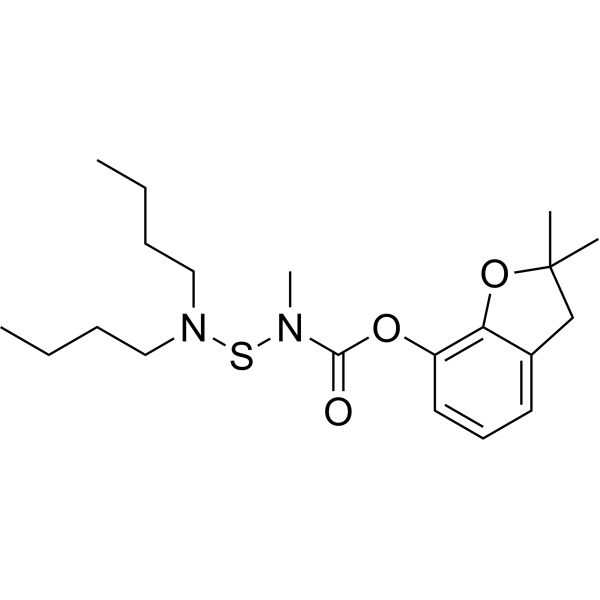
Carbosulfan is an orally active AChE inhibitor that hydrolyzes to Carbofuran in organisms to exert insecticidal effects. Carbosulfan exhibits broad-spectrum insecticidal activity, and it also induces severe oxidative stress by enhancing lipid peroxidation and impairing the antioxidant defense system. Carbosulfan causes reproductive toxicity in male rats and developmental disorders in their offspring. Carbosulfan shows persistence in paddy field environments and potential hazards to non-target organisms, and it is commonly used in studies related to reproductive toxicity and environmental risk assessment.
Para uso exclusivo en investigación. No vendemos a pacientes.
- Pureza : 98.0%
- No. CAS: 55285-14-8
- Fòrmula: C20H32N2O3S
- Peso molecular:380.54
-
Almacenamiento:Pure form -20°C, 3 years , 4°C, 2 years ; In solvent -80°C, 6 months , -20°C, 1 month

To place orders, for customer services and technical support, please contact: MedChemExpress USA
Tel: 609-228-6898 E-mail: [email protected] [email protected]


-
 Actividad biológica
-
Chemical Information
-
Solvente y solubilidad
- Protocolo
- Pureza y Documentación
- Referencias
-
 Help & FAQs



Ver todos los productos específicos de isoformas Parasite
More

Actividad biológica
Descripciòn
IC50 & Target
|
AChE |
In Vitro
Carbosulfan distorts polymerization of purified porcine brain tubulin[1].
Carbosulfan (0.025-0.4 %; 24 h) induces dose-dependent mortality in test mosquitoes, with 100 % mortality observed at 0.2 and 0.4 % concentrations after 24 h exposure[2].
MedChemExpress (MCE) has not independently confirmed the accuracy of these methods. They are for reference only.
In Vivo
Carbosulfan (0.4%; impregnated on paper; single exposure) induces 100% mortality in Kisumu strain Anopheles gambiae adults within 24 hours of exposure[2].
Carbosulfan (3.4-6.37 mg/kg bw; daily; 60 days) induces dose-dependent reproductive toxicity in male Wistar rats[4].
MedChemExpress (MCE) has not independently confirmed the accuracy of these methods. They are for reference only.
-
Animal Model:Wistar albino rats (male, 7-8-week-old, 200-250 g)[4]
-
Dosage:3.4 mg/kg bw; 6.37 mg/kg bw
-
Administration:daily; 60 days
-
Result:Caused mild testes histology alterations including intercellular vacuolization in seminiferous tubules and interstitial cells, plus sloughing of germ cells into the tubular lumen at 3.4 mg/kg bw.
Caused severe testes histology alterations including tubular degeneration, disorganization and displacement of spermatogonial cells, frequent vacuolization, sloughing of germ cells into the lumen, and absence of spermatozoa at 6.37 mg/kg bw.
Reduced testosterone levels to 81.87 ± 1.68 ng/dL (3.4 mg/kg bw) and 65.38 ± 1.75 ng/dL (6.37 mg/kg bw), FSH levels to 2.15 ± 0.22 mIU/mL (3.4 mg/kg bw) and 1.63 ± 0.30 mIU/mL (6.37 mg/kg bw), LH levels to 0.89 ± 0.08 mIU/mL (3.4 mg/kg bw) and 0.59 ± 0.08 mIU/mL (6.37 mg/kg bw), all significantly relative to controls.
Reduced sperm count to 8.21 ± 0.60 x10⁹ (3.4 mg/kg bw) and 6.41 ± 0.41 x10⁹ (6.37 mg/kg bw), sperm motility to 61.66 ± 1.50% (3.4 mg/kg bw) and 47.83 ± 4.70% (6.37 mg/kg bw), both significantly relative to controls.
Increased sperm abnormality rate to 21.33 ± 3.50% (3.4 mg/kg bw) and 47 ± 3.09% (6.37 mg/kg bw), significantly relative to controls.
Induced a 30.8% reduction in testosterone levels, a 40% reduction in sperm motility, and a 450% increase in sperm abnormality rate at 6.37 mg/kg bw relative to controls.


Chemical Information
-
No. CAS 55285-14-8
-
Appearance Liquid (Density: 1.056 g/cm3)
-
Peso molecular 380.54
-
Fòrmula C20H32N2O3S
-
Color Light brown to brown
-
SMILES
O=C(OC1=C(OC(C)(C)C2)C2=CC=C1)N(SN(CCCC)CCCC)C
-
Envío
Room temperature in continental US; may vary elsewhere.
-
Almacenamiento
Pure form -20°C 3 years 4°C 2 years In solvent -80°C 6 months -20°C 1 month


Solvente y solubilidad
In Vitro:
DMSO : ≥ 100 mg/mL (262.78 mM; Hygroscopic DMSO has a significant impact on the solubility of product, please use newly opened DMSO)
* "≥" means soluble, but saturation unknown.
Please refer to the solubility information to select the appropriate solvent. Once prepared, please aliquot and store the solution to prevent product inactivation from repeated freeze-thaw cycles.
Storage method and period of stock solution: -80°C, 6 months; -20°C, 1 month. When stored at -80°C, please use it within 6 months. When stored at -20°C, please use it within 1 month.
Please refer to the solubility information to select the appropriate solvent. Once prepared, please aliquot and store the solution to prevent product inactivation from repeated freeze-thaw cycles.
Storage method and period of stock solution: -80°C, 6 months; -20°C, 1 month. When stored at -80°C, please use it within 6 months. When stored at -20°C, please use it within 1 month.
Concentration (start) × Volume (start) = Concentration (final) × Volume (final)
In Vivo:
Select the appropriate dissolution method based on your experimental animal and administration route.
- For the following dissolution methods, please ensure to first prepare a clear stock solution using an In Vitro approach and then sequentially add co-solvents:
- To ensure reliable experimental results, the clarified stock solution can be appropriately stored based on storage conditions. As for the working solution for In Vivo experiments, it is recommended to prepare freshly and use it on the same day.
- The percentages shown for the solvents indicate their volumetric ratio in the final prepared solution. If precipitation or phase separation occurs during preparation, heat and/or sonication can be used to aid dissolution.
Add each solvent one by one: 10% DMSO 40% PEG300 5% Tween-80 45% Saline
Solubility: ≥ 2.5 mg/mL (6.57 mM); Clear solution
This protocol yields a clear solution of ≥ 2.5 mg/mL (saturation unknown).
Taking 1 mL working solution as an example, add 100 μL DMSO stock solution (25.0 mg/mL) to 400 μL PEG300, and mix evenly; then add 50 μL Tween-80 and mix evenly; then add 450 μL Saline to adjust the volume to 1 mL.
Preparation of Saline: Dissolve 0.9 g sodium chloride in ddH₂O and dilute to 100 mL to obtain a clear Saline solution.
Add each solvent one by one: 10% DMSO 90% (20% SBE-β-CD in Saline)
Solubility: 2.5 mg/mL (6.57 mM); Suspended solution; Need ultrasonic
This protocol yields a suspended solution of 2.5 mg/mL. Suspended solution can be used for oral and intraperitoneal injection.
Taking 1 mL working solution as an example, add 100 μL DMSO stock solution (25.0 mg/mL) to 900 μL 20% SBE-β-CD in Saline, and mix evenly.
Preparation of 20% SBE-β-CD in Saline (4°C, storage for one week): 2 g SBE-β-CD powder is dissolved in 10 mL Saline, completely dissolve until clear.
In Vivo Dissolution Calculator
Please enter the basic information of animal experiments:
-
-
-
-
Recommended: Prepare an additional quantity of animals to account for potential losses during experiments.
Please enter your animal formula composition:
-
%DMSO +
Recommended: Keep the proportion of DMSO in working solution below 2% if your animal is weak.
-
%+
-
+%Tween-80 + +
-
%Saline +
The co-solvents required include: DMSO, . All of co-solvents are available by MedChemExpress (MCE). , Tween 80. All of co-solvents are available by MedChemExpress (MCE).
Working solution concentration: 0.22 mg/mL
Method for preparing stock solution: mg drug dissolved in μL DMSO. Stock solution concentration: mg/mL.
1. Take μL DMSO stock solution;
2. Add μL .
μL , mix evenly;
3. Then add μL Tween 80, mix evenly;
4. Then add μL
Please ensure that the stock solution in the first step is dissolved to a clear state, and add co-solvents in sequence. You can use ultrasonic heating (ultrasonic cleaner, recommended frequency 20-40 kHz), vortexing, etc. to assist dissolution.


Pureza y Documentación
-
Ficha de datos (276 KB)
-
SDS (564 KB)
- English - EN (564 KB)
- Français - FR (564 KB)
- Deutsch - DE (564 KB)
- Norwegian - NO (564 KB)
- Español - ES (564 KB)
- Swedish - SV (564 KB)
- Italian - IT (564 KB)
- Korean - KR (564 KB)
- Portuguese - PT (564 KB)
-
Instrucciones de manejo (2659 KB)
Referencias
[1]. Banji D, et al. Carbosulfan exposure during embryonic period can cause developmental disability in rats. Environ Toxicol Pharmacol. 2014;38(1):230-238. [Content Brief]
[3]. de Melo Plese LP, et al. Kinetics of carbosulfan hydrolysis to carbofuran and the subsequent degradation of this last compound in irrigated rice fields. Chemosphere. 2005;60(2):149-156. [Content Brief]


Complete Stock Solution Preparation Table
Please refer to the solubility information to select the appropriate solvent. Once prepared, please aliquot and store the solution to prevent product inactivation from repeated freeze-thaw cycles.
Storage method and period of stock solution: -80°C, 6 months; -20°C, 1 month. When stored at -80°C, please use it within 6 months. When stored at -20°C, please use it within 1 month.
| Optional Solvent | Concentration Solvent Mass | 1 mg | 5 mg | 10 mg | 25 mg |
|---|---|---|---|---|---|
| DMSO | 1 mM | 2.6278 mL | 13.1392 mL | 26.2784 mL | 65.6961 mL |
| 5 mM | 0.5256 mL | 2.6278 mL | 5.2557 mL | 13.1392 mL | |
| 10 mM | 0.2628 mL | 1.3139 mL | 2.6278 mL | 6.5696 mL | |
| 15 mM | 0.1752 mL | 0.8759 mL | 1.7519 mL | 4.3797 mL | |
| 20 mM | 0.1314 mL | 0.6570 mL | 1.3139 mL | 3.2848 mL | |
| 25 mM | 0.1051 mL | 0.5256 mL | 1.0511 mL | 2.6278 mL | |
| 30 mM | 0.0876 mL | 0.4380 mL | 0.8759 mL | 2.1899 mL | |
| 40 mM | 0.0657 mL | 0.3285 mL | 0.6570 mL | 1.6424 mL | |
| 50 mM | 0.0526 mL | 0.2628 mL | 0.5256 mL | 1.3139 mL | |
| 60 mM | 0.0438 mL | 0.2190 mL | 0.4380 mL | 1.0949 mL | |
| 80 mM | 0.0328 mL | 0.1642 mL | 0.3285 mL | 0.8212 mL | |
| 100 mM | 0.0263 mL | 0.1314 mL | 0.2628 mL | 0.6570 mL |


Carbosulfan Related Classifications
HY-B2015 Related Classifications
 Powered by Bioz
Keywords
- Carbosulfan
- 55285-14-8
- Environmental Pollutants
- Cholinesterase (ChE)
- Parasite
- Insecticide
- mosquito populations
- tropical irrigated rice field soil solution
- porcine brain tubulin
- paddy water
- rice-infesting weevils
- male albino rats
- Anopheles gambiae
- rat pups
- cerebellar Purkinje cells
- acetylcholinesterase
- Inhibitor
- inhibitor
- inhibit