



Cefsulodin sodium

Based on 1 Customer Validation
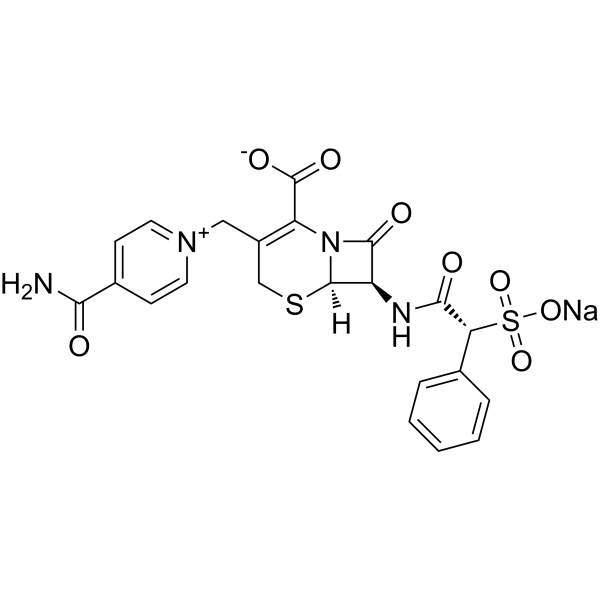
Cefsulodin (SCE-129) sodium is a third generation β lactam antibiotic and member of the cephems subgroup of antibiotics. Cefsulodin sodium inhibits cell wall synthesis by competitively inhibiting penicillin binding protein (PBP) cross-linking and transpeptidation of peptidogly. Cefsulodin sodium is a potent tyrosine phosphatase inhibitor against mPTPB, a virulent phosphatase from Mycobacterium tuberculosis, with an IC50 value of 16 μM.
Para uso exclusivo en investigación. No vendemos a pacientes.
- Pureza : 98.23%
- No. CAS: 52152-93-9
- Fòrmula: C22H19N4NaO8S2
- Peso molecular:554.52
-
Almacenamiento:
4°C, stored under nitrogen
* In solvent : -80°C, 6 months; -20°C, 1 month (stored under nitrogen)

To place orders, for customer services and technical support, please contact: MedChemExpress USA
Tel: 609-228-6898 E-mail: [email protected] [email protected]


-
 Actividad biológica
-
Chemical Information
-
Solvente y solubilidad
- Pureza y Documentación
- Referencias
-
 Help & FAQs


-
HY-B0221
Amphotericin BAntifungal Agent -
HY-A0089
Colistin sulfateAntibiotic -
HY-B0510
TrimethoprimBacteriostatic Antibiotic -

HY-B0510R
Trimethoprim (Standard)Bacteriostatic Antibiotic -
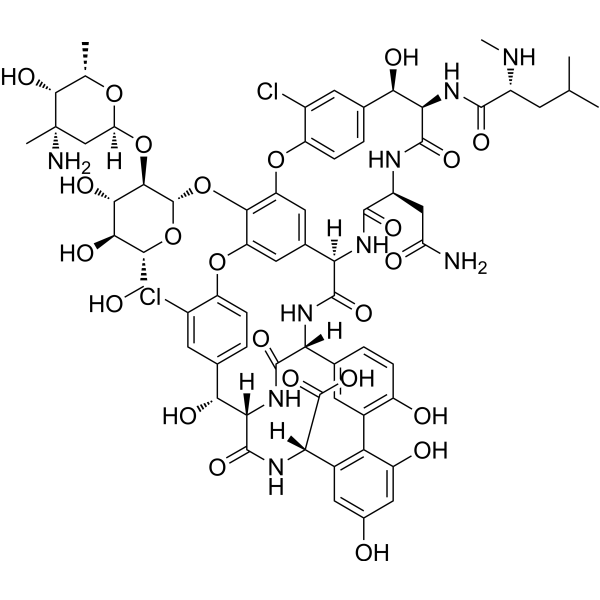
HY-B0671
VancomycinAntibiotic -
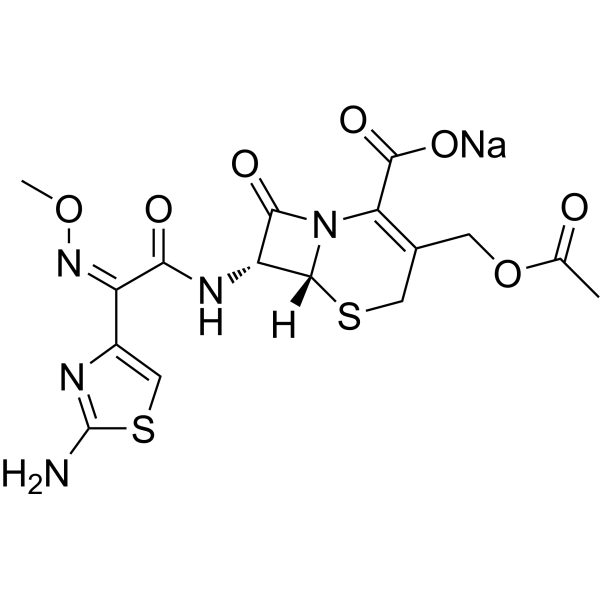
HY-A0088
Cefotaxime sodiumBacterial Inhibitor -
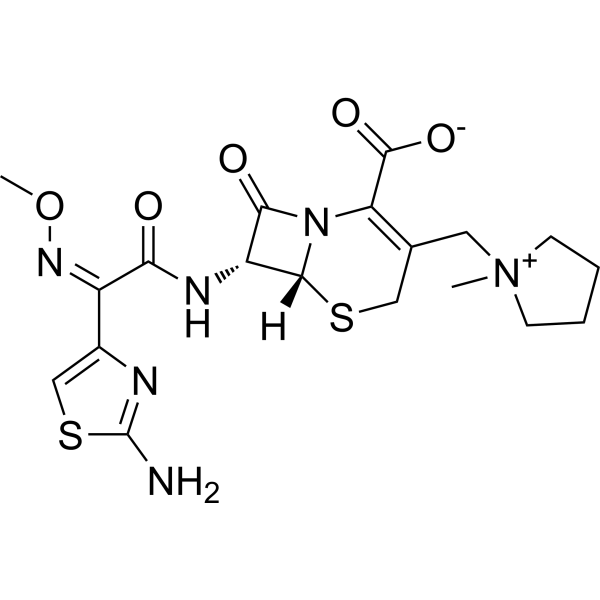
HY-B0692
CefepimeAntibiotic -
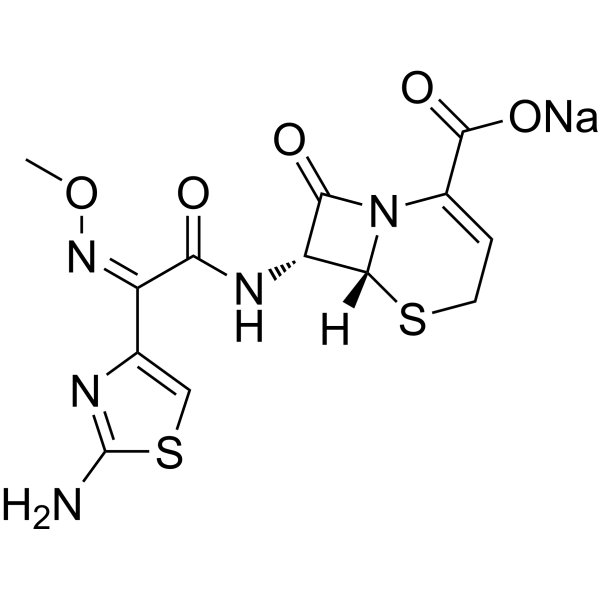
HY-B1596A
Ceftizoxime sodiumBacterial Inhibitor
Ver todos los productos específicos de isoformas Antibiotic
More

Actividad biológica
Descripciòn
IC50 & Target
|
β-lactam |
In Vitro
Cefsulodin sodium (0.5-64 mg/mL; 18 h) is active in minimum inhibitory concentrations (MICs) of 0.5-64 mg/mL, is about 16- to 32-fold more active than Carbenicillin (HY-B0525) against Psuedomonas aeruginosa[1].
Cefsulodin sodium (8-16 μg/mL; 4.5 h) is not hydrolyzed by the beta-lactamase induced in P. aeruginosa by growth in the presence of benzylpenicillin[1].
MedChemExpress (MCE) has not independently confirmed the accuracy of these methods. They are for reference only. .
In Vivo
MedChemExpress (MCE) has not independently confirmed the accuracy of these methods. They are for reference only.
-
Animal Model:Female Wistar rats (200 g)[4]
-
Dosage:1000 mg/kg/tag
-
Administration:Intraperitoneal injection; 5 days; nine single doses, with intervals of 12 h (injection volume: 10 mL)
-
Result:Increased in excretion of tubule cells in the 12-hour night urine during five-day treatment.


Chemical Information
-
No. CAS 52152-93-9
-
Appearance Solid
-
Peso molecular 554.52
-
Fòrmula C22H19N4NaO8S2
-
Color Off-white to light yellow
-
SMILES
O=C(N[C@H]1[C@@]2([H])SCC(C[N+]3=CC=C(C(N)=O)C=C3)=C(C([O-])=O)N2C1=O)[C@@H](C4=CC=CC=C4)S(=O)(O[Na])=O
-
Synonyms
SCE-129 sodium
-
Envío
Room temperature in continental US; may vary elsewhere.
-
Almacenamiento
4°C, stored under nitrogen
* In solvent : -80°C, 6 months; -20°C, 1 month (stored under nitrogen)


Solvente y solubilidad
In Vitro:
H2O : 50 mg/mL (90.17 mM; Need ultrasonic)
DMSO : 13.5 mg/mL (24.35 mM; Need ultrasonic; Hygroscopic DMSO has a significant impact on the solubility of product, please use newly opened DMSO)
Please refer to the solubility information to select the appropriate solvent. Once prepared, please aliquot and store the solution to prevent product inactivation from repeated freeze-thaw cycles.
Storage method and period of stock solution: -80°C, 6 months; -20°C, 1 month (stored under nitrogen). When stored at -80°C, please use it within 6 months. When stored at -20°C, please use it within 1 month.
* Note: If you choose water as the stock solution, please dilute it to the working solution, then filter and sterilize it with a 0.22 μm filter before use.
Please refer to the solubility information to select the appropriate solvent. Once prepared, please aliquot and store the solution to prevent product inactivation from repeated freeze-thaw cycles.
Storage method and period of stock solution: -80°C, 6 months; -20°C, 1 month (stored under nitrogen). When stored at -80°C, please use it within 6 months. When stored at -20°C, please use it within 1 month.
* Note: If you choose water as the stock solution, please dilute it to the working solution, then filter and sterilize it with a 0.22 μm filter before use.
Concentration (start) × Volume (start) = Concentration (final) × Volume (final)
In Vivo:
Select the appropriate dissolution method based on your experimental animal and administration route.
- For the following dissolution methods, please ensure to first prepare a clear stock solution using an In Vitro approach and then sequentially add co-solvents:
- To ensure reliable experimental results, the clarified stock solution can be appropriately stored based on storage conditions. As for the working solution for In Vivo experiments, it is recommended to prepare freshly and use it on the same day.
- The percentages shown for the solvents indicate their volumetric ratio in the final prepared solution. If precipitation or phase separation occurs during preparation, heat and/or sonication can be used to aid dissolution.
Add each solvent one by one: 10% DMSO 40% PEG300 5% Tween-80 45% Saline
Solubility: ≥ 2.25 mg/mL (4.06 mM); Clear solution
This protocol yields a clear solution of ≥ 2.25 mg/mL (saturation unknown).
Taking 1 mL working solution as an example, add 100 μL DMSO stock solution (22.5 mg/mL) to 400 μL PEG300, and mix evenly; then add 50 μL Tween-80 and mix evenly; then add 450 μL Saline to adjust the volume to 1 mL.
Preparation of Saline: Dissolve 0.9 g sodium chloride in ddH₂O and dilute to 100 mL to obtain a clear Saline solution.
Add each solvent one by one: 10% DMSO 90% (20% SBE-β-CD in Saline)
Solubility: ≥ 2.25 mg/mL (4.06 mM); Clear solution
This protocol yields a clear solution of ≥ 2.25 mg/mL (saturation unknown).
Taking 1 mL working solution as an example, add 100 μL DMSO stock solution (22.5 mg/mL) to 900 μL 20% SBE-β-CD in Saline, and mix evenly.
Preparation of 20% SBE-β-CD in Saline (4°C, storage for one week): 2 g SBE-β-CD powder is dissolved in 10 mL Saline, completely dissolve until clear.
For the following dissolution methods, please prepare the working solution directly:
It is recommended to prepare fresh solutions and use them promptly within a short period of time.
The percentages shown for the solvents indicate their volumetric ratio in the final prepared solution. If precipitation or phase separation occurs during preparation, heat and/or sonication can be used to aid dissolution.
Add each solvent one by one: PBS
Solubility: 100 mg/mL (180.34 mM); Clear solution; Need ultrasonic
In Vivo Dissolution Calculator
Please enter the basic information of animal experiments:
-
-
-
-
Recommended: Prepare an additional quantity of animals to account for potential losses during experiments.
Working solution concentration: 0.22 mg/mL
This product has good water solubility, please refer to the measured solubility data in water/PBS/Saline for details.


Pureza y Documentación
-
Ficha de datos (276 KB)
-
SDS (394 KB)
- English - EN (394 KB)
- Français - FR (394 KB)
- Deutsch - DE (394 KB)
- Norwegian - NO (394 KB)
- Español - ES (394 KB)
- Swedish - SV (394 KB)
- Italian - IT (394 KB)
- Korean - KR (394 KB)
- Portuguese - PT (394 KB)
-
Instrucciones de manejo (2659 KB)
Referencias
[1]. He R, et al. Cefsulodin Inspired Potent and Selective Inhibitors of mPTPB, a Virulent Phosphatase from Mycobacterium tuberculosis. ACS Med Chem Lett. 2015 Nov 3;6(12):1231-5. [Content Brief]
[2]. King A, et al. In vitro antibacterial activity and susceptibility of cefsulodin, an antipseudomonal cephalosporin, to beta-lactamases. Antimicrob Agents Chemother. 1980 Feb;17(2):165-9. [Content Brief]
[3]. Gotoh N, et al. Resistance of Pseudomonas aeruginosa to cefsulodin: modification of penicillin-binding protein 3 and mapping of its chromosomal gene. J Antimicrob Chemother. 1990 Apr;25(4):513-23. [Content Brief]
[4]. Sack K, et al. Renal tolerance of imipenem/cilastatin and other beta-lactam antibiotics in rats. Infection. 1985;13 Suppl 1:S156-60. [Content Brief]


Complete Stock Solution Preparation Table
Please refer to the solubility information to select the appropriate solvent. Once prepared, please aliquot and store the solution to prevent product inactivation from repeated freeze-thaw cycles.
Storage method and period of stock solution: -80°C, 6 months; -20°C, 1 month (stored under nitrogen). When stored at -80°C, please use it within 6 months. When stored at -20°C, please use it within 1 month.
| Optional Solvent | Concentration Solvent Mass | 1 mg | 5 mg | 10 mg | 25 mg |
|---|---|---|---|---|---|
| DMSO / H2O | 1 mM | 1.8034 mL | 9.0168 mL | 18.0336 mL | 45.0840 mL |
| 5 mM | 0.3607 mL | 1.8034 mL | 3.6067 mL | 9.0168 mL | |
| 10 mM | 0.1803 mL | 0.9017 mL | 1.8034 mL | 4.5084 mL | |
| 15 mM | 0.1202 mL | 0.6011 mL | 1.2022 mL | 3.0056 mL | |
| 20 mM | 0.0902 mL | 0.4508 mL | 0.9017 mL | 2.2542 mL | |
| H2O | 25 mM | 0.0721 mL | 0.3607 mL | 0.7213 mL | 1.8034 mL |
| 30 mM | 0.0601 mL | 0.3006 mL | 0.6011 mL | 1.5028 mL | |
| 40 mM | 0.0451 mL | 0.2254 mL | 0.4508 mL | 1.1271 mL | |
| 50 mM | 0.0361 mL | 0.1803 mL | 0.3607 mL | 0.9017 mL | |
| 60 mM | 0.0301 mL | 0.1503 mL | 0.3006 mL | 0.7514 mL | |
| 80 mM | 0.0225 mL | 0.1127 mL | 0.2254 mL | 0.5636 mL |
* Note: If you choose water as the stock solution, please dilute it to the working solution, then filter and sterilize it with a 0.22 μm filter before use.


Cefsulodin sodium Related Classifications
HY-13588 Related Classifications
 Powered by Bioz