



Diazinon
Based on 2 publication(s) in Google Scholar
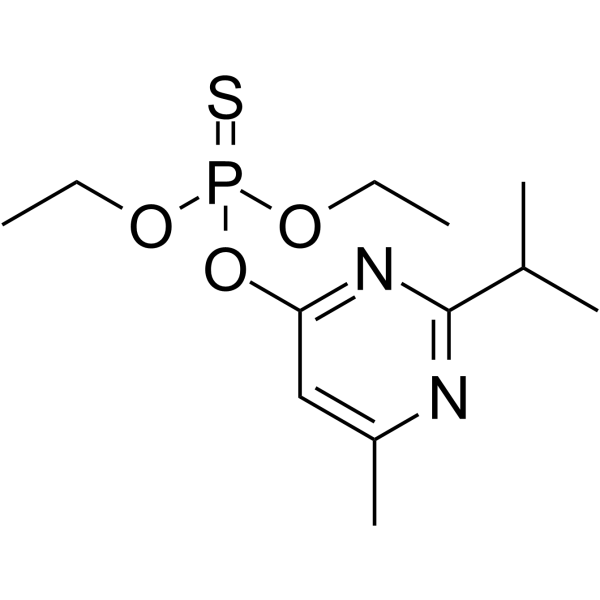
Diazinon is an orally active, irreversible AChE inhibitor and insecticide that can be absorbed through the digestive system, skin or respiratory tract. Diazinon inhibits AChE, leading to accumulation of acetylcholine, which in turn overstimulates ACh receptors and affects the nervous system. Diazinon also produces reactive oxygen species (ROS), which induce oxidative stress in various tissues. Diazinon is mainly used in the agricultural field as an insecticide and may have potential effects on human and animal health.
연구목적의 판매만을 진행합니다. 환자를 대상으로 한 판매는 하지 않습니다.
- Purity : 99.25%
- CAS No.: 333-41-5
- 화학식: C12H21N2O3PS
- 분자량:304.35
-
보관:Pure form -20°C, 3 years , 4°C, 2 years ; In solvent -80°C, 6 months , -20°C, 1 month

To place orders, for customer services and technical support, please contact: MedChemExpress USA
Tel: 609-228-6898 E-mail: [email protected] [email protected]


-
 Biological Activity
-
Chemical Information
-
용액&용해도
- Protocol
- 순도&문서
- References
-
 Help & FAQs




Publications Citing Use of MedChemExpress (MCE) Diazinon
MoreAll Parasite Isoforms
More

Biological Activity
제품 설명
In Vitro
Diazinon (10-50 μM; 0.5-48 h) inhibited the cell viability of BRL-3A cells and spleen mononuclear cells (SMC) in a dose- and time-dependent manner1].
Diazinon (10-50μM; 0.5-24 h) caused increased ROS generation and elevated O2- levels in BRL-3A cells, and enhanced TBARS formation, indicating increased lipid peroxidation1].
Diazinon (10-50 μM; 48 h) induced cell cycle arrest at the G1 phase of SMC cells1].
Diazinon (0.125-2 μM; 90 min) affected the swimming behavior of Daphnia pulex in a concentration- and time-dependent manner, resulting in significant changes in the cumulative swimming distance and angle change. The higher the concentration, the smaller the cumulative swimming distance[2].
Diazinon (0.0625-0.5 μM; 50-90 min) combined with 0.5 μM 4-nonylphenol enhanced the toxic effects on the swimming behavior of Daphnia pulex[2].
MedChemExpress (MCE) has not independently confirmed the accuracy of these methods. They are for reference only.
In Vivo
Diazinon (2 mg/kg, 25 mg/kg; intraperitoneal injection; 5 times a week; 28 days) caused obvious histopathological changes in the thymus and spleen of mice, suppressed the humoral and cellular activities of the mouse immune system, and inhibited erythrocyte cholinesterase[4].
MedChemExpress (MCE) has not independently confirmed the accuracy of these methods. They are for reference only.
-
Animal Model:Sprague Dawley male rats (male, 150-200 g, 4-8 weeks old)[3]
-
Dosage:10 mg/kg, 15, 30 mg/kg (dissolved in corn oil)
-
Administration:Oral gavage, daily for 8 weeks
-
Result:Showed a dose-dependent decrease in renal glutathione reduced.
Decreased the activities of renal antioxidant enzymes, such as glutathione reductase, glucose-6-phosphate dehydrogenase, catalase, and glutathione peroxidase.
Increased renal lipid peroxidation, blood urea nitrogen and serum creatinine levels, indicating enhanced renal damage.
Resulted kidney swelling, nuclear pycnosis, degeneration of tubular epithelial cells, necrosis of proximal tubules, flattened epithelium, and congested blood vessels in the kidneys of rats treated with diazinon at all doses in histopathological studies.
-
Animal Model:Female C57bl/6 inbred mice (female, 19-21 g, 4 weeks old)[4]
-
Dosage:25 mg/kg, 2 mg/kg, 0.2 mg/kg (diluted in Sweet Almond Oil)
-
Administration:Intraperitoneal injection, 5 times per week for 28 days Result: (25 mg/kg)
-
Result:Had significant histopathological changes in the thymus and spleen, including medullar atrophy in the thymus and an increase in the ratio of spleen red pulp to white pulp, along with white pulp atrophy.
Suppressed their humoral and cellular immune activities, as shown by decreased IgM-PFC response, suppressed splenocytes proliferative response to PHA, and decreased DTH response.
Significantly inhibited RBC-cholinesterase activity.
0.2 mg/kg of Diazinon causes no histopathological or functional disturbances.


Chemical Information
-
CAS No. 333-41-5
-
Appearance Liquid (Density: 1.117 g/cm3)
-
분자량 304.35
-
화학식 C12H21N2O3PS
-
Color Light brown to brown
-
SMILES
S=P(OCC)(OCC)OC1=NC(C(C)C)=NC(C)=C1
-
Synonyms
Dimpylate
-
선적
Room temperature in continental US; may vary elsewhere.
-
보관
Pure form -20°C 3 years 4°C 2 years In solvent -80°C 6 months -20°C 1 month


Publications (2)
-
Journal Impact Factor
-
Most Recent
-
ACS Environ Au
Machine Learning-Assisted Recognition of Environmental Sulfur-Containing Chemicals in Nontargeted Mass Spectrometry Analysis of Inadequate Mass Resolution. [Abstract]2025 Aug 5;5(6):573-582. PMID: 41277996 -
Anal Chem
Exposome-Scale Investigation of Cl-/Br-Containing Chemicals Using High-Resolution Mass Spectrometry, Multistage Machine Learning, and Cloud Computing. [Abstract]2025 Jun 3;97(21):11099-11109. PMID: 40401576


용액&용해도
In Vitro:
DMSO : 100 mg/mL (328.57 mM; Need ultrasonic; Hygroscopic DMSO has a significant impact on the solubility of product, please use newly opened DMSO)
Please refer to the solubility information to select the appropriate solvent. Once prepared, please aliquot and store the solution to prevent product inactivation from repeated freeze-thaw cycles.
Storage method and period of stock solution: -80°C, 6 months; -20°C, 1 month. When stored at -80°C, please use it within 6 months. When stored at -20°C, please use it within 1 month.
Please refer to the solubility information to select the appropriate solvent. Once prepared, please aliquot and store the solution to prevent product inactivation from repeated freeze-thaw cycles.
Storage method and period of stock solution: -80°C, 6 months; -20°C, 1 month. When stored at -80°C, please use it within 6 months. When stored at -20°C, please use it within 1 month.
Concentration (start) × Volume (start) = Concentration (final) × Volume (final)
In Vivo:
Select the appropriate dissolution method based on your experimental animal and administration route.
- For the following dissolution methods, please ensure to first prepare a clear stock solution using an In Vitro approach and then sequentially add co-solvents:
- To ensure reliable experimental results, the clarified stock solution can be appropriately stored based on storage conditions. As for the working solution for In Vivo experiments, it is recommended to prepare freshly and use it on the same day.
- The percentages shown for the solvents indicate their volumetric ratio in the final prepared solution. If precipitation or phase separation occurs during preparation, heat and/or sonication can be used to aid dissolution.
Add each solvent one by one: 10% DMSO 40% PEG300 5% Tween-80 45% Saline
Solubility: ≥ 2.5 mg/mL (8.21 mM); Clear solution
This protocol yields a clear solution of ≥ 2.5 mg/mL (saturation unknown).
Taking 1 mL working solution as an example, add 100 μL DMSO stock solution (25.0 mg/mL) to 400 μL PEG300, and mix evenly; then add 50 μL Tween-80 and mix evenly; then add 450 μL Saline to adjust the volume to 1 mL.
Preparation of Saline: Dissolve 0.9 g sodium chloride in ddH₂O and dilute to 100 mL to obtain a clear Saline solution.
Add each solvent one by one: 10% DMSO 90% (20% SBE-β-CD in Saline)
Solubility: 2.5 mg/mL (8.21 mM); Suspended solution; Need ultrasonic
This protocol yields a suspended solution of 2.5 mg/mL. Suspended solution can be used for oral and intraperitoneal injection.
Taking 1 mL working solution as an example, add 100 μL DMSO stock solution (25.0 mg/mL) to 900 μL 20% SBE-β-CD in Saline, and mix evenly.
Preparation of 20% SBE-β-CD in Saline (4°C, storage for one week): 2 g SBE-β-CD powder is dissolved in 10 mL Saline, completely dissolve until clear.
In Vivo Dissolution Calculator
Please enter the basic information of animal experiments:
-
-
-
-
Recommended: Prepare an additional quantity of animals to account for potential losses during experiments.
Please enter your animal formula composition:
-
%DMSO +
Recommended: Keep the proportion of DMSO in working solution below 2% if your animal is weak.
-
%+
-
+%Tween-80 + +
-
%Saline +
The co-solvents required include: DMSO, . All of co-solvents are available by MedChemExpress (MCE). , Tween 80. All of co-solvents are available by MedChemExpress (MCE).
Working solution concentration: 0.22 mg/mL
Method for preparing stock solution: mg drug dissolved in μL DMSO. Stock solution concentration: mg/mL.
1. Take μL DMSO stock solution;
2. Add μL .
μL , mix evenly;
3. Then add μL Tween 80, mix evenly;
4. Then add μL
Please ensure that the stock solution in the first step is dissolved to a clear state, and add co-solvents in sequence. You can use ultrasonic heating (ultrasonic cleaner, recommended frequency 20-40 kHz), vortexing, etc. to assist dissolution.


순도&문서
-
Data Sheet (280 KB)
-
SDS (252 KB)
- English - EN (252 KB)
- Français - FR (252 KB)
- Deutsch - DE (252 KB)
- Norwegian - NO (252 KB)
- Español - ES (252 KB)
- Swedish - SV (252 KB)
- Italian - IT (252 KB)
- Korean - KR (252 KB)
- Portuguese - PT (252 KB)
-
Handling Instructions (2659 KB)
References
[1]. Girón-Pérez MI, et al. Diazinon toxicity in hepatic and spleen mononuclear cells is associated to early induction of oxidative stress. Int J Environ Health Res. 2022 Oct;32 (10) :2309-2323. [Content Brief]
[2]. Zein MA, et al. Toxic effects of combined stressors on Daphnia pulex: Interactions between diazinon, 4-nonylphenol, and wastewater effluent. Environ Toxicol Chem. 2015 May;34 (5) :1145-53. [Content Brief]
[3]. Shah MD, et al. Diazinon-induced oxidative stress and renal dysfunction in rats. Food Chem Toxicol. 2010 Dec;48 (12) :3345-53. [Content Brief]
[4]. Neishabouri EZ, et al. Evaluation of immunotoxicity induced by diazinon in C57bl/6 mice. Toxicology. 2004 Mar 15;196 (3) :173-9. [Content Brief]


Complete Stock Solution Preparation Table
Please refer to the solubility information to select the appropriate solvent. Once prepared, please aliquot and store the solution to prevent product inactivation from repeated freeze-thaw cycles.
Storage method and period of stock solution: -80°C, 6 months; -20°C, 1 month. When stored at -80°C, please use it within 6 months. When stored at -20°C, please use it within 1 month.
| Optional Solvent | Concentration Solvent Mass | 1 mg | 5 mg | 10 mg | 25 mg |
|---|---|---|---|---|---|
| DMSO | 1 mM | 3.2857 mL | 16.4285 mL | 32.8569 mL | 82.1423 mL |
| 5 mM | 0.6571 mL | 3.2857 mL | 6.5714 mL | 16.4285 mL | |
| 10 mM | 0.3286 mL | 1.6428 mL | 3.2857 mL | 8.2142 mL | |
| 15 mM | 0.2190 mL | 1.0952 mL | 2.1905 mL | 5.4762 mL | |
| 20 mM | 0.1643 mL | 0.8214 mL | 1.6428 mL | 4.1071 mL | |
| 25 mM | 0.1314 mL | 0.6571 mL | 1.3143 mL | 3.2857 mL | |
| 30 mM | 0.1095 mL | 0.5476 mL | 1.0952 mL | 2.7381 mL | |
| 40 mM | 0.0821 mL | 0.4107 mL | 0.8214 mL | 2.0536 mL | |
| 50 mM | 0.0657 mL | 0.3286 mL | 0.6571 mL | 1.6428 mL | |
| 60 mM | 0.0548 mL | 0.2738 mL | 0.5476 mL | 1.3690 mL | |
| 80 mM | 0.0411 mL | 0.2054 mL | 0.4107 mL | 1.0268 mL | |
| 100 mM | 0.0329 mL | 0.1643 mL | 0.3286 mL | 0.8214 mL |


Diazinon Related Classifications
HY-B1113 Related Classifications
 Powered by Bioz