



Cancer Targeted Therapy
Cancer targeted therapy is the foundation of precision medicine; it uses drugs or other substances to target specific genes and proteins that control cancer cells’ growth, division and spreading. Compared to traditional chemotherapy drugs, targeted-drugs can specifically act on cancer cells with high efficacy without damaging normal cells. Drugs used in cancer targeted therapy mainly includes small molecules and macromolecules (e.g., monoclonal antibodies), which can target cancer cells and constituents in the tumor microenvironment to activate the immune system. Anti-angiogenesis drugs, such as those targeting vascular endothelial growth factor (VEGF), epidermal growth factor receptor (EGFR), transforming growth factor (TGF)-α, TGF-β, Tumor necrosis factor (TNF)-α, and platelet-derived endothelial growth factor (PDGFR) inhibit the proliferation and metastasis of cancer cells. In recent years, the proportion of antibody drugs in cancer treatment has gradually become prominent. Antibody-drug conjugates (ADCs) are a new type of targeted drugs that are composed of monoclonal antibody, cytotoxic drug and linker. ADCs can deliver drugs to tumor cells and minimize the toxicity to normal tissues. Proteolysis-targeting chimera (PROTAC) is a useful technology for targeted protein degradation. PROTAC exploits the ubiquitin-proteasome system and forms a ternary complex with a hijacked E3 ubiquitin ligase and target protein, leading to polyubiquitination and degradation of the target protein.
Targeted therapy is a useful strategy in treatment of cancer either alone or in combination with standard chemotherapy. At present, targeted therapy has proved significant clinical success in the treatment of many types of cancer, including breast cancer, colorectal cancer, leukemia, ovarian cancer and lung cancer.
-
Propargyl-PEG4-O-C1-Boc
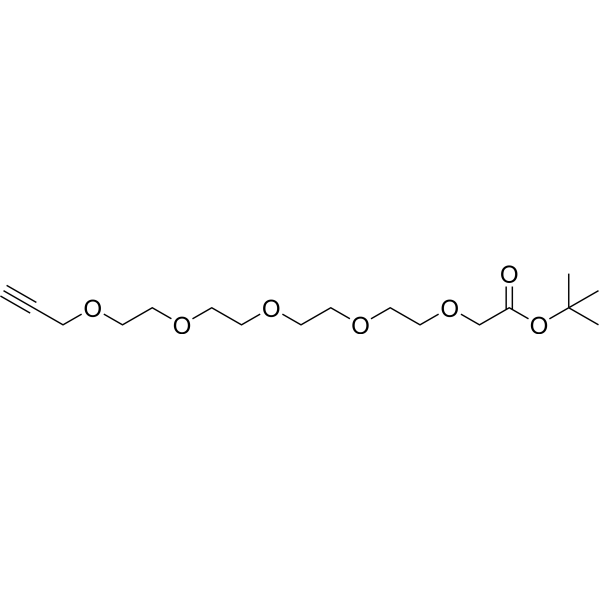 0 ImagesCat. No.: HY-130389CAS No.: 2098489-63-3
-
STA-1474
 0 ImagesCat. No.: HY-13752CAS No.: 1118915-78-8
STA-1474 is an orally active and highly selective HSP90 inhibitor, as well as a phosphate prodrug of the HSP90 inhibitor STA-9090 (HY-15205). STA-1474 disrupts the chaperone function of HSP90 and promotes the degradation of client proteins. STA-1474 inhibits the phosphorylation of Met, Akt and STAT3, thereby blocking related signaling pathways. STA-1474 induces apoptosis and inhibits proliferation of osteosarcoma cells, and triggers the up-regulation of HSP70 and HSP90. STA-1474 induces tumor regression and caspase-3 activation in mouse osteosarcoma xenograft models. STA-1474 can be used in the research of osteosarcoma.
-
Antibiotic DC 81
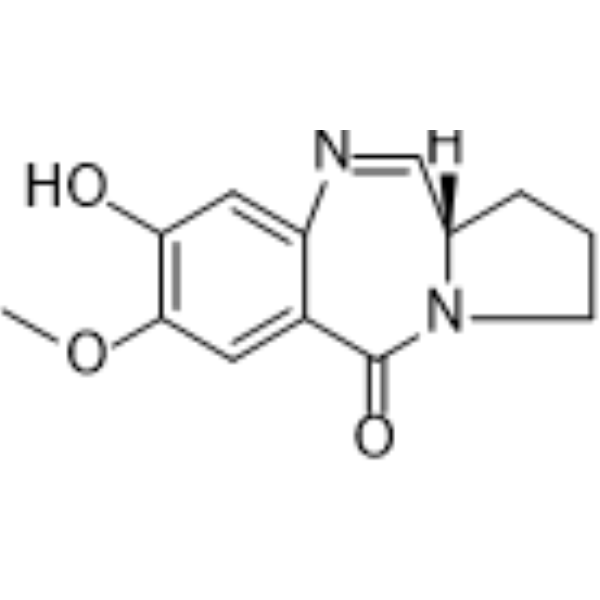 0 ImagesCat. No.: HY-107767CAS No.: 81307-24-6Synonyms: DC 81
Antibiotic DC 81 (DC 81), an antitumor antibiotic produced by Streptomyces species, is a PBD (pyrrolo[2,1-c][1,4]benzodiazepine). Antibiotic DC 81 is potent inhibitor of nucleic acid synthesis. Antibiotic DC 81 can recognize and bind to specific sequences of DNA and form a labile covalent adduct.
-
PDI-IN-5
 0 ImagesCat. No.: HY-181574CAS No.: 3097563-91-9
PDI-IN-5 (compound 30z) is an allosteric-covalent inhibitor targeting protein disulfide isomerase (PDI) with a 2-chloro-pyrrolopyrimidin-4-one scaffold, with an IC50 of 0.4 μM. PDI-IN-5 exhibits selectivity for ERp57 and GPX4, and inhibits glioblastoma. PDI-IN-5 can be used in glioblastoma-related research.

-
Swertiamarin (Standard)
 0 ImagesCat. No.: HY-N0807RCAS No.: 17388-39-5
Swertiamarin (Standard) is the analytical standard of Swertiamarin. This product is intended for research and analytical applications. Swertiamarin is an orally active iridoid compound with hypoglycemic, hypolipidemic, anti rheumatic and antioxidant activities, which can be used in the research of diabetes and arthritis.
-
hsa-miR-1202 inhibitor
 0 ImagesCat. No.: HY-RI00082
hsa-miR-1202 inhibitors are chemically-modified oligonucleotides that hybridize with mature miRNAs. The miRNA inhibitors have full-length nucleotide 2'-methoxy modification. The miRNA inhibitors strongly compete with mature miRNAs to prevent the complementary pairing of miRNAs and their target genes, thereby inhibiting miRNAs from functioning.
-
PROTAC HPK1 Degrader-4
 0 ImagesCat. No.: HY-174135
PROTAC HPK1 Degrader-4 is an orally active HPK1 PROTAC degrader and immune activator, with DC50 values of 3.16 nM and 72.59 nM in Jurkat cells and PBMCs, respectively. PROTAC HPK1 Degrader-4 induces degradation via the ubiquitin-proteasome system, downregulates the HPK1-SLP76 signaling pathway, reduces the phosphorylation level of SLP76 (S376), and promotes immune activation. PROTAC HPK1 Degrader-4 can be used in the research of colorectal cancer and B-cell lymphoma.
-
Vps34-IN-5
 0 ImagesCat. No.: HY-182378CAS No.: 1801903-15-0
Vps34-IN-5 is an orally active VPS34 inhibitor, 98% target inhibition, and an IC50 categorized as B. Vps34-IN-5 induces additive or synergistic anti-proliferative activity with EGFR inhibitors in cancer cells. Vps34-IN-5 is administered orally alone or with Erlotinib (HY-50896) in mouse xenograft models. Vps34-IN-5 can be used for the research of non-small cell lung cancer.
-
CNTO-860
 0 ImagesSynonyms: TF8-5G9
CNTO-860 is a humanized anti-tissue factor monoclonal antibody. CNTO-860 can improve tumor control when combined with Paclitaxel (HY-B0015) in colon cancer model and significantly increase tumor-free survival.
-
NSC 330770
 0 ImagesCat. No.: HY-148022CAS No.: 82585-91-9
NSC 330770, a demethylated hydrogenated molecule, is a potent tubulin polymerization inhibitor (IC50 of 2 μM). NSC 330770 elicites GTPase activity and the formation of abnormal polymers.
-
LSD1-IN-16
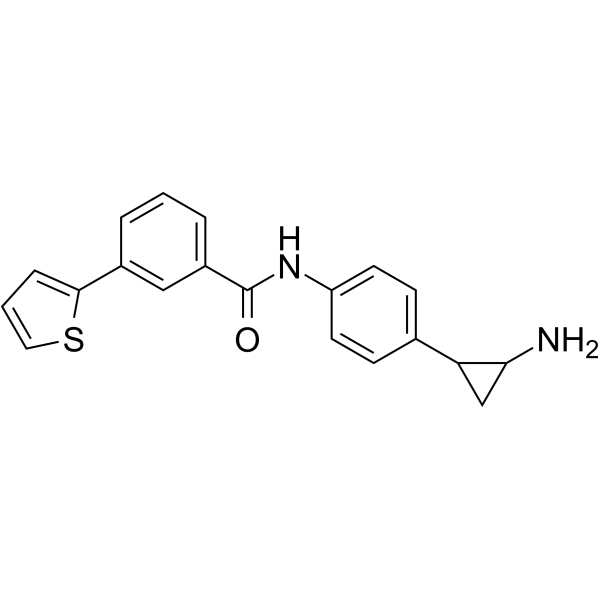 0 ImagesCat. No.: HY-144757CAS No.: 3033060-68-0
LSD1-IN-16 (compound 4b) is a potent LSD1 inhibitor. LSD1-IN-16 can inhibit LSD1-CoREST, MAO-A and MAO-B, with IC50 values of 0.015, 0.024, and 0.366 μM, respectively. LSD1-IN-16 displays cell growth arrest in prostate cancer LNCaP cells, with an IC50 of 15.2 μM.


-
hsa-miR-199b-5p antagomir
 0 ImagesCat. No.: HY-RI00400A
hsa-miR-199b-5p antagomirs are chemically-modified oligonucleotides that hybridize with mature miRNAs. The miRNA antagomirs have 2 phosphorothioates at the 5' end, 4 phosphorothioates at the 3' end, 1 cholesterol group at the 3' end, and full-length nucleotide 2'-methoxy modification. The miRNA antagomirs strongly compete with mature miRNAs to prevent the complementary pairing of miRNAs and their target genes, thereby inhibiting miRNAs from functioning. Stability of miRNA antagomirs appears to be significantly higher than miRNA inhibitors, they exhibits enhanced cellular uptake, stability and regulatory activity in vivo.
-
hsa-miR-4423-3p antagomir
 0 ImagesCat. No.: HY-RI01021A
hsa-miR-4423-3p antagomirs are chemically-modified oligonucleotides that hybridize with mature miRNAs. The miRNA antagomirs have 2 phosphorothioates at the 5' end, 4 phosphorothioates at the 3' end, 1 cholesterol group at the 3' end, and full-length nucleotide 2'-methoxy modification. The miRNA antagomirs strongly compete with mature miRNAs to prevent the complementary pairing of miRNAs and their target genes, thereby inhibiting miRNAs from functioning. Stability of miRNA antagomirs appears to be significantly higher than miRNA inhibitors, they exhibits enhanced cellular uptake, stability and regulatory activity in vivo.
-
hsa-miR-548ai inhibitor
 0 ImagesCat. No.: HY-RI01642
hsa-miR-548ai inhibitors are chemically-modified oligonucleotides that hybridize with mature miRNAs. The miRNA inhibitors have full-length nucleotide 2'-methoxy modification. The miRNA inhibitors strongly compete with mature miRNAs to prevent the complementary pairing of miRNAs and their target genes, thereby inhibiting miRNAs from functioning.
-
hsa-miR-6850-3p antagomir
 0 ImagesCat. No.: HY-RI02262A
hsa-miR-6850-3p antagomirs are chemically-modified oligonucleotides that hybridize with mature miRNAs. The miRNA antagomirs have 2 phosphorothioates at the 5' end, 4 phosphorothioates at the 3' end, 1 cholesterol group at the 3' end, and full-length nucleotide 2'-methoxy modification. The miRNA antagomirs strongly compete with mature miRNAs to prevent the complementary pairing of miRNAs and their target genes, thereby inhibiting miRNAs from functioning. Stability of miRNA antagomirs appears to be significantly higher than miRNA inhibitors, they exhibits enhanced cellular uptake, stability and regulatory activity in vivo.
-
mmu-miR-298-3p antagomir
 0 ImagesCat. No.: HY-RI02884A
mmu-miR-298-3p antagomirs are chemically-modified oligonucleotides that hybridize with mature miRNAs. The miRNA antagomirs have 2 phosphorothioates at the 5' end, 4 phosphorothioates at the 3' end, 1 cholesterol group at the 3' end, and full-length nucleotide 2'-methoxy modification. The miRNA antagomirs strongly compete with mature miRNAs to prevent the complementary pairing of miRNAs and their target genes, thereby inhibiting miRNAs from functioning. Stability of miRNA antagomirs appears to be significantly higher than miRNA inhibitors, they exhibits enhanced cellular uptake, stability and regulatory activity in vivo.



