



Cancer Targeted Therapy
Cancer targeted therapy is the foundation of precision medicine; it uses drugs or other substances to target specific genes and proteins that control cancer cells’ growth, division and spreading. Compared to traditional chemotherapy drugs, targeted-drugs can specifically act on cancer cells with high efficacy without damaging normal cells. Drugs used in cancer targeted therapy mainly includes small molecules and macromolecules (e.g., monoclonal antibodies), which can target cancer cells and constituents in the tumor microenvironment to activate the immune system. Anti-angiogenesis drugs, such as those targeting vascular endothelial growth factor (VEGF), epidermal growth factor receptor (EGFR), transforming growth factor (TGF)-α, TGF-β, Tumor necrosis factor (TNF)-α, and platelet-derived endothelial growth factor (PDGFR) inhibit the proliferation and metastasis of cancer cells. In recent years, the proportion of antibody drugs in cancer treatment has gradually become prominent. Antibody-drug conjugates (ADCs) are a new type of targeted drugs that are composed of monoclonal antibody, cytotoxic drug and linker. ADCs can deliver drugs to tumor cells and minimize the toxicity to normal tissues. Proteolysis-targeting chimera (PROTAC) is a useful technology for targeted protein degradation. PROTAC exploits the ubiquitin-proteasome system and forms a ternary complex with a hijacked E3 ubiquitin ligase and target protein, leading to polyubiquitination and degradation of the target protein.
Targeted therapy is a useful strategy in treatment of cancer either alone or in combination with standard chemotherapy. At present, targeted therapy has proved significant clinical success in the treatment of many types of cancer, including breast cancer, colorectal cancer, leukemia, ovarian cancer and lung cancer.
-
hsa-miR-4470 inhibitor
 0 ImagesCat. No.: HY-RI01074
hsa-miR-4470 inhibitors are chemically-modified oligonucleotides that hybridize with mature miRNAs. The miRNA inhibitors have full-length nucleotide 2'-methoxy modification. The miRNA inhibitors strongly compete with mature miRNAs to prevent the complementary pairing of miRNAs and their target genes, thereby inhibiting miRNAs from functioning.
-
hsa-miR-548o-3p antagomir
 0 ImagesCat. No.: HY-RI01694A
hsa-miR-548o-3p antagomirs are chemically-modified oligonucleotides that hybridize with mature miRNAs. The miRNA antagomirs have 2 phosphorothioates at the 5' end, 4 phosphorothioates at the 3' end, 1 cholesterol group at the 3' end, and full-length nucleotide 2'-methoxy modification. The miRNA antagomirs strongly compete with mature miRNAs to prevent the complementary pairing of miRNAs and their target genes, thereby inhibiting miRNAs from functioning. Stability of miRNA antagomirs appears to be significantly higher than miRNA inhibitors, they exhibits enhanced cellular uptake, stability and regulatory activity in vivo.
-
UC-773587
 0 ImagesCat. No.: HY-122685CAS No.: 116679-70-0
UC-773587 is a selective SOS1 catalytic activity inhibitor. UC-773587 binds to the catalytic site of Sos1 over HRas and ITSN (a RhoGEF) and inhibits nucleotide exchange with an IC50 value of 4.5 μM. UC-773587 mappes to the Ras switch II interaction region of the Sos1 catalytic site. UC-773587 can be used for the study of prostate cancer.
-
Avenanthramide A (Standard)
 0 ImagesCat. No.: HY-114977RCAS No.: 108605-70-5
Avenanthramide A (Standard) is the analytical standard of Avenanthramide A. This product is intended for research and analytical applications. Avenanthramide A is an orally active phytoalexin that targets the RNA helicase DDX3 with a KD of 8.8 μM. Avenanthramide A induces mitochondrial swelling and increased ROS production, and triggers apoptosis in CRC cells. Avenanthramide A inhibits smooth muscle cell proliferation and enhances nitric oxide production. Avenanthramide A can be used in research on colorectal cancer and atherosclerosis.
-
PTPN2-IN-2
 0 ImagesCat. No.: HY-179380CAS No.: 3093350-44-5
PTPN2-IN-2 is a potent and orally active PTPN2 inhibitor (IC50 = 7.05 nM) that enhances the IFN-γ signaling pathway. PTPN2-IN-2 inhibits PTP1B with an IC50 of 9.88 nM. PTPN2-IN-2 inhibits tumor growth, promotes the activation and infiltration of tumor immune cells in a B16-OVA mouse model. PTPN2-IN-2 can be used for the research of melanoma.
-
hsa-miR-6852-5p inhibitor
 0 ImagesCat. No.: HY-RI02267
hsa-miR-6852-5p inhibitors are chemically-modified oligonucleotides that hybridize with mature miRNAs. The miRNA inhibitors have full-length nucleotide 2'-methoxy modification. The miRNA inhibitors strongly compete with mature miRNAs to prevent the complementary pairing of miRNAs and their target genes, thereby inhibiting miRNAs from functioning.
-
T-10531
 0 ImagesCat. No.: HY-183604CAS No.: 3129176-25-3
T-10531 is a selective USP25/USP28 inhibitor. T-10531 exhibits an IC50 of 0.03 μM and a Kd of 0.2 μM against human USP25, as well as an IC50 of 0.12 μM and a Kd of 0.06 μM against human USP28. T-10531 inhibits USP25/USP28 activity and induces the degradation of USP25 via the proteasomal pathway, without inhibiting other deubiquitinases. T-10531 can be used in the research of squamous cell carcinoma, colorectal cancer, gastric cancer, triple-negative breast cancer and pancreatic cancer.
-
mmu-miR-29b-1-5p inhibitor
 0 ImagesCat. No.: HY-RI02889
mmu-miR-29b-1-5p inhibitors are chemically-modified oligonucleotides that hybridize with mature miRNAs. The miRNA inhibitors have full-length nucleotide 2'-methoxy modification. The miRNA inhibitors strongly compete with mature miRNAs to prevent the complementary pairing of miRNAs and their target genes, thereby inhibiting miRNAs from functioning.
-
mmu-miR-6897-5p inhibitor
 0 ImagesCat. No.: HY-RI03514
mmu-miR-6897-5p inhibitors are chemically-modified oligonucleotides that hybridize with mature miRNAs. The miRNA inhibitors have full-length nucleotide 2'-methoxy modification. The miRNA inhibitors strongly compete with mature miRNAs to prevent the complementary pairing of miRNAs and their target genes, thereby inhibiting miRNAs from functioning.
-
mmu-miR-802-3p inhibitor
 0 ImagesCat. No.: HY-RI04135
mmu-miR-802-3p inhibitors are chemically-modified oligonucleotides that hybridize with mature miRNAs. The miRNA inhibitors have full-length nucleotide 2'-methoxy modification. The miRNA inhibitors strongly compete with mature miRNAs to prevent the complementary pairing of miRNAs and their target genes, thereby inhibiting miRNAs from functioning.
-
Argatroban solution
 0 ImagesCat. No.: HY-FLB0375ACAS No.: 141396-28-3Synonyms: MD-805 monohydrate solution; MCI-9038 monohydrate solution
Argatroban solution is mainly composed of Argatroban monohydrate (HY-B0375A). Argatroban monohydrate is a direct, selective thrombin inhibitor with anticoagulant properties, and can be used to alleviate motor paralysis caused by ischemic cerebral infarction.
-
Thymine-d4
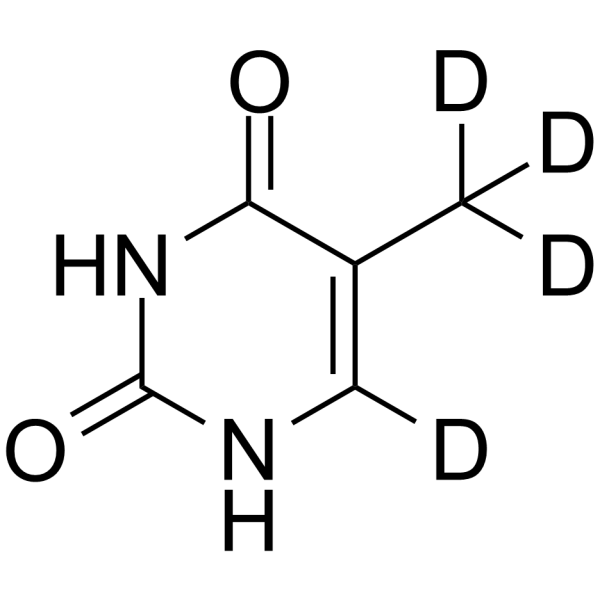 0 ImagesCat. No.: HY-W010450SCAS No.: 200496-79-3
-
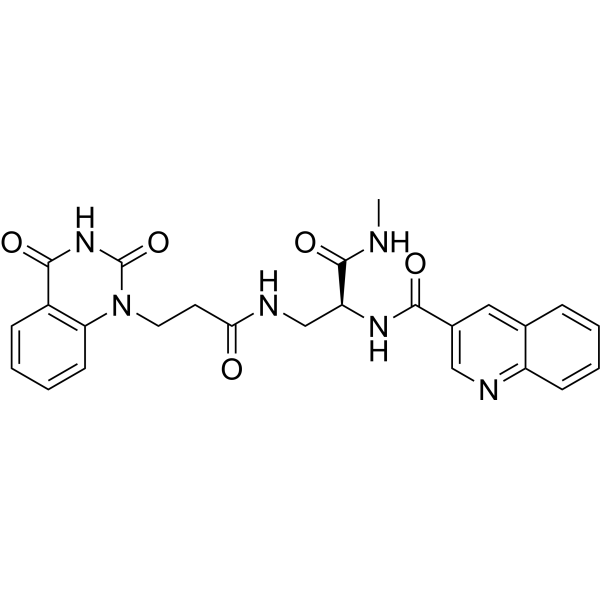
BrP-LPA sodium
 0 ImagesCat. No.: HY-148291CAS No.: 944265-88-7
BrP-LPA sodium is a pan-opposite agent for lysophosphatidic acid (LPA). It has antagonistic activity against LPA1 (IC50 = 4520 nM), LPA2 (IC50 = 468 nM), LPA3, and LPA4. BrP-LPA sodium also has partial agonistic activity for LPA5, with its EC50 being 1282 nM. BrP-LPA sodium has ATX inhibitory activity. BrP-LPA sodium effectively inhibits the migration and invasion of breast cancer cells. BrP-LPA sodium achieves tumor regression and anti-angiogenesis in mice breast cancer xenograft model. BrP-LPA sodium can be used for the study of breast cancer.
-
Tubulin inhibitor 40
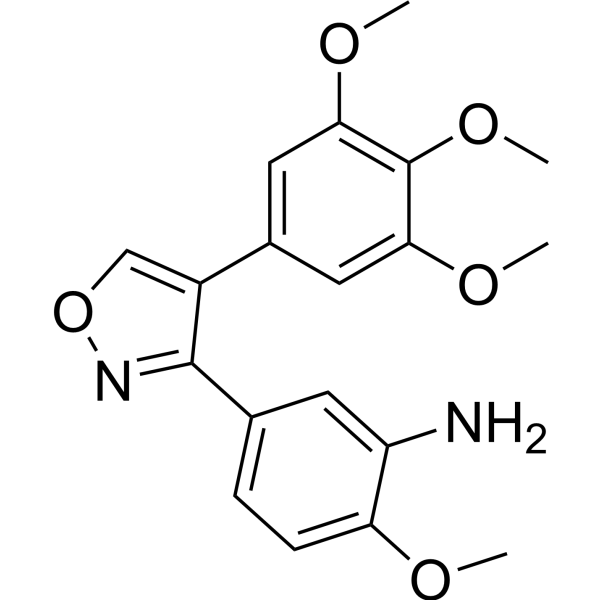 0 ImagesCat. No.: HY-163195CAS No.: 3026839-57-3
Tubulin inhibitor 40 (compound 45) is a tubulin inhibitor with IC50 of 1.2 μM. Tubulin inhibitor 40 shows selective cytotoxicity towards cancer cells. Tubulin inhibitor 40 processes antitumor activity .

-
Hyp-dBET1
 0 ImagesCat. No.: HY-173256
Hyp-dBET1 is a hypoxia-activated BRD4 PROTAC degrader. The IC50 of Hyp-dBET1 for reducing cell viability under hypoxic conditions is approximately 153 nM to 192 nM, while it shows low activity under normoxic conditions (IC50 of approximately 2.8 μM to 3.8 μM). Hyp-dBET1 induces BRD4 degradation under hypoxic conditions, converts to dBET1 in hypoxic environments, and downregulates the expression level of ZFP-91. Hyp-dBET1 can be used in studies related to breast cancer, cervical cancer and solid tumors.
-
(R)-HM5023507
 0 ImagesCat. No.: HY-177277ACAS No.: 1549740-86-4
(R)-HM5023507 (Compound 470) is a potential PI3K inhibitor. (R)-HM5023507 can be used for the research of cancer, inflammatory, allergic and autoimmune diseases and leukemia etc.
-
hsa-miR-31-5p inhibitor
 0 ImagesCat. No.: HY-RI00613
hsa-miR-31-5p inhibitors are chemically-modified oligonucleotides that hybridize with mature miRNAs. The miRNA inhibitors have full-length nucleotide 2'-methoxy modification. The miRNA inhibitors strongly compete with mature miRNAs to prevent the complementary pairing of miRNAs and their target genes, thereby inhibiting miRNAs from functioning.
-
hsa-miR-4669 inhibitor
 0 ImagesCat. No.: HY-RI01234
hsa-miR-4669 inhibitors are chemically-modified oligonucleotides that hybridize with mature miRNAs. The miRNA inhibitors have full-length nucleotide 2'-methoxy modification. The miRNA inhibitors strongly compete with mature miRNAs to prevent the complementary pairing of miRNAs and their target genes, thereby inhibiting miRNAs from functioning.



