



Autophagy
Autophagy is a conserved cellular degradation and recycling process in the lysosome. In mammalian cells, there are three primary types of autophagy: microautophagy, macroautophagy, and chaperone-mediated autophagy (CMA). Microphagy captures cargoes by means of invaginations or protrusions of the lysosomal membrane directly, CMA uses chaperones to identify cargo proteins and then unfolds and transfers them into the lysosomal, while macroautophagy sequesters cargo by autophagosomes-de novo synthesized of double-membrane vesicles-and subsequently transport it to the lysosome.
Macroautophagy is the best studied and it occurs at a low level constitutively and can also be further induced under stress conditions, such as nutrient or energy starvation with a salient feature of autophagy protein degradation. Stress-induced macrophagy plays an important role in protein catabolism with another key protein degradation pathway, the ubiquitin–proteasome system (UPS).
As the study progressed, autophagy gains its importance under basal, nutrient-rich conditions, and is now recognized as a critical housekeeping pathway in catabolism of diverse cellular constituents, such as protein aggregates (aggrephagy), lipid droplets (lipophagy), iron complex (Ferritinophagy) and carbohydrate. Except for macromolecules, autophagy can also target several organelles and structures, such as mitochondria (mitophagy), peroxisome (pexophagy), endoplasmic reticulum (reticulophagy or ER-phagy), ribosome (ribophagy), spermatozoon-inherited organelles following fertilization (allophagy), secretory granules within pancreatic cells (zymophagy) and intracellular pathogens (xenophagy).
Autophagy and its dysfunction are associated with a variety of human pathologies, including ageing, cancer, neurodegenerative disease, heart disease and metabolic diseases, such as diabetes. Plenty of drugs and natural products are involved in autophagy modulation through multiple signaling pathways. Small molecules that can regulate autophagy seem to have great potential to intervene such diseases in animal models or clinical courses.
All Product Categories
-
Autophagy Inhibitors
(488)
View all products
-
Autophagy Agonists
(6)
View all products
-
Autophagy Activators
(124)
View all products
-
Autophagy Modulators
(59)
View all products
-
Autophagy Chemicals
(2)
View all products
-
Autophagy Inducers
(2220)
View all products
-
Autophagy Controls
(5)
View all products
-
Autophagy Ligand
(1)
View all products
-
Autophagy Related Products (3441)
Related Products (3441)

-
Antibodies (31)
-
Autophagy Signaling Pathway
-
FAAH-IN-2 (Standard)
 0 ImagesCat. No.: HY-79511RCAS No.: 184475-71-6Synonyms: O-Desmorpholinopropyl Gefitinib (Standard)
-
TA-02 (Standard)
 0 ImagesTA-02 (Standard) is the analytical standard of TA-02 (HY-100115). This product is intended for research and analytical applications. TA-02, an analog of SB 203580 (HY-10256), is a p38 MAPK inhibitor with an IC50 of 20 nM. TA-02 especially inhibits TGFBR-2. TA-02 exhibits similar cardiogenic properties as SB 203580 and SB 202190 (HY-10295).
-
Isoliquiritigenin (Standard)
 0 ImagesSynonyms: GU17 (Standard); ISL (Standard); Isoliquiritigen (Standard); SJ000286237 (Standard)Isoliquiritigenin (Standard) is the analytical standard of Isoliquiritigenin. This product is intended for research and analytical applications. Isoliquiritigenin is an anti-tumor flavonoid from the root of Glycyrrhiza uralensis Fisch., which inhibits aldose reductase with an IC50 of 320 nM. Isoliquiritigenin is a potent inhibitor of influenza virus replication with an EC50 of 24.7 μM.
-
Tazarotene-13C6
 0 ImagesCat. No.: HY-15388S2Synonyms: AGN 190168-13C6Tazarotene-13C6 (AGN 190168-13C6) is 13C labeled Tazarotene. Tazarotene (AGN 190168) is a selective retinoic acid receptor (RAR) agonist for the treatment of plaque psoriasis and acne vulgaris. Tazarotene is a click chemistry reagent, it contains an Alkyne group and can undergo copper-catalyzed azide-alkyne cycloaddition (CuAAc) with molecules containing Azide groups.
-
NAcM-OPT hydrochloride
 0 ImagesCat. No.: HY-111505ACAS No.: 2416146-10-4NAcM-OPT (hydrochloride) is a protein interaction inhibitor. NAcM-OPT (hydrochloride) can disrupt the interaction between DCN1 and UBC12, with an IC50 value of 80 nM. NAcM-OPT (hydrochloride) can protect keratinocytes from H2O2-induced cell damage by promoting autophagy.
-
Silmitasertib (Standard)
 0 ImagesSynonyms: CX-4945 (Standard)Silmitasertib (Standard) is the analytical standard of Silmitasertib. This product is intended for research and analytical applications. Silmitasertib (CX-4945) is an orally bioavailable, highly selective and potent CK2 inhibitor, with IC50 values of 1 nM against CK2α and CK2α'.
-
10074-G5 (Standard)
 0 ImagesCat. No.: HY-100996RCAS No.: 413611-93-5
-
SD 0006 (Standard)
 0 ImagesCat. No.: HY-11087RCAS No.: 271576-80-8Synonyms: SD-06 (Standard)
-
Nesolicaftor (Standard)
 0 ImagesCat. No.: HY-111680RCAS No.: 1953130-87-4Synonyms: PTI-428 (Standard)Nesolicaftor (Standard) is the analytical standard of Nesolicaftor (HY-111680). This product is intended for research and analytical applications. Nesolicaftor (PTI-428) is a specific cystic fibrosis transmembrane conductance regulator (CFTR) amplifier.
-
Crizotinib (Standard)
 0 ImagesSynonyms: PF-02341066 (Standard)Crizotinib (Standard) is the analytical standard of Crizotinib. This product is intended for research and analytical applications. Crizotinib (PF-02341066) is an orally bioavailable, ATP-competitive ALK and c-Met inhibitor with IC50s of 20 and 8 nM, respectively. Crizotinib inhibits tyrosine phosphorylation of NPM-ALK and tyrosine phosphorylation of c-Met with IC50s of 24 and 11 nM in cell-based assays, respectively. Crizotinib is also a ROS1 inhibitor. Crizotinib has effective tumor growth inhibition.
-
EIPA hydrochloride (Standard)
 0 ImagesSynonyms: L593754 hydrochloride (Standard); MH 12-43 hydrochloride (Standard); Ethylisopropylamiloride hydrochloride (Standard)EIPA (hydrochloride) (Standard) is the analytical standard of EIPA (hydrochloride). This product is intended for research and analytical applications. EIPA (L593754) hydrochloride is an orally active TRPP3 channel inhibitor with an IC50 of 10.5 μM. EIPA hydrochloride also enhances autophagy by inhibiting Na+/H+-exchanger 3 (NHE3). EIPA hydrochloride inhibits macropinocytosis as well. EIPA hydrochloride can be used in the research of inflammation and cancers, such as gastric cancer, colon carcinoma, pancreatic carcinoma.
-
Vandetanib trifluoroacetate
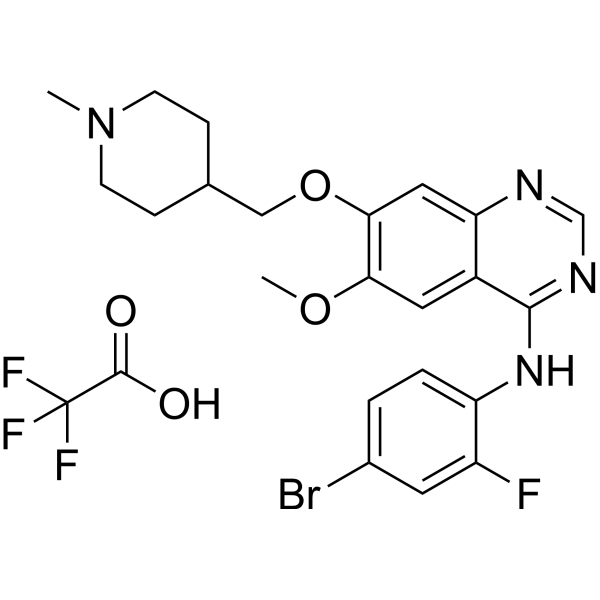 0 ImagesCat. No.: HY-10260ACAS No.: 338992-53-3Synonyms: ZD6474 trifluoroacetateVandetanib trifluoroacetate (D6474 trifluoroacetate) is a potent, orally active inhibitor of VEGFR2/KDR tyrosine kinase activity (IC50=40 nM). Vandetanib trifluoroacetate also has activity versus the tyrosine kinase activity of VEGFR3/FLT4 (IC50=110 nM) and EGFR/HER1 (IC50=500 nM).
-
Veliparib dihydrochloride (Standard)
 0 ImagesCat. No.: HY-10130RCAS No.: 912445-05-7Synonyms: ABT-888 dihydrochloride (Standard)Veliparib (dihydrochloride) (Standard) is the analytical standard of Veliparib (dihydrochloride) (HY-10130). This product is intended for research and analytical applications. Veliparib (dihydrochloride) is a potent inhibitor of PARP1 and PARP2 with Kis of 5.2 nM and 2.9 nM in cell-free assays, respectively.
-
Lapatinib-d7
 0 ImagesCat. No.: HY-50898S4CAS No.: 1009307-23-6Synonyms: GW572016-d7; GW2016-d7
-
Retinoic acid-d3-1
 0 ImagesCat. No.: HY-14649S6CAS No.: 3041101-53-2Synonyms: Vitamin A acid-d3-1; all-trans-Retinoic acid-d3-1; ATRA-d3-1Retinoic acid-d3-1 is the deuterium labeled Retinoic acid (HY-14649). Retinoic acid is a metabolite of vitamin A that plays important roles in cell growth, differentiation, and organogenesis. Retinoic acid is a natural agonist of RAR nuclear receptors, with IC50s of 14 nM for RARα/β/γ. Retinoic acid bind to PPARβ/δ with Kd of 17 nM. Retinoic acid acts as an inhibitor of transcription factor Nrf2 through activation of retinoic acid receptor alpha.
-
Pazopanib (Standard)
 0 ImagesSynonyms: GW786034 (Standard)Pazopanib (Standard) is the analytical standard of Pazopanib. This product is intended for research and analytical applications. Pazopanib (GW786034) is a novel multi-target inhibitor of VEGFR1, VEGFR2, VEGFR3, PDGFRβ, c-Kit, FGFR1, and c-Fms with IC50s of 10, 30, 47, 84, 74, 140 and 146 nM, respectively.
-
SMER28 (Standard)
 0 ImagesCat. No.: HY-100200RCAS No.: 307538-42-7
-
N-Desmethyl clomipramine-d6
 0 ImagesCat. No.: HY-12388S1Synonyms: Desmethylclomipramine-d6; Norclomipramine-d6N-Desmethyl clomipramine-d6 (Desmethylclomipramine-d6; Norclomipramine-d6) is the deuterated-labeled N-Desmethyl clomipramine (HY-12388). N-Desmethyl clomipramine (Desmethylclomipramine; Norclomipramine) is the orally active major active metabolite of the tricyclic antidepressant Clomipramine (HY-B0457A), possessing multiple activities including anti-inflammatory, antioxidant, antibacterial, and antiparasitic effects. N-Desmethyl clomipramine blocks autophagosome-lysosome fusion, leading to the accumulation of LC3-II, p62, ATG7, WIPI2, and ATG5-12, reactivates the p53/p21 pathway, induces apoptosis through C-PARP and C-CAS3, and inhibits the proliferation, migration, and invasion of renal cancer cells. N-Desmethyl clomipramine inhibits LdTOPIA, inducing R-loop accumulation in the nucleus of Leishmania, ultimately causing parasite death. N-Desmethyl clomipramine can be used for research on depression, metastatic renal cell carcinoma, and leishmaniasis.
-
TPEN (Standard)
 0 ImagesSynonyms: TPEDA (Standard)TPEN (Standard) is the analytical standard of TPEN (HY-100202). This product is intended for research and analytical applications. TPEN (TPEDA) is a specific cell-permeable heavy metal chelator. TPEN has a higher affinity for Zn2+, but a lower affinity for Mg2+ and Ca2+. TPEN induces DNA damage and increases intracellular ROS production. TPEN also inhibits cell proliferation and induces apoptosis.
-
Efavirenz-d5
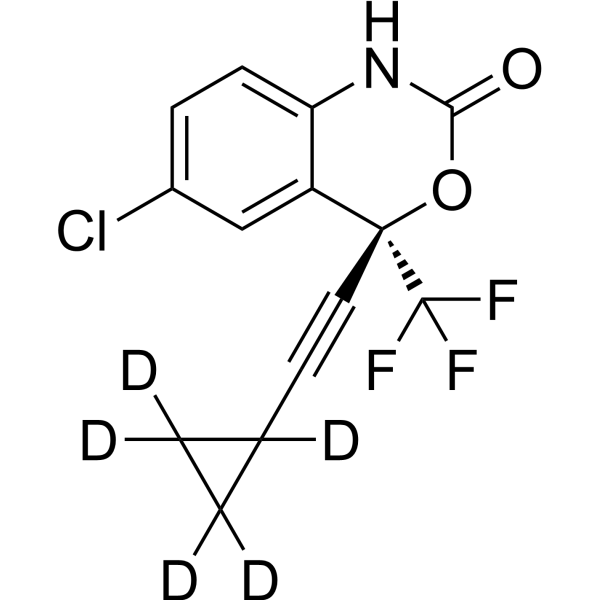 0 ImagesCat. No.: HY-10572SCAS No.: 1132642-95-5Efavirenz-d5 (DMP 266-d5) is the deuterium labeled Efavirenz. Efavirenz (DMP 266) is a potent inhibitor of the wild-type HIV-1 reverse transcriptase with a Ki of 2.93 nM and exhibits an IC95 of 1.5 nM for the inhibition of HIV-1 replicative spread in cell culture. Efavirenz-d5 is a click chemistry reagent, it contains an Alkyne group and can undergo copper-catalyzed azide-alkyne cycloaddition (CuAAc) with molecules containing Azide groups.




