



Bacterial
Anything that destroys bacteria or suppresses their growth or their ability to reproduce. Heat, chemicals such as chlorine, and antibiotic drugs all have antibacterial properties. Many antibacterial products for cleaning and handwashing are sold today. Such products do not reduce the risk for symptoms of viral infectious diseases in otherwise healthy persons. This does not preclude the potential contribution of antibacterial products to reducing symptoms of bacterial diseases in the home.
All Product Categories
-
Bacterial Inhibitors
(7553)
View all products
-
Bacterial Agonists
(3)
View all products
-
Bacterial Antagonists
(9)
View all products
-
Bacterial Activators
(25)
View all products
-
Bacterial Modulators
(27)
View all products
-
Bacterial Chemicals
(2)
View all products
-
Bacterial Inducers
(6)
View all products
-
Bacterial Controls
(14)
View all products
-
Bacterial Substrates
(2)
View all products
-
Bacterial Ligand
(1)
View all products
-
Bacterial Related Products (8893)
Related Products (8893)

-
Antibodies (14)
-
Related Compound Screening Libraries (1)
-
Netzahualcoyone
 0 ImagesCat. No.: HY-126662CAS No.: 87686-36-0Netzahualcoyone is a triterpenoid compound isolated from the Celastraceae plant family. Netzahualcoyone exhibits broad-spectrum antibiotic activity against Gram-positive bacteria and yeasts, but is not active against Gram-negative bacteria. Netzahualcoyone can be utilized in the development of antibiotics and for studying antimicrobial mechanisms.
-
BPH-1086
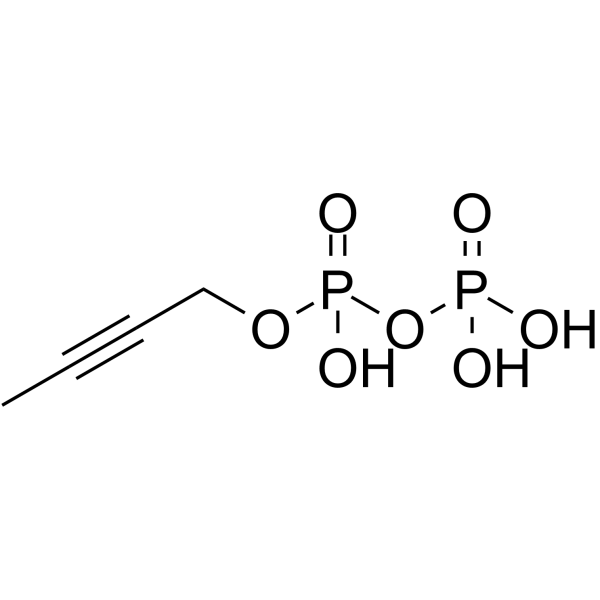 0 ImagesCat. No.: HY-147304CAS No.: 1226901-43-4
-
Momilactone A
 0 ImagesCat. No.: HY-N11293CAS No.: 51415-07-7Momilactone A is a naturally derived diterpene lactone with multiple biological activities including anticancer, antibacterial and antioxidant properties. Momilactone A inhibits inflammatory responses by reducing NO production and iNOS expression. Momilactone A acts as a corrosion inhibitor for mild steel; it forms an isolating film on the metal surface via adsorption between oxygen atoms of the molecule and iron ions, thereby blocking corrosive media. Momilactone A inhibits the growth of fungal and bacterial organisms, and also functions as an allelochemical to inhibit the growth of adjacent competing plants. Momilactone A can be used in studies related to leukemia, fungal infections and bacterial infections.
-
Glenthmycin L
 0 ImagesCat. No.: HY-N19214CAS No.: 3040055-91-9Glenthmycin L is a potent antibiotic that can be found in Australian sheep pasture-derived Streptomyces sp. CMB-PB041. Glenthmycin L exhibits antibacterial activity against Gram-positive bacterial pathogens including Staphylococcus aureus, Enterococcus faecalis, Methicillin (HY-B0974)-resistant Staphylococcus aureus, and Vancomycin (HY-B0671)-resistant Enterococci. Glenthmycin L can be used for the research of bacterial infections caused by Gram-positive pathogens.
-
XT-4
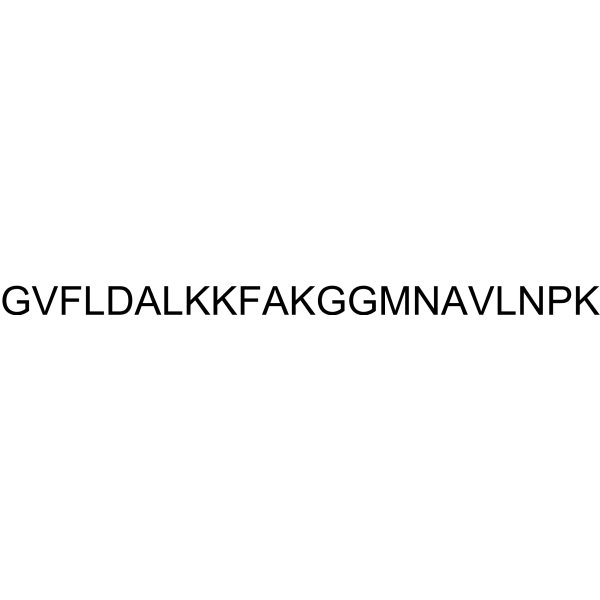 0 ImagesCat. No.: HY-P5627CAS No.: 398143-81-2XT-4 is an antimicrobial peptide derived from skin secretions of Xenopus tropicalis. XT-4 has strong activity against E.coli, the vaule of MIC is 18 μM.
-
(RFR)4XB
 0 ImagesCat. No.: HY-P10565CAS No.: 1139931-15-9(RFR)4XB is a cationic membrane-penetrating peptide. (RFR)4XB carries its cargo (the antisense oligomer) across the outer membrane of gram-negative bacteria.
-
Corylifol B
 0 ImagesCat. No.: HY-N21579CAS No.: 775351-90-1Corylifol B is an antibacterial agent and an isoprenyl flavonoid compound. Corylifol B can be used in research on bacterial infections.
-
Varacin
 0 ImagesCat. No.: HY-N21817CAS No.: 134029-48-4Varacin is a benzopentathiepin polysulfide derived from marine ascidians. It exerts cytotoxic, antibacterial, and antifungal activities by cleaving DNA through a redox pathway. Varacin can be used in research on cancer, fungal infections, and bacterial infections.
-
Deoxymorellin
 0 ImagesDeoxymorellin is a caged xanthone found in resins and fruits of Garcinia hanburyi hook. f.. Deoxymorellin exhibits cytotoxicity. Deoxymorellin can be used for research of Methicillin (HY-121544)-resistant or Methicillin-susceptible Staphylococcus aureus.
-
Thioridazine hydrochloride (Standard)
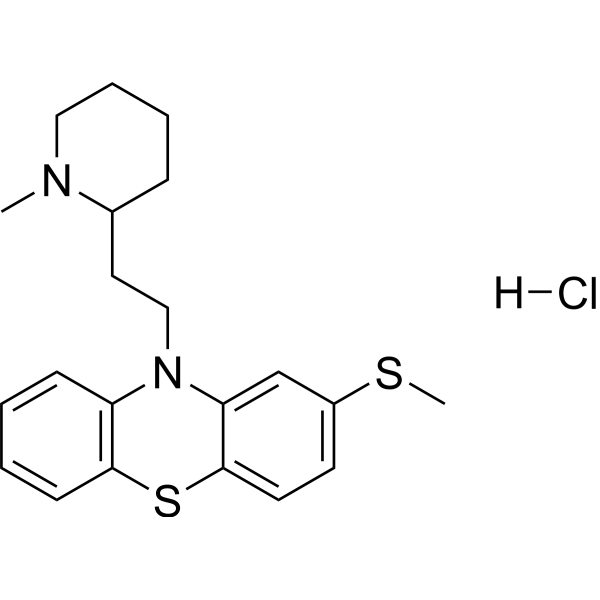 0 ImagesThioridazine (hydrochloride) (Standard) is the analytical standard of Thioridazine (hydrochloride). This product is intended for research and analytical applications. Thioridazine hydrochloride, an orally active antagonist of the dopamine receptor D2 family proteins, exhibits potent anti-psychotic and anti-anxiety activities. Thioridazine hydrochloride is also a potent inhibitor of PI3K-Akt-mTOR signaling pathways with anti-angiogenic effect. Thioridazine hydrochloride shows antiproliferative and apoptosis induction effects in various types of cancer cells, with specificity on targeting cancer stem cells (CSCs).
-
Rifamexil
 0 ImagesCat. No.: HY-135285CAS No.: 113102-19-5Rifamexil is an antibiotic Rifamycin (HY-B1907A) derivative that is active against Mycobacterium avium complex and other mycobacteria.
-
Cephalexin hydrochloride (Standard)
 0 ImagesSynonyms: Cefalexin hydrochloride (Standard); Cephacillin hydrochloride (Standard)Cephalexin (hydrochloride) (Standard) is the analytical standard of Cephalexin (hydrochloride). This product is intended for research and analytical applications. Cephalexin (Cefalexin) hydrochloride is a potent, orally active new semisynthetic cephalosporin antibiotic with a broad antibacterial spectrum. Cephalexin (Cefalexin) hydrochloride has antibacterial activity against a wide variety of gram-positive and gram-negative bacteria. Cephalexin (Cefalexin) hydrochloride targets penicillin-binding proteins (PBPs) to inhibit bacterial cell wall assembly. Cephalexin (Cefalexin) hydrochloride is used for the research of pneumonia, strep throat, and bacterial endocarditis, et al[1][2].
-
Antibacterial agent 31
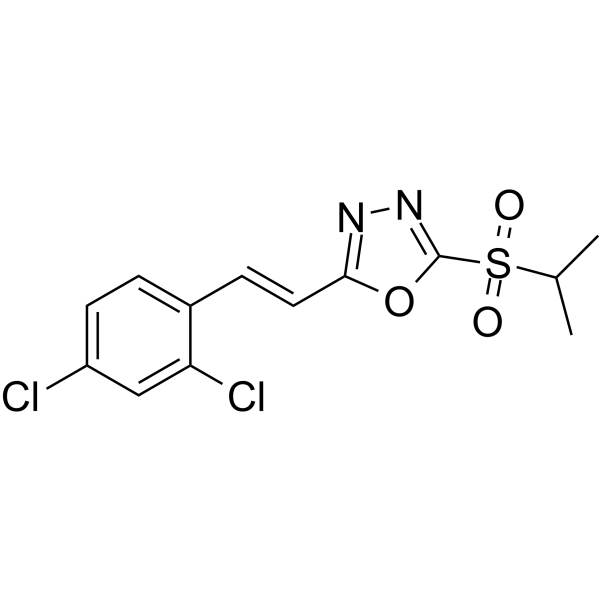 0 ImagesCat. No.: HY-139739CAS No.: 2719842-14-3
-
Emestrin
 0 ImagesCat. No.: HY-N8501CAS No.: 97816-62-1Emestrin is a mycotoxin originally isolated from E. striata that has antimicrobial, immunomodulatory, and cytotoxic activities. It is active against the fungi C. albicans and C. neoformans, as well as the bacteria E. coli, S. aureus, and methicillin-resistant S. aureus (MRSA; IC50s=3.94, 0.6, 2.21, 4.55, and 2.21 μg/mL, respectively).2 Emestrin is a chemokine (C-C motif) receptor 2 (CCR2) antagonist (IC50=5.4 μM in a radioligand binding assay using isolated human monocytes).3 Emestrin (0.1 μg/mL) induces apoptosis in HL-60 cells. It induces heart, thymus, and liver tissue necrosis in mice when administered at doses ranging from 18 to 30 mg/kg.
-
3,4-Dihydroxyallylbenzene 3,4-di-O-glucoside
 0 ImagesCat. No.: HY-N12325CAS No.: 454473-97-33,4-Dihydroxyallylbenzene 3,4-di-O-glucoside (Compound 4) is a phenylpropanoid glycoside. 3,4-Dihydroxyallylbenzene 3,4-di-O-glucoside is found in the the dragon’s blood of Dracaena cambodiana. 3,4-Dihydroxyallylbenzene 3,4-di-O-glucoside exhibits antibacterial activity.
-
DZ-2640
 0 ImagesCat. No.: HY-19246CAS No.: 184633-88-3DZ-2640 is an orally active Carbapenem antibiotic, a prodrug of DU-6681 (HY-19247). DU-6681 exhibits antibacterial activity against a broad spectrum of gram-positive and -negative bacteria.
-
N-19004
 0 ImagesCat. No.: HY-178919CAS No.: 2996841-28-0N-19004 is a FPR1 antagonist. N-19004 shows broad-spectrum antibacterial effects against a variety of pathogens. N-19004 exhibits significant retinal protective effects in the rd10 mouse model of retinitis pigmentosa (RP). N-19004 can attenuate retinal dysfunction, mitigate rod and cone degeneration, and reduce immune cell activation, gliosis, inflammation, oxidative stress, and apoptosis. N-19004 can reduce the size of laser-induced choroidal lesions and promote edema absorption through dual anti-inflammatory and anti-angiogenic effects. N-19004 can be used for the research of retinal degenerative diseases such as retinitis pigmentosa.
-
Geministatin B
 0 ImagesCat. No.: HY-N19233Geministatin B is a potent antibiotic that can be found in the fungus Austroacremonium gemini MST-FP2131. Geministatin B exhibits antibacterial activity against Gram-positive bacteria including Bacillus subtilis, Staphylococcus aureus, and methicillin-resistant S. aureus (MRSA). Geministatin B can be used for the research of bacterial infections.
-
Butylparaben-d9
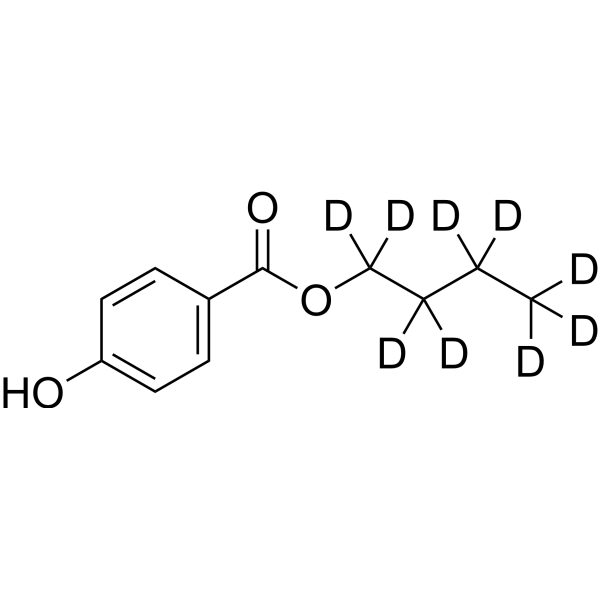 0 ImagesCat. No.: HY-B1431S2CAS No.: 1216904-65-2Synonyms: Butyl parahydroxybenzoate-d9; Butyl paraben-d9; Butyl 4-hydroxybenzoate-d9Butylparaben-d9 (Butyl parahydroxybenzoate-d9; Butyl paraben-d9) is a deuterium labeled Butylparaben (HY-B1431).
-
Lexithromycin (Standard)
 0 ImagesCat. No.: HY-105932RCAS No.: 53066-26-5Synonyms: Erythromycin A 9-methoxime (Standard); Wy 48314 (Standard)Lexithromycin (Standard) is the analytical standard of Lexithromycin. This product is intended for research and analytical applications. Lexithromycin is an erythromycin A derivative, with antibacterial activity.




