



Bcl-2 Family
Bcl-2 is a family of evolutionarily related proteins. These proteins govern mitochondrial outer membrane permeabilization (MOMP) and can be either pro-apoptotic (Bax, Bad, Bak and Bok among others) or anti-apoptotic (including Bcl-2 proper, Bcl-xL, and Bcl-w, among an assortment of others). There are a total of 25 genes in the Bcl-2 family known to date. Human genes encoding proteins that belong to this family include: Bak1, Bax, Bal-2, Bok, Mcl-1.
Bcl-2 Family Isoform Specific Products
-
Bcl-2 Family
(448)
View all products
-
Bcl-2
(320)
View all products
-
Bcl-xL
(123)
View all products
-
Bcl-W
(17)
View all products
-
Mcl-1
(97)
View all products
-
Bfl-1
(11)
View all products
-
Bcl-B
(6)
View all products
-
Bax
(213)
View all products
-
Bak
(14)
View all products
-
Bim
(14)
View all products
-
BNIP3
(1)
View all products
-
Bad
(10)
View all products
All Product Categories
-
Bcl-2 Family Inhibitors
(564)
View all products
-
Bcl-2 Family Agonists
(5)
View all products
-
Bcl-2 Family Antagonists
(9)
View all products
-
Bcl-2 Family Activators
(89)
View all products
-
Bcl-2 Family Modulators
(148)
View all products
-
Bcl-2 Family Inducers
(12)
View all products
-
Bcl-2 Family Degraders
(21)
View all products
-
Bcl-2 Family Controls
(2)
View all products
-
Bcl-2 Family Ligands
(9)
View all products
-
Bcl-2 Family Related Products (1035)
Related Products (1035)

-
Antibodies (31)
-
Bcl-2 Family Signaling Pathway
-
Bcl-2 Family Isoform Comparison
-
BCL2/BAX modulator-1
 0 ImagesCat. No.: HY-189216CAS No.: 1416344-06-3BCL2/BAX modulator-1 is an orally active BCL2/BAX modulator and apoptosis inducer. BCL2/BAX modulator-1 downregulates BCL2 mRNA expression, upregulates BAX mRNA expression, and occupies the BAX trigger site. BCL2/BAX modulator-1 can be used for research on prostate adenocarcinoma, hepatocellular carcinoma, and lung adenocarcinoma.
-
Glycocholic acid sodium (Standard)
 0 ImagesCat. No.: HY-N1423ARCAS No.: 863-57-0Glycocholic acid (sodium) (Standard) is the analytical standard of Glycocholic acid sodium (HY-N1423A). This product is intended for research and analytical applications. Glycocholic acid sodium is a bile acid derivative. Glycocholic acid downregulates MDR1, Bcl-2, MRP1, MRP2 and FXR, upregulates Bax, p53, caspase-9, caspase-3, TGR5 and S1PR2. Glycocholic acid sodium inhibits multidrug resistance and efflux pumps, induces mitochondrial apoptosis, and enhances chemosensitivity. Glycocholic acid sodium modulates related bile acid receptor signaling. Glycocholic acid sodium suppresses growth and conjugation of Enterobacteriaceae and increases their antibiotic susceptibility. Glycocholic acid sodium can be used for the research of colon adenocarcinoma and cholangiocarcinoma (CCA).
-
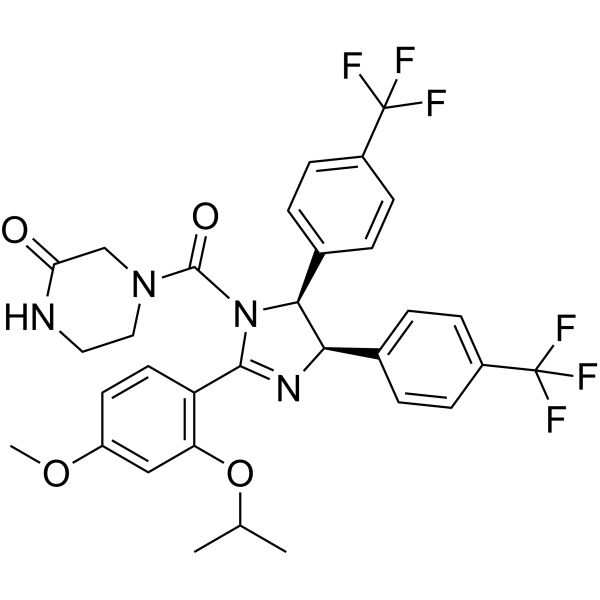
Apoptosis inducer 50
 0 ImagesCat. No.: HY-179052Apoptosis inducer 50 (Compound 5e) is an apoptosis inducer as well as an autophagy inducer agent. Apoptosis inducer 50 exhibits potent and selective anti-cancer activity against triple-negative breast cancer cells and metastatic colon cancer cells. Apoptosis inducer 50 upregulates the expression of pro-apoptotic proteins (Bax, Bim, cleaved Caspase-9) and downregulates the expression of the anti-apoptotic protein (BCL-XL). Apoptosis inducer 50 upregulates key autophagy markers such as Beclin-1 and ATG5, and enhances the conversion of LC3-I to LC3-II., Apoptosis inducer 50 arrests cancer cells in the G1/S phase by upregulating the expression of p21 and p27 while downregulating Cyclin D1. Apoptosis inducer 50 increases the level of ROS.
-
EGFR-IN-169
 0 ImagesCat. No.: HY-175531EGFR-IN-169 is an epidermal growth factor (EGFR) (IC50 = 5.19 μM) inhibitor form panaxadiol. EGFR-IN-169 interferes with the migration and growth of colorectal cancer cells by inhibiting EGFR-mediated RalA/EMT pathway. EGFR-IN-169 shows an IC50 value of 4.46 μM and SI of 16.92 for HCT-116 cells. EGFR-IN-169 inhibits CDKs activity, induces G0/G1 cycle arrest and inhibits migration and invasion. EGFR-IN-169 reduces mitochondrial membrane potential and induces apoptosis and ROS production. EGFR-IN-169 can be used for the research of cancer, such as colorectal cancer.
-
HDAC-IN-93
 0 ImagesCat. No.: HY-178104HDAC-IN-93 is a HDAC inhibitor with promising total pan-HDAC inhibitory activity. HDAC-IN-93 demonstrates significant broad-spectrum antiproliferative activity across various cancer cell lines. HDAC-IN-93 induces cell apoptosis along with necrosis. HDAC-IN-93 can be used for the studies of prostate cancer and breast cancer.
-
GPER/Bcl-2-IN-1
 0 ImagesCat. No.: HY-174338GPER/Bcl-2-IN-1 is a GPER/Bcl-2 inhibitor. GPER/Bcl-2-IN-1 can inhibit the proliferation and neurospheres formation of glioblastoma cells. GPER/Bcl-2-IN-1 can be used for the study of glioblastoma multiforme (GBM).
-
EGFR-IN-191
 0 ImagesCat. No.: HY-181093EGFR-IN-191 is an anti-tumor agent targeting both EGFR and AKT. EGFR-IN-191 exerts its anti-tumor activity by inducing DNA damage, apoptosis, cell cycle arrest, and inhibition of the PI3K/AKT-EGFR signaling pathway in tumor cells. EGFR-IN-191 can be used in the study of tumors such as triple-negative breast cancer.
-
BCL2L11 Human Pre-designed siRNA Set A
 0 ImagesCat. No.: HY-RS01427
BCL2L11 Human Pre-designed siRNA Set A contains three designed siRNAs for BCL2L11 gene (Human), as well as a negative control, a positive control, and a FAM-labeled negative control.
-
Anticancer agent 63
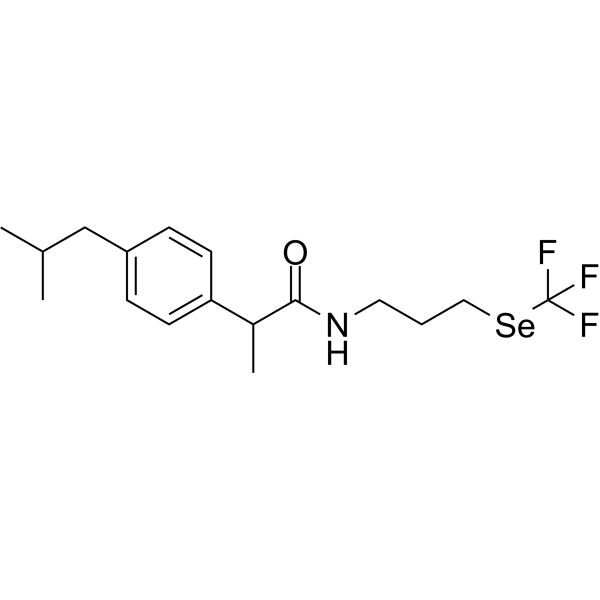 0 ImagesCat. No.: HY-147504CAS No.: 2529657-32-5Anticancer agent 63 (compound 3h) shows active in reducing the viability of different cancer cell lines, including SW480, HeLa, A549 and MCF-7, with IC50 values at 24 h of 4.9, 11.5, 9.4, and 3.4 μM, respectively. Anticancer agent 63 induce apoptosis in MCF-7 cells via down-regulating the expression of Bcl-2 and up-regulating the expression of IL-2 and Caspase-3. Anticancer agent 63 also shows antioxidant activity.
-
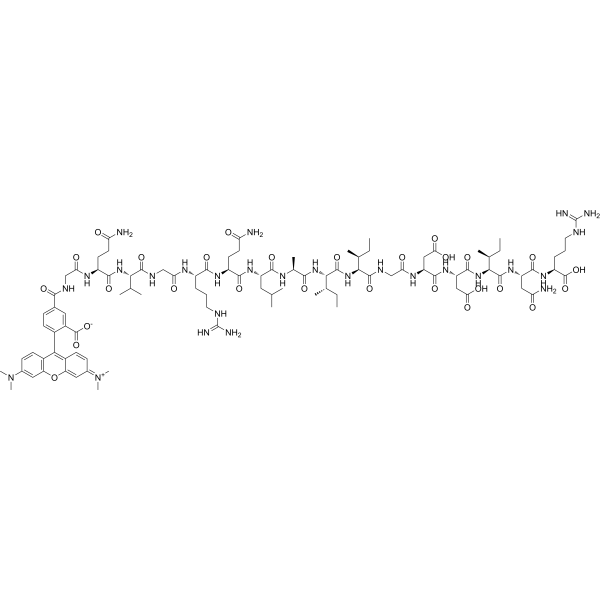
(-)-Mcl-1 inhibitor 22
 0 ImagesCat. No.: HY-170763BCAS No.: 2332611-95-5
-
Tubulin/LSD1-IN-1
 0 ImagesCat. No.: HY-176283Tubulin/LSD1-IN-1 is an effective dual inhibitor of Tubulin polymerization and LSD1 (IC50 = 1.72 μM). Tubulin/LSD1-IN-1 has broad-spectrum antiproliferative activity against cancer cell lines. Tubulin/LSD1-IN-1 inhibits tubulin polymerization by targeting colchicine binding sites, thereby disrupting the microtubule network in gastric cancer cells. Tubulin/LSD1-IN-1 increases the methylation levels of H3K4me1/2 and H3K9me2/3, thereby achieving epigenetic regulation. Tubulin/LSD1-IN-1 induces G2/M arrest, promotes apoptosis, and effectively inhibits colony formation of gastric cancer cells.
-
Bcl2l11 Rat Pre-designed siRNA Set A
 0 ImagesCat. No.: HY-RS01429
Bcl2l11 Rat Pre-designed siRNA Set A contains three designed siRNAs for Bcl2l11 gene (Rat), as well as a negative control, a positive control, and a FAM-labeled negative control.
-
FKA-9i
 0 ImagesCat. No.: HY-181098CAS No.: 3060515-85-4FKA-9i is an orally active anticancer agent. FKA-9i directly binds to and promotes the degradation of oncoproteins LRPPRC (kd: 7.387 μM), YBX1 (kd: 16.52 μM) and RPN1 (kd: 26.82 μM). FKA-9i inhibits the MAPK signaling pathway and mitochondrial oxidative phosphorylation. FKA-9i also induces cancer cell cycle arrest, apoptosis, mitochondrial dysfunction and ROS accumulation. FKA-9i can be used in the research of tumors such as gastric cancer.
-
Furowanin A
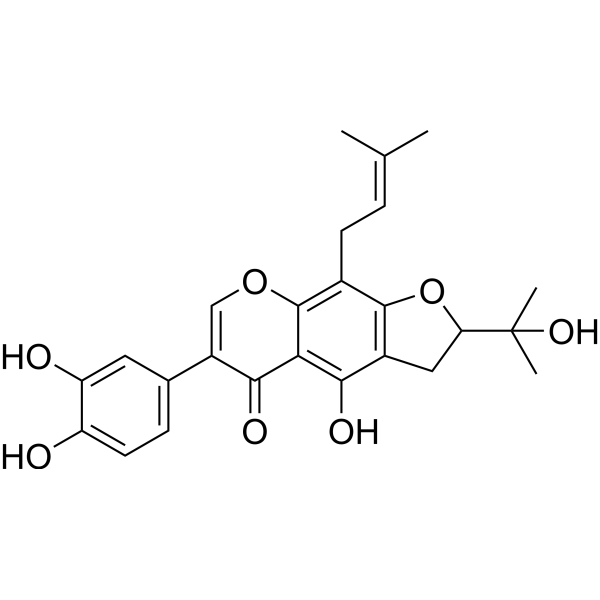 0 ImagesCat. No.: HY-N3913CAS No.: 911004-72-3Furowanin A is a flavonoid with anti-neoplastic effects. Furowanin A inhibits STAT3/Mcl-1 axis to suppress proliferation, block cell cycle progression, induce apoptosis and promote autophagy. Furowanin A potently inhibits colorectal cancer (CRC) cells.
-
Apoptosis inducer 56
 0 ImagesCat. No.: HY-181060CAS No.: 952306-31-9Apoptosis inducer 56 is an apoptosis inducer. Apoptosis inducer 56 induces DNA damage (upregulation of γH2AX and p-ATM expression) by minor groove binding. Apoptosis inducer 56 induces intrinsic apoptosis (upregulation of p53 and Bax/Bcl-2 ratio, cleaved caspase-7) via S-phase cell cycle arrest. Apoptosis inducer 56 shows selectivity for cancer cells over normal breast epithelial cells. Apoptosis inducer 56 can be used for the research of breast cancer.
-
Daphnetin (Standard)
 0 ImagesDaphnetin (Standard) is the analytical standard of Daphnetin. This product is intended for research and analytical applications. Daphnetin (7,8-dihydroxycoumarin), one coumarin derivative can be found in plants of the Genus Daphne, is a potent, oral active protein kinase inhibitor, with IC50s of 7.67 μM, 9.33 μM and 25.01 μM for EGFR, PKA and PKC in vitro, respectively. Daphnetin triggers ROS-induced cell apoptosis and induces cytoprotective autophagy by modulating the AMPK/Akt/mTOR pathway. Daphnetin has anti-inflammation activitity and inhibits TNF-α, IL-1 , ROS, and MDA production. Daphnetin has schizontocidal activity against malaria parasites. Daphnetin can be used for rheumatoid arthritis , cancer and anti-malarian research.
-
Gambogic Acid (Standard)
 0 ImagesGambogic Acid (Standard) is the analytical standard of Gambogic Acid. This product is intended for research and analytical applications. Gambogic Acid (Beta-Guttiferrin) is derived from the gamboges resin of the tree Garcinia hanburyi. Gambogic Acid (Beta-Guttiferrin) inhibits Bcl-XL, Bcl-2, Bcl-W, Bcl-B, Bfl-1 and Mcl-1 with IC50s of 1.47 μM, 1.21 μM, 2.02 μM, 0.66 μM, 1.06 μM and 0.79 μM.
-
Torulene
 0 ImagesTorulene (Torulin) is an orally active carotenoid with anti-cancer activity. Torulene inhibits proliferation and induces apoptosis of tumor cells via a mitochondrial signal pathway and the down-regulation of androgen receptor (AR) expression. Torulene can be used for the study of prostate cancer.




