



c-Myc
Myc
The transcription factor c-Myc is a member of the basic helix-loop-helix leucinezipper (bHLHZip) protein family. The target genes of the c-MYC protein participate in different cellular functions, including cell cycle, survival, protein synthesis, cell adhesion, and micro-RNA expression. c-Myc is also one of the four factors used in reprogramming somatic cells to induce pluripotent stem (iPS) cells and is implicated in maintaining cancer stem-like cells (CSCs). Most biological functions of c-Myc require heterodimerization with its activation partner Max.
c-Myc is also part of a dynamic network whose members interact selectively with one another and with various transcriptional coregulators and histone-modifying enzymes. Deregulated expression of c-MYC caused by gene amplification, retroviral insertion, or chromosomal translocation is associated with tumorigenesis. c-Myc has been identified as a highly promising target for cancer therapy.
All Product Categories
-
c-Myc Related Products (282)
Related Products (282)

-
Antibodies (12)
-
BRD4-BD1-IN-4
 0 ImagesCat. No.: HY-187207BRD4-BD1-IN-4 is a selective BRD4 BD1 inhibitor with an IC50 of 0.82 μM and a Kd of 0.98 μM. BRD4-BD1-IN-4 downregulates the expression of c-myc and anti-apoptotic proteins, elevates ROS levels, reduces mitochondrial membrane potential, induces DNA damage and triggers apoptosis. BRD4-BD1-IN-4 inhibits the migration and proliferation of cancer cells. BRD4-BD1-IN-4 can be used in the research of lung cancer, breast cancer and colon cancer.
-
c-MYC/BCL2 ligand 1 iodide
 0 ImagesCat. No.: HY-174403c-MYC/BCL2 ligand 1 iodide is a dual-targeting c-MYC/Bcl-2 G4 ligand with Kd values of 0.90 μM (c-MYC G4) and 0.56 μM (Bcl-2 G4). c-MYC/BCL2 ligand 1 iodide inhibits c-MYC and Bcl-2 gene transcription by binding to G4-forming sequences and downregulates their protein expression. c-MYC/BCL2 ligand 1 iodide inhibits suppresses migration, induces caspase-dependent apoptosis, and triggers cell cycle G1 arrest in MCF-7 cells. c-MYC/BCL2 ligand 1 iodide significantly suppresses tumor growth in a 4T1 syngeneic model with no observable toxicity. c-MYC/BCL2 ligand 1 iodide can be used for the research of breast cancer.
-
Eleven-Nineteen-Leukemia Protein IN-4
 0 ImagesCat. No.: HY-183825Eleven-Nineteen-Leukemia Protein IN-4 is a ENL YEATS domain inhibitor with an IC50 of 62.0 nM and a Kd of 100.4 nM. Eleven-Nineteen-Leukemia Protein IN-4 downregulates MYC expression and inhibits cancer cell growth; it exerts a synergistic effect with the bromodomain inhibitor JQ-1 (HY-13030). Eleven-Nineteen-Leukemia Protein IN-4 can be used in the research of acute myeloid leukemia.
-
USP25/28-IN-2
 0 ImagesCat. No.: HY-122686CAS No.: 2165322-95-0USP25/28-IN-2 is a selectivity dual USP25/28 inhibitor with IC50 values of 0.88 and 1.1 μM, respectively. USP25/28-IN-2 modulates USP25 and USP28 activity to affect downstream pathways, modulates c-Myc oncoprotein total levels and half-life, induces apoptosis, reduces cell viability. USP25/28-IN-2 can be used for the research of colorectal carcinoma, colorectal adenocarcinoma.
-
PROTAC BRD9 Degrader-12
 0 ImagesCat. No.: HY-189226PROTAC BRD9 Degrader-12 is a BRD9 PROTAC degrader, with DC50 values of 57 pM and 62 pM against BRD9 and IKZF1, respectively. PROTAC BRD9 Degrader-12 promotes CRL-CRBN-dependent ubiquitination and proteasome-mediated BRD9 degradation by simultaneously binding to BRD9 and CRBN, and concurrently recruits IKZF1 as a neosubstrate via CRBN to induce its degradation. PROTAC BRD9 Degrader-12 selectively degrades BRD9 and IKZF1. The synergistic degradation of BRD9/IKZF1 downregulates MYC-related signaling, induces apoptosis and S-phase cell cycle arrest, and thereby inhibits the proliferation of hematological malignant cells. PROTAC BRD9 Degrader-12 is used for research related to hematological malignancies.
-
CDK9-IN-45
 0 ImagesCat. No.: HY-179023CDK9-IN-45 (Compound B11) is a highly selective CDK9 inhibitor with IC50 values for CDK9 and CDK1 of 7.13 and 489.5 nM respectively. CDK9-IN-45 exhibits a potent inhibitory effect on colorectal cancer cells. CDK9-IN-45 induces cell apoptosis and leads to significant accumulation of ROS. CDK9-IN-45 activates Caspase-3, downregulates Mcl-1, XIAP, and c-Myc. CDK9-IN-45 can be used for research on colorectal cancer.
-
Anticancer agent 263
 0 ImagesCat. No.: HY-168886Anticancer agent 263 (compound 7) is a potent anticancer agent. Anticancer agent 263 binds to the G-quadruplex DNA (G4) sequence 22-mer Pu22, a mimic of c-Myc DNA. Anticancer agent 263 is a structure modulator, showcasing a significant enhancement in protein α-helix formation and the capability to form supramolecular network. Anticancer agent 263 shows no cytotoxicity.
-
Scopadulciol
 0 ImagesCat. No.: HY-183390CAS No.: 136565-26-9Scopadulciol is an orally effective β-catenin degrader, HSV-TK activator and proton pump inhibitor. By inducing β-catenin degradation, Scopadulciol downregulates the expression of downstream target genes such as cyclin D1, c-myc, and survivin; it also upregulates DR4/DR5 and downregulates Bcl-2, thereby exerting cytotoxicity and inducing apoptosis in cancer cells. Scopadulciol enhances the tumor-killing and bystander effects of prodrugs via activating HSV-TK, and can inactivate HSV-1. It shows synergistic antiviral effects when combined with Acyclovir (HY-17422) or Ganciclovir (HY-13637), with no cytotoxicity as a single agent. Scopadulciol can be applied in research related to bladder cancer, cervical cancer, glioblastoma, and digestive system cancers.
-
OSU-03013
 0 ImagesCat. No.: HY-122352CAS No.: 742112-34-1OSU-03013 is a Celecoxib (HY-14398) analog. OSU-03013 can promote apoptosis, up-regulate E-cadherin, and down-regulate β-catenin, c-myc, Wnt1, and N-cadherin. OSU-03013 reduces cell migration and invasion. OSU-03013 regulates both Wnt and mTOR expression to inhibit colon cancer (CC) cell proliferation. OSU-03013 can be used for CC cancer research.
-
CDK9 degrader-2
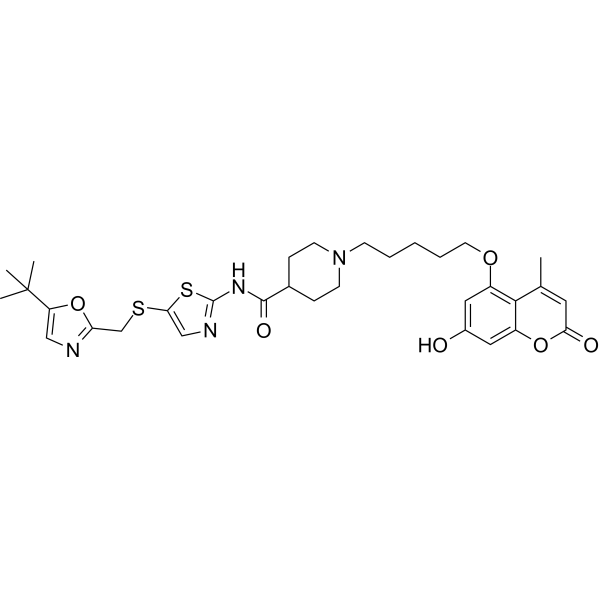 0 ImagesCat. No.: HY-156083CAS No.: 3020773-81-0CDK9 degrader-2 is a bifunctional degrader of ATTEC (Autophagy-Tethering Compound) that degrades the CDK9/cyclin T1 complex. CDK9 degrader-2 forms a ternary complex with CDK9 and LC3B, and achieves degradation through the autophagy-lysosome pathway, a process independent of the ubiquitin-proteasome system. CDK9 degrader-2 downregulates the expression of Mcl-1 and c-Myc proteins, induces apoptosis, and exhibits antitumor activity in in vivo MV4-11 xenograft models. CDK9 degrader-2 can be used for leukemia research.
-
8α-Tigloyloxyhirsutinolide 13-O-acetate
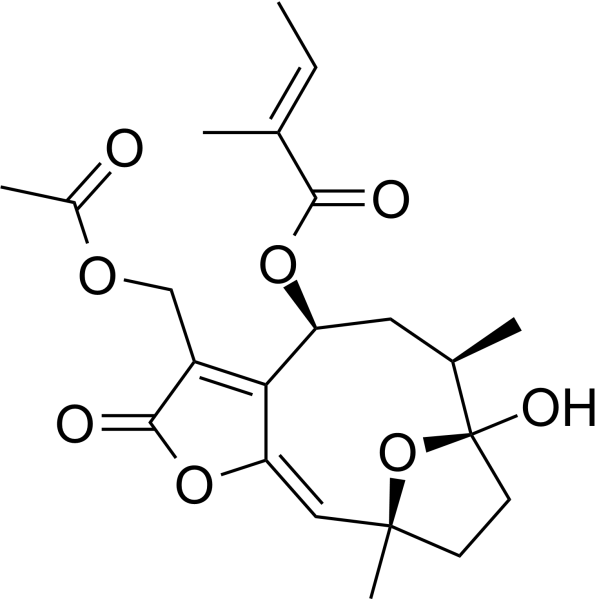 0 ImagesCat. No.: HY-138071CAS No.: 83182-58-5Synonyms: 8αTGH8α-Tigloyloxyhirsutinolide 13-O-acetate (8αTGH) is a potent and orally active STAT3 inhibitor. 8α-Tigloyloxyhirsutinolide 13-O-acetate induces early oxidative stress and pyroptosis, and late DNA damage, cell cycle arrest, apoptosis in the TNBC cells. 8α-Tigloyloxyhirsutinolide 13-O-acetate suppresses tumor cell growth in vitro and tumor growth in vivo.
-
PROTAC CDK9 degrader-11
 0 ImagesCat. No.: HY-170978CAS No.: 3039540-19-4PROTAC CDK9 degrader-11 is an orally active, selective CDK9 PROTAC degrader with a DC50 of 1.09 nM. PROTAC CDK9 degrader-11 recruits CRBN to form a ternary complex and degrades CDK9 via the ubiquitin-proteasome pathway, thereby inhibiting RNA polymerase II phosphorylation and downregulating the expression of anti-apoptotic and pro-oncogenic genes, ultimately inducing apoptosis. PROTAC CDK9 degrader-11 is suitable for research on small-cell lung cancer (SCLC).

-
PROTAC CBP/p300/BRD4 Degrader-1
 0 ImagesCat. No.: HY-181758CAS No.: 3109024-12-3PROTAC CBP/p300/BRD4 Degrader-1 is a dual-target PROTAC degrader with DC50 values of 8.8 pM (BRD4), 6.55 nM (CBP), and 1.05 nM (p300). PROTAC CBP/p300/BRD4 Degrader-1 induces CRBN- and proteasome-dependent degradation of BRD4 and CBP/p300, downregulates c-Myc and acetyl-H3K27, induces apoptosis. PROTAC CBP/p300/BRD4 Degrader-1 acts as an antiproliferative and antitumor agent, induces tumor growth inhibition in xenograft models. PROTAC CBP/p300/BRD4 Degrader-1 can be used for the research of prostate cancer and colorectal cancer.
-
TYMJ-01
 0 ImagesCat. No.: HY-181506CAS No.: 3109321-90-3TYMJ-01 is a fluorescent probe and eEF2K degrader. TYMJ-01 induces dose-dependent and specific degradation of eEF2K via the ubiquitin-proteasome pathway, with a DC50 of 82 nM. TYMJ-01 inhibits the proliferation, migration and invasion of triple-negative breast cancer cells. TYMJ-01 enables dynamic fluorescent imaging of eEF2K degradation in triple-negative breast cancer cells; it enhances the anti-tumor activity of Paclitaxel (HY-B0015). TYMJ-01 can be used for the research of triple-negative breast cancer.
-
BRD4 Inhibitor-15
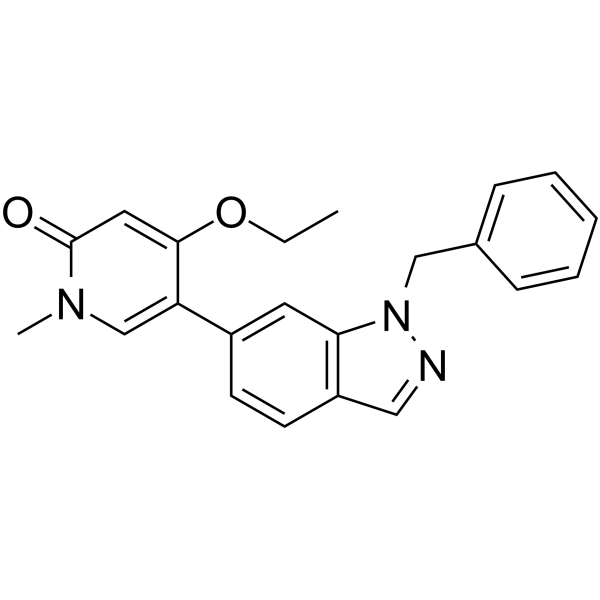 0 ImagesCat. No.: HY-143235CAS No.: 2761366-60-1BRD4 Inhibitor-15 (compound 13) is a potent BRD4 inhibitor, with an IC50 of 18 nM. BRD4 Inhibitor-15 induces apoptosis of 22RV1 cells by regulating Bcl-2/Bax proteins and activating caspase-3 signaling pathway. BRD4 Inhibitor-15 down-regulates the c-Myc level in 22RV1 cells. BRD4 Inhibitor-15 can be used for prostate cancer research.
-
HIT211504993
 0 ImagesCat. No.: HY-181541HIT211504993 is a selective histone deacetylase 6 (HDAC6) inhibitor with an IC50 of 0.070 μM. HIT211504993 suppresses cancer cell proliferation, cause G1 phase cell cycle arrest and induces apoptosis. HIT211504993 inhibits Myc-driven tumorigenesis via nucleocytoplasmic acetylation, p53 modulation, and Wnt/β-catenin signaling modulation. HIT211504993 inhibits tumor growth in a colon cancer xenograft mouse model. HIT211504993 can be used for the research of colon cancer.
-
PROTAC BRD4 Degrader-46
 0 ImagesCat. No.: HY-182801CAS No.: 2766179-68-2PROTAC BRD4 Degrader-46 is a heterobifunctional BRD4 PROTAC degrader. PROTAC BRD4 Degrader-46 binds to both BRD4 and CRBN, thereby triggering ubiquitination and proteasomal degradation of BRD4. PROTAC BRD4 Degrader-46 downregulates the levels of downstream BRD2, BRD3 and MYC. PROTAC BRD4 Degrader-46 can be used in the research of cancers such as multiple myeloma.
-
MYCMI-7 hydrobromide
 0 ImagesCat. No.: HY-187521CAS No.: 102537-38-2MYCMI-7 hydrobromide is a potent and selective MYC/MYCN inhibitor, with a Kd of 4 μM for MYC and an IC50 of 10 μM for topoisomerase IIα (Topoisomerase IIα). MYCMI-7 hydrobromide binds directly to MYC, selectively inhibits the interactions of MYC:MAX and MYCN:MAX, reduces MYC-driven transcription levels, induces MYC/MYCN protein degradation, and blocks the binding of MYC to chromatin, thereby inducing tumor cell growth arrest, apoptosis and reducing cell viability, while only inducing G1 phase growth arrest in normal cells. MYCMI-7 hydrobromide can be used in research related to MYC-driven acute myeloid leukemia and breast cancer, MYCN-amplified neuroblastoma, glioblastoma, Burkitt's lymphoma, melanoma, colon cancer, osteosarcoma, cervical cancer and histiocytic lymphoma.
-
Ravoxertinib (GMP)
 0 ImagesCat. No.: HY-15947GCAS No.: 1453848-26-4Synonyms: GDC-0994 (GMP)Ravoxertinib GMP is Ravoxertinib (HY-15947) produced by using GMP guidelines. GMP small molecules works appropriately as an auxiliary reagent for cell therapy manufacture. Ravoxertinib (GDC-0994) is an orally active ERK1/2 inhibitor. Ravoxertinib inhibits the ERK1/2 MAPK signaling pathway and reduces the expression levels of c-Myc, HK2 and LDHA. Ravoxertinib decreases mammosphere formation, and exerts additive and/or superadditive cytotoxicity when combined with Ipatasertib (HY-15186) in 3D tumor sphere models. Ravoxertinib can be used in research related to various cancers including breast cancer, melanoma, head and neck cancer, non-small cell lung cancer, ovarian cancer and Merkel cell carcinoma.




