



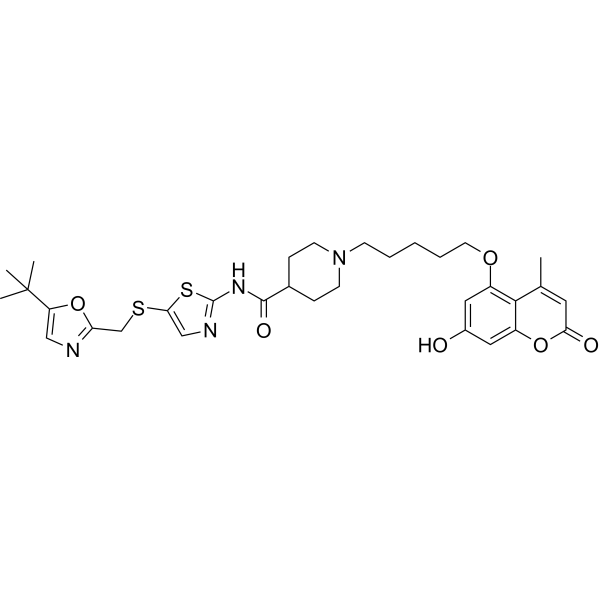
CDK9 degrader-2
CDK9 degrader-2 is a bifunctional degrader of ATTEC (Autophagy-Tethering Compound) that degrades the CDK9/cyclin T1 complex. CDK9 degrader-2 forms a ternary complex with CDK9 and LC3B, and achieves degradation through the autophagy-lysosome pathway, a process independent of the ubiquitin-proteasome system. CDK9 degrader-2 downregulates the expression of Mcl-1 and c-Myc proteins, induces apoptosis, and exhibits antitumor activity in in vivo MV4-11 xenograft models. CDK9 degrader-2 can be used for leukemia research.
For research use only. We do not sell to patients.
- CAS No.: 3020773-81-0
- Formula: C32H40N4O6S2
- Molecular Weight:640.81
-
Storage:
Please store the product under the recommended conditions in the Certificate of Analysis.

To place orders, for customer services and technical support, please contact: MedChemExpress USA
Tel: 609-228-6898 E-mail: [email protected] [email protected]


-
 Biological Activity
-
Chemical Information
- Purity & Documentation
- References
-
 Help & FAQs




Biological Activity
Description
IC50 & Target
[1]|
CDK9/cyclinT1 |
Mcl-1 |
Cellular Effect
|
Cell Line

|
Type | Value | Description | References |
|---|---|---|---|---|
| U2932 | IC50 |
45 nM
|
Antiproliferative activity against human U-2932 cells assessed as reduction in cell viability incubated for 72 hrs by CCK8 assay.
Antiproliferative activity against human U-2932 cells assessed as reduction in cell viability incubated for 72 hrs by CCK8 assay.
|
37671907 |
In Vitro
CDK9 degrader-2 (compound 10) inhibits purified CDK9/cyclin T1 enzyme, with an inhibition rate of 1% at 10 nM and 54% at 100 nM; it also inhibits the proliferation of U-2932 cells, with an IC50 of 45 nM[1].
CDK9 degrader-2 (1-1000 nM; 1-24 h) induces dose- and time-dependent degradation of CDK9 in U-2932 cells, while downregulating the expression of cyclin T1, Mcl-1 and c-Myc[1].
CDK9 degrader-2 (100 nM; 24 h) selectively degrades CDK9 in U-2932 cells, with minimal effects on CDK1, CDK2, CDK4 and CDK7[1].
CDK9 degrader-2 (10-1000 nM; 6 h) reduces pSer2-RNAP2 levels in a dose-dependent manner in U-2932 cells, with no effect on pSer5-RNAP2 levels after 6 h of treatment; it also decreases the mRNA expression of Mcl-1 and c-Myc in U-2932 cells in a dose-dependent manner[1].
CDK9 degrader-2 (10-1000 nM; 24 h) induces apoptosis in U-2932 cells[1].
CDK9 degrader-2 (500 nM; 12 h) degrades CDK9 in U-2932 cells via the LC3B-dependent autophagy-lysosome pathway. This process requires simultaneous binding to both CDK9 and LC3B and is independent of the ubiquitin-proteasome system. It promotes the formation of CDK9-LC3B complexes in U-2932 cells treated with Bafilomycin A1 (HY-100558) for 12 h[1].
CDK9 degrader-2 (100 nM; 24 h) induces LC3B-dependent degradation of CDK9 in wild-type (WT) 293T cells[1].
MedChemExpress (MCE) has not independently confirmed the accuracy of these methods. They are for reference only.
-
Cell Line:U-2932 cells
-
Concentration:1 nM, 4 nM, 12 nM, 37 nM, 111 nM, 333 nM, 1000 nM (dose-dependent)
100 nM (time-dependent) -
Incubation Time:1 h, 3 h, 6 h, 12 h, 24 h (time-dependent)
24 h (fixed concentration) -
Result:Reduced CDK9 55 levels to 0.69 relative abundance and CDK9 42 levels to 0.49 relative abundance at 100 nM for 24 h.
Downregulated cyclin T1 and Mcl-1 levels at 100 nM for 24 h.
Achieved a maximum degradation (Dmax) of 58.96% for CDK9 42 and 54.84% for CDK9 55 in dose-dependent analysis.
Decreased CDK9 levels over 24 h in time-dependent analysis.
Reduced Mcl-1 and c-Myc levels in time-dependent analysis.
-
Cell Line:U-2932 cells
-
Concentration:100 nM
-
Incubation Time:24 h
-
Result:Induced obvious degradation of CDK9.
Caused minimal effect on CDK1, CDK2, CDK4, and CDK7 levels.
-
Cell Line:U-2932 cells
-
Concentration:10 nM, 100 nM, 1000 nM
-
Incubation Time:6 h
-
Result:Dose-dependently downregulated the level of pSer2-RNAP2.
Did not suppress pSer5-RNAP2 levels.
-
Cell Line:U-2932 cells
-
Concentration:10 nM, 1000 nM
-
Incubation Time:6 h
-
Result:Decreased Mcl-1 and c-Myc mRNA levels in a dose-dependent manner.
Showed greater potency than the PROTAC THAL-SNS-032.
-
Cell Line:U-2932 cells
-
Concentration:10 nM, 100 nM, 1000 nM
-
Incubation Time:24 h
-
Result:Strongly induced apoptosis at 100 nM and 1000 nM.
Exhibited higher efficacy than the parental inhibitor SNS-032 (HY-10008) and the PROTAC THAL-SNS-032 (HY-123937).
-
Cell Line:U-2932 cells
-
Concentration:500 nM
1 μM SNS-032 (HY-10008); 10 μM coumarin analog; 500 nM Bafilomycin A1 (HY-100558); 10 μM Hydroxychloroquine (HY-W031727); 10 μM MG132 (HY-13259); 1 μM MLN4924 (HY-70062) (pretreatment) -
Incubation Time:12 h
2 h (pretreatments) -
Result:Weakened CDK9 degradation when cells were pretreated with SNS-032 or coumarin analog.
Rescued CDK9 degradation when cells were pretreated with Bafilomycin A1 or Hydroxychloroquine.
Showed no effect on CDK9 degradation when cells were pretreated with MG132 or MLN4924.
-
Cell Line:wild-type (WT) 293T cells, LC3B-KO 293T cells
-
Concentration:100 nM
-
Incubation Time:24 h
-
Result:Degraded CDK9 in WT 293T cells.
Blocked CDK9 degradation in LC3B-KO 293T cells due to loss of LC3B.
Parmacokinetics
In Vivo
MedChemExpress (MCE) has not independently confirmed the accuracy of these methods. They are for reference only.
-
Animal Model:Nude mice (female, 3-4 weeks old, subcutaneously injected with 5 × 10⁶ MV4-11 cells to establish leukemia xenograft)[1]
-
Dosage:5 mg/kg
-
Administration:i.p.; daily; 15 days
-
Result:Reduced relative tumor volume, yielding a tumor growth inhibition rate of 52%.
Significantly reduced CDK9, c-Myc, and Mcl-1 protein levels in tumor samples.
Caused no body weight loss.


Chemical Information
-
CAS No. 3020773-81-0
-
Molecular Weight 640.81
-
Formula C32H40N4O6S2
-
SMILES
CC(C)(C1=CN=C(O1)CSC2=CN=C(S2)NC(C3CCN(CC3)CCCCCOC4=C5C(OC(C=C5C)=O)=CC(O)=C4)=O)C
-
Shipping
Room temperature in continental US; may vary elsewhere.
-
Storage
Please store the product under the recommended conditions in the Certificate of Analysis.


Purity & Documentation
References

Calculators
Concentration (start) × Volume (start) = Concentration (final) × Volume (final)


CDK9 degrader-2 Related Classifications
HY-156083 Related Classifications
 Powered by Bioz