



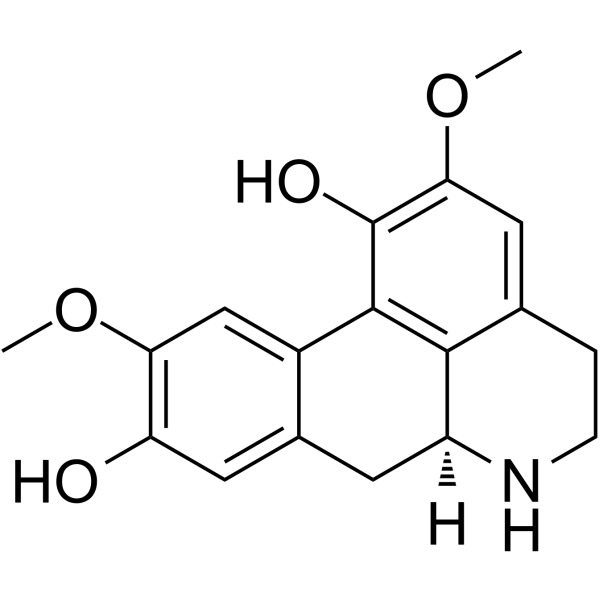
Norisoboldine

Based on 1 Customer Validation
Norisoboldine is an orally active natural aryl hydrocarbon receptor (AhR) agonist. Norisoboldine, as a major isoquinoline alkaloid present in Radix Linderae, can be used for the research of Rheumatoid arthritis and Ulcerative colitis.
Nur für Forschungszwecke. Wir verkaufen nicht an Patienten.
- Reinheit : 99.93%
- CAS. Nr.: 23599-69-1
- Formel: C18H19NO4
- Molecular Weight:313.35
-
Speicherung:
-20°C, protect from light
* In solvent : -80°C, 6 months; -20°C, 1 month (protect from light)

To place orders, for customer services and technical support, please contact: MedChemExpress USA
Tel: 609-228-6898 E-mail: [email protected] [email protected]


-
 Biologische Aktivität
-
Chemical Information
-
Lösungsmittel & Löslichkeit
- Protokoll
- Reinheit & Dokumentation
- Verweise
-
 Help & FAQs



Alle Adenosine Receptor Isoform-spezifische Produkte anzeigen
More

Biologische Aktivität
Beschreibung
IC50 & Target
AhR[2]
In Vitro
Norisoboldine (1~30 μM; 0~24 hours; CD4+T cells) activates AhR under hypoxic microenvironment and significantly downregulates mRNA expression of miR-31[2].
Norisoboldine (30 μM; 0~24 hours; CD4+T cells) inhibits glycolysis in hypoxia[2].
Norisoboldine (1~30 μM; 0~72 hours; Treg cells) promotes Treg differentiation in hypoxia[2].
Norisoboldine (10, 30 μM) facilitates the disassociation of HSP90/AhR complexes, the nuclear translocation of AhR, and the formation of AhR/ARNT complexes. Norisoboldine induces generation of Treg cells in hypoxia is independent of miR-31[2].
MedChemExpress (MCE) has not independently confirmed the accuracy of these methods. They are for reference only. Further protocols information, click here.
-
Cell Line:CD4+T cells
-
Concentration:1~30 μM
-
Incubation Time:24 hours
-
Result:Activated AhR in cells under hypoxic microenvironment.
-
Cell Line:CD4+T cells
-
Concentration:1~30 μM
-
Incubation Time:24 hours
-
Result:Significantly downregulated mRNA expression of miR-31.
-
Cell Line:CD4+T cells
-
Concentration:30 μM
-
Incubation Time:24 hours
-
Result:Inhibited glycolysis in hypoxia.
-
Cell Line:Treg cells
-
Concentration:1~30 μM
-
Incubation Time:72 hours
-
Result:Promoted Treg differentiation in hypoxia.
In Vivo
Norisoboldine (40 mg/kg; i.g.; 10 days) induces enhancement of CYP1A1 expression and suppresses expressions of Glut1 and HK2 in colons[2].
MedChemExpress (MCE) has not independently confirmed the accuracy of these methods. They are for reference only.
-
Animal Model:Male ICR mice (18–22 g)
-
Dosage:10~40 mg/kg
-
Administration:P.o.
-
Result:Significantly reduced the severity of joint swelling and erythema during the course of the experiment.
-
Animal Model:Female C57BL/6 mice (18–22 g)
-
Dosage:40 mg/kg
-
Administration:I.g.
-
Result:Induced enhancement of CYP1A1 expression and suppressed expressions of Glut1 and HK2 in colons.


Chemical Information
-
CAS. Nr. 23599-69-1
-
Appearance Solid
-
Molecular Weight 313.35
-
Formel C18H19NO4
-
Color Brown to khaki
-
SMILES
OC1=C(OC)C=C2CCN[C@@]3([H])CC4=CC(O)=C(OC)C=C4C1=C23
-
Synonyms
(+)-Laurelliptine
-
Structure Classification
-
Initial Source
-
Versand
Room temperature in continental US; may vary elsewhere.
-
Speicherung
-20°C, protect from light
* In solvent : -80°C, 6 months; -20°C, 1 month (protect from light)


Lösungsmittel & Löslichkeit
In Vitro:
DMSO : ≥ 62.5 mg/mL (199.46 mM; Hygroscopic DMSO has a significant impact on the solubility of product, please use newly opened DMSO)
* "≥" means soluble, but saturation unknown.
Please refer to the solubility information to select the appropriate solvent. Once prepared, please aliquot and store the solution to prevent product inactivation from repeated freeze-thaw cycles.
Storage method and period of stock solution: -80°C, 6 months; -20°C, 1 month (protect from light). When stored at -80°C, please use it within 6 months. When stored at -20°C, please use it within 1 month.
Please refer to the solubility information to select the appropriate solvent. Once prepared, please aliquot and store the solution to prevent product inactivation from repeated freeze-thaw cycles.
Storage method and period of stock solution: -80°C, 6 months; -20°C, 1 month (protect from light). When stored at -80°C, please use it within 6 months. When stored at -20°C, please use it within 1 month.
Konzentration (Stammlösung) × Volumen (Stammlösung) = Konzentration (Ziellösung) × Volumen (Ziellösung)
In Vivo:
Select the appropriate dissolution method based on your experimental animal and administration route.
- For the following dissolution methods, please ensure to first prepare a clear stock solution using an In Vitro approach and then sequentially add co-solvents:
- To ensure reliable experimental results, the clarified stock solution can be appropriately stored based on storage conditions. As for the working solution for In Vivo experiments, it is recommended to prepare freshly and use it on the same day.
- The percentages shown for the solvents indicate their volumetric ratio in the final prepared solution. If precipitation or phase separation occurs during preparation, heat and/or sonication can be used to aid dissolution.
Add each solvent one by one: 10% DMSO 40% PEG300 5% Tween-80 45% Saline
Solubility: ≥ 2.08 mg/mL (6.64 mM); Clear solution
This protocol yields a clear solution of ≥ 2.08 mg/mL (saturation unknown).
Taking 1 mL working solution as an example, add 100 μL DMSO stock solution (20.8 mg/mL) to 400 μL PEG300, and mix evenly; then add 50 μL Tween-80 and mix evenly; then add 450 μL Saline to adjust the volume to 1 mL.
Preparation of Saline: Dissolve 0.9 g sodium chloride in ddH₂O and dilute to 100 mL to obtain a clear Saline solution.
Add each solvent one by one: 10% DMSO 90% (20% SBE-β-CD in Saline)
Solubility: ≥ 2.08 mg/mL (6.64 mM); Clear solution
This protocol yields a clear solution of ≥ 2.08 mg/mL (saturation unknown).
Taking 1 mL working solution as an example, add 100 μL DMSO stock solution (20.8 mg/mL) to 900 μL 20% SBE-β-CD in Saline, and mix evenly.
Preparation of 20% SBE-β-CD in Saline (4°C, storage for one week): 2 g SBE-β-CD powder is dissolved in 10 mL Saline, completely dissolve until clear.
In Vivo Dissolution Calculator
Please enter the basic information of animal experiments:
-
-
-
-
Recommended: Prepare an additional quantity of animals to account for potential losses during experiments.
Please enter your animal formula composition:
-
%DMSO +
Recommended: Keep the proportion of DMSO in working solution below 2% if your animal is weak.
-
%+
-
+%Tween-80 + +
-
%Saline +
The co-solvents required include: DMSO, . All of co-solvents are available by MedChemExpress (MCE). , Tween 80. All of co-solvents are available by MedChemExpress (MCE).
Working solution concentration: 0.22 mg/mL
Method for preparing stock solution: mg drug dissolved in μL DMSO. Stock solution concentration: mg/mL. * In solvent : -80°C, 6 months; -20°C, 1 month (protect from light)
1. Take μL DMSO stock solution;
2. Add μL .
μL , mix evenly;
3. Then add μL Tween 80, mix evenly;
4. Then add μL
Please ensure that the stock solution in the first step is dissolved to a clear state, and add co-solvents in sequence. You can use ultrasonic heating (ultrasonic cleaner, recommended frequency 20-40 kHz), vortexing, etc. to assist dissolution.

Protokoll
-
Collagen-Induced Arthritis
Collagen-induced arthritis (CIA) is an autoimmune murine model of rheumatoid arthritis in which immunization with type II collagen (CII) emulsified in an adjuvant induces a T cell- and autoantibody-driven inflammatory arthritis characterized by synovial hyperplasia, immune cell infiltration, and joint destruction. The model typically relies on genetically susceptible mouse strains (e. g. , DBA/1) and reproduces key features of human rheumatoid arthritis, including anti-collagen immune responses and progressive joint inflammation. Disease onset generally occurs within ~3-4 weeks after immunization, depending on antigen/adjuvant combinations and protocol variation. The immunopathology is driven by adaptive immune activation against CII, leading to systemic and local joint inflammation mediated by pro-inflammatory cytokines and effector immune cells, making CIA a standard preclinical platform for evaluating immunomodulatory and anti-arthritic interventions.
-
DSS-Induced Colitis
Dextran sulfate sodium (DSS)-induced colitis is generated by administering DSS in mouse drinking water, producing epithelial injury, barrier disruption, weight loss, diarrhea, fecal blood, colon shortening, histologic mucosal damage, and inflammatory mediator changes; the model is mainly used to study acute or chronic intestinal inflammation resembling selected features of ulcerative colitis. DSS injury is interpreted through clinical and tissue readouts rather than a single molecular endpoint: daily body weight, stool consistency, and bleeding are combined into a disease activity index, while colon length, histology, cytokines, myeloperoxidase activity, intestinal permeability, and tight-junction markers provide complementary measures of inflammation and barrier damage.
-
TNBS-Induced Colitis
TNBS-induced colitis is produced by intrarectal delivery of 2,4,6-trinitrobenzene sulfonic acid in ethanol, where ethanol disrupts the mucosal barrier and TNBS haptenates colonic proteins, generating immune-mediated colonic inflammation with weight loss, diarrhea, ulceration, transmural injury, inflammatory-cell infiltration, and cytokine responses. The model is used as an experimental intestinal inflammation model with Crohn’s disease–like features, especially when Th1-type responses, IL-12–dependent inflammation, chronic relapsing inflammation, or fibrosis-related endpoints are studied.


Reinheit & Dokumentation
-
Data Sheet (283 KB)
-
SDS (394 KB)
- English - EN (394 KB)
- Français - FR (394 KB)
- Deutsch - DE (394 KB)
- Norwegian - NO (394 KB)
- Español - ES (394 KB)
- Swedish - SV (394 KB)
- Italian - IT (394 KB)
- Korean - KR (394 KB)
- Portuguese - PT (394 KB)
-
Handling Instructions (2659 KB)
Verweise
[1]. Luo Y, et al. Therapeutic effect of norisoboldine, an alkaloid isolated from Radix Linderae, on collagen-induced arthritis in mice. Phytomedicine. 2010;17(10):726-731. [Content Brief]
[2]. Lv Q, et al. Norisoboldine, a natural AhR agonist, promotes Treg differentiation and attenuates colitis via targeting glycolysis and subsequent NAD+/SIRT1/SUV39H1/H3K9me3 signaling pathway. Cell Death Dis. 2018;9(3):258. Published 2018 Feb 15. [Content Brief]


Complete Stock Solution Preparation Table
Please refer to the solubility information to select the appropriate solvent. Once prepared, please aliquot and store the solution to prevent product inactivation from repeated freeze-thaw cycles.
Storage method and period of stock solution: -80°C, 6 months; -20°C, 1 month (protect from light). When stored at -80°C, please use it within 6 months. When stored at -20°C, please use it within 1 month.
| Optional Solvent | Concentration Solvent Mass | 1 mg | 5 mg | 10 mg | 25 mg |
|---|---|---|---|---|---|
| DMSO | 1 mM | 3.1913 mL | 15.9566 mL | 31.9132 mL | 79.7830 mL |
| 5 mM | 0.6383 mL | 3.1913 mL | 6.3826 mL | 15.9566 mL | |
| 10 mM | 0.3191 mL | 1.5957 mL | 3.1913 mL | 7.9783 mL | |
| 15 mM | 0.2128 mL | 1.0638 mL | 2.1275 mL | 5.3189 mL | |
| 20 mM | 0.1596 mL | 0.7978 mL | 1.5957 mL | 3.9891 mL | |
| 25 mM | 0.1277 mL | 0.6383 mL | 1.2765 mL | 3.1913 mL | |
| 30 mM | 0.1064 mL | 0.5319 mL | 1.0638 mL | 2.6594 mL | |
| 40 mM | 0.0798 mL | 0.3989 mL | 0.7978 mL | 1.9946 mL | |
| 50 mM | 0.0638 mL | 0.3191 mL | 0.6383 mL | 1.5957 mL | |
| 60 mM | 0.0532 mL | 0.2659 mL | 0.5319 mL | 1.3297 mL | |
| 80 mM | 0.0399 mL | 0.1995 mL | 0.3989 mL | 0.9973 mL | |
| 100 mM | 0.0319 mL | 0.1596 mL | 0.3191 mL | 0.7978 mL |


Norisoboldine Related Classifications
HY-N0586 Related Classifications
 Powered by Bioz