



Ulodesine
Based on 1 publication(s) in Google Scholar
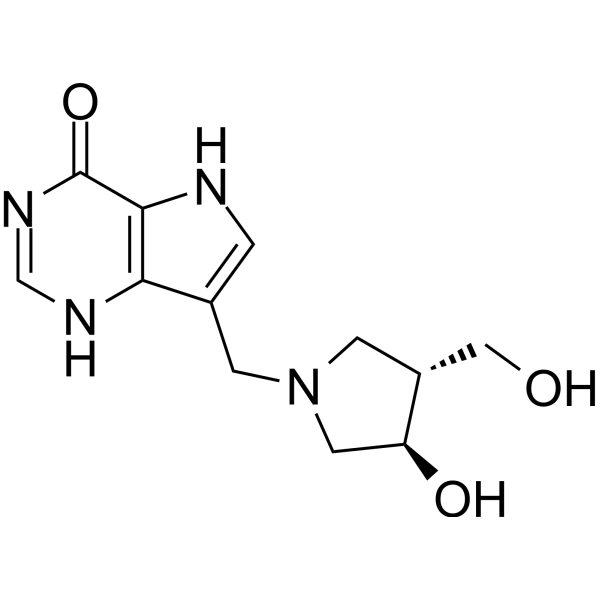
Ulodesine (BCX4208) is a purine nucleoside phosphorylase (PNP) inhibitor, with an IC50 of 2.293 nM against human PNP, and low nanomolar IC50 values against mouse, rat and monkey PNP. Ulodesine blocks the production of uric acid precursors, reduces serum uric acid levels, clears accumulated uric acid in the blood, and elevates the levels of purine nucleosides including guanosine. Ulodesine reduces the counts of total lymphocytes, T lymphocytes and lymphocyte subsets, inhibits the proliferation of cancer cells and activated lymphocytes, and enhances vaccine immune responses. Ulodesine can be used in research related to hyperuricemia and gout.
Nur für Forschungszwecke. Wir verkaufen nicht an Patienten.
- Reinheit : 99.32%
- CAS. Nr.: 548486-59-5
- Formel: C12H16N4O3
- Molecular Weight:264.28
-
Speicherung:Powder -20°C, 3 years , 4°C, 2 years ; In solvent -80°C, 6 months , -20°C, 1 month

To place orders, for customer services and technical support, please contact: MedChemExpress USA
Tel: 609-228-6898 E-mail: [email protected] [email protected]


-
 Biologische Aktivität
-
Chemical Information
-
Lösungsmittel & Löslichkeit
- Protokoll
- Reinheit & Dokumentation
- Verweise
-
 Help & FAQs


Publications Citing Use of MedChemExpress (MCE) Ulodesine
More

Biologische Aktivität
Beschreibung
|
PNP 2.293 nM (IC50) |
In Vitro
MedChemExpress (MCE) has not independently confirmed the accuracy of these methods. They are for reference only.
In Vivo
MedChemExpress (MCE) has not independently confirmed the accuracy of these methods. They are for reference only.
Clinical Trial
| NCT Number | Sponsor | Condition | Start Date |
Phase

|
|---|---|---|---|---|
| NCT01329991 | 2011-05 | PHASE1 |


Chemical Information
-
CAS. Nr. 548486-59-5
-
Appearance Solid
-
Molecular Weight 264.28
-
Formel C12H16N4O3
-
Color White to off-white
-
SMILES
O=C1C(NC=C2CN3C[C@H](O)[C@@H](CO)C3)=C2NC=N1
-
Synonyms
BCX4208
-
Structure Classification
-
Initial Source
-
Versand
Room temperature in continental US; may vary elsewhere.
-
Speicherung
Powder -20°C 3 years 4°C 2 years In solvent -80°C 6 months -20°C 1 month


Publications (1)
-
Journal Impact Factor
-
Most Recent
-
Gut Microbes
Fusobacterium nucleatum plays a pathogenic role in a murine model of irritable bowel syndrome by modulating intestinal purine metabolism and promoting mast cell activation. [Abstract]2026 Dec 31;18(1):2620124. PMID: 41605881


Lösungsmittel & Löslichkeit
In Vitro:
DMSO : 25 mg/mL (94.60 mM; ultrasonic and warming and heat to 60°C; Hygroscopic DMSO has a significant impact on the solubility of product, please use newly opened DMSO)
Please refer to the solubility information to select the appropriate solvent. Once prepared, please aliquot and store the solution to prevent product inactivation from repeated freeze-thaw cycles.
Storage method and period of stock solution: -80°C, 6 months; -20°C, 1 month. When stored at -80°C, please use it within 6 months. When stored at -20°C, please use it within 1 month.
Please refer to the solubility information to select the appropriate solvent. Once prepared, please aliquot and store the solution to prevent product inactivation from repeated freeze-thaw cycles.
Storage method and period of stock solution: -80°C, 6 months; -20°C, 1 month. When stored at -80°C, please use it within 6 months. When stored at -20°C, please use it within 1 month.
Konzentration (Stammlösung) × Volumen (Stammlösung) = Konzentration (Ziellösung) × Volumen (Ziellösung)
In Vivo:
Select the appropriate dissolution method based on your experimental animal and administration route.
- For the following dissolution methods, please ensure to first prepare a clear stock solution using an In Vitro approach and then sequentially add co-solvents:
- To ensure reliable experimental results, the clarified stock solution can be appropriately stored based on storage conditions. As for the working solution for In Vivo experiments, it is recommended to prepare freshly and use it on the same day.
- The percentages shown for the solvents indicate their volumetric ratio in the final prepared solution. If precipitation or phase separation occurs during preparation, heat and/or sonication can be used to aid dissolution.
Add each solvent one by one: 10% DMSO 40% PEG300 5% Tween-80 45% Saline
Solubility: ≥ 1 mg/mL (3.78 mM); Clear solution
This protocol yields a clear solution of ≥ 1 mg/mL (saturation unknown).
Taking 1 mL working solution as an example, add 100 μL DMSO stock solution (10.0 mg/mL) to 400 μL PEG300, and mix evenly; then add 50 μL Tween-80 and mix evenly; then add 450 μL Saline to adjust the volume to 1 mL.
Preparation of Saline: Dissolve 0.9 g sodium chloride in ddH₂O and dilute to 100 mL to obtain a clear Saline solution.
Add each solvent one by one: 10% DMSO 90% (20% SBE-β-CD in Saline)
Solubility: ≥ 1 mg/mL (3.78 mM); Clear solution
This protocol yields a clear solution of ≥ 1 mg/mL (saturation unknown).
Taking 1 mL working solution as an example, add 100 μL DMSO stock solution (10.0 mg/mL) to 900 μL 20% SBE-β-CD in Saline, and mix evenly.
Preparation of 20% SBE-β-CD in Saline (4°C, storage for one week): 2 g SBE-β-CD powder is dissolved in 10 mL Saline, completely dissolve until clear.
In Vivo Dissolution Calculator
Please enter the basic information of animal experiments:
-
-
-
-
Recommended: Prepare an additional quantity of animals to account for potential losses during experiments.
Please enter your animal formula composition:
-
%DMSO +
Recommended: Keep the proportion of DMSO in working solution below 2% if your animal is weak.
-
%+
-
+%Tween-80 + +
-
%Saline +
The co-solvents required include: DMSO, . All of co-solvents are available by MedChemExpress (MCE). , Tween 80. All of co-solvents are available by MedChemExpress (MCE).
Working solution concentration: 0.22 mg/mL
Method for preparing stock solution: mg drug dissolved in μL DMSO. Stock solution concentration: mg/mL.
1. Take μL DMSO stock solution;
2. Add μL .
μL , mix evenly;
3. Then add μL Tween 80, mix evenly;
4. Then add μL
Please ensure that the stock solution in the first step is dissolved to a clear state, and add co-solvents in sequence. You can use ultrasonic heating (ultrasonic cleaner, recommended frequency 20-40 kHz), vortexing, etc. to assist dissolution.


Reinheit & Dokumentation
-
Data Sheet (276 KB)
-
SDS (254 KB)
- English - EN (254 KB)
- Français - FR (254 KB)
- Deutsch - DE (254 KB)
- Norwegian - NO (254 KB)
- Español - ES (254 KB)
- Swedish - SV (254 KB)
- Italian - IT (254 KB)
- Korean - KR (254 KB)
- Portuguese - PT (254 KB)
-
Handling Instructions (2659 KB)
Verweise
[1]. van der Meer JW, et al. Abstract!. The Netherlands journal of medicine. 2002 Dec;60(11):418. [Content Brief]
[2]. Shahid H, et al. Investigational drugs for hyperuricemia. Expert opinion on investigational drugs. 2015;24(8):1013-30. [Content Brief]
[4]. Tang DH, et al. Inosine induces acute hyperuricaemia in rhesus monkey (Macaca mulatta) as a potential disease animal model. Pharm Biol. 2021 Dec;59(1):175-182. [Content Brief]
[5]. Evans GB, et al. Immucillins in Infectious Diseases. ACS infectious diseases. 2018 Feb 09;4(2):107-117. [Content Brief]


Complete Stock Solution Preparation Table
Please refer to the solubility information to select the appropriate solvent. Once prepared, please aliquot and store the solution to prevent product inactivation from repeated freeze-thaw cycles.
Storage method and period of stock solution: -80°C, 6 months; -20°C, 1 month. When stored at -80°C, please use it within 6 months. When stored at -20°C, please use it within 1 month.
| Optional Solvent | Concentration Solvent Mass | 1 mg | 5 mg | 10 mg | 25 mg |
|---|---|---|---|---|---|
| DMSO | 1 mM | 3.7839 mL | 18.9193 mL | 37.8387 mL | 94.5966 mL |
| 5 mM | 0.7568 mL | 3.7839 mL | 7.5677 mL | 18.9193 mL | |
| 10 mM | 0.3784 mL | 1.8919 mL | 3.7839 mL | 9.4597 mL | |
| 15 mM | 0.2523 mL | 1.2613 mL | 2.5226 mL | 6.3064 mL | |
| 20 mM | 0.1892 mL | 0.9460 mL | 1.8919 mL | 4.7298 mL | |
| 25 mM | 0.1514 mL | 0.7568 mL | 1.5135 mL | 3.7839 mL | |
| 30 mM | 0.1261 mL | 0.6306 mL | 1.2613 mL | 3.1532 mL | |
| 40 mM | 0.0946 mL | 0.4730 mL | 0.9460 mL | 2.3649 mL | |
| 50 mM | 0.0757 mL | 0.3784 mL | 0.7568 mL | 1.8919 mL | |
| 60 mM | 0.0631 mL | 0.3153 mL | 0.6306 mL | 1.5766 mL | |
| 80 mM | 0.0473 mL | 0.2365 mL | 0.4730 mL | 1.1825 mL |


Ulodesine Related Classifications
HY-19480 Related Classifications
 Powered by Bioz