



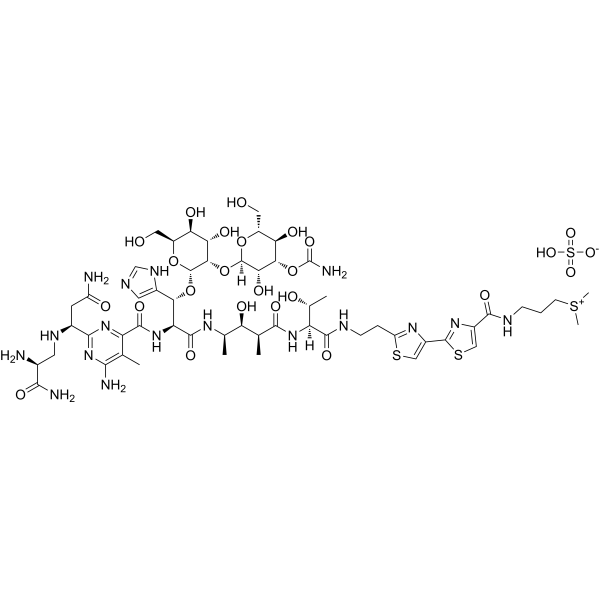
Bleomycin A2

Based on 1 Customer Validation
Bleomycin A2 is an antitumor Antibiotic and also an aspartate/asparagine-β-hydroxylase (AspH) inhibitor with an IC50 of 1.47 μM. Bleomycin A2 inhibits the polynucleotide ligase reaction in E. coli B infected by T4 phage. Bleomycin A2 promotes DNA degradation, induces DNA strand breaks and regulates DNA polymerase activity. Bleomycin A2 can be used in research related to leukemia, head and neck cancer, and Ehrlich carcinoma.
연구목적의 판매만을 진행합니다. 환자를 대상으로 한 판매는 하지 않습니다.
- Purity : 99.89%
- CAS No.: 41432-97-7
- 화학식: C55H85N17O25S4
- 분자량:1512.62
-
보관:
4°C, sealed storage, away from moisture
* In solvent : -80°C, 6 months; -20°C, 1 month (sealed storage, away from moisture)

To place orders, for customer services and technical support, please contact: MedChemExpress USA
Tel: 609-228-6898 E-mail: [email protected] [email protected]


-
 Biological Activity
-
Chemical Information
-
용액&용해도
- 순도&문서
- References
-
 Help & FAQs




Biological Activity
제품 설명
IC50 & Target
|
Glycopeptide |
In Vitro
Bleomycin A2 (40 μg/mL; 30 min) inhibits DNA polymerase activity by 89% in crude extracts of E. coli B. This effect is reversible by divalent cations or EDTA, and Bleomycin A2 also stimulates DNase-mediated primer DNA degradation in the same system[3].
Bleomycin A2 (2-20 μg/mL; 120 min) stimulates pancreatic DNase-mediated degradation of salmon sperm DNA, with a stronger effect at higher concentrations[3].
Bleomycin A2 (5-25 μM; 1 h) induces DNA strand breaks in L1210 cells in a concentration-dependent manner. Co-incubation with Lidocaine significantly enhances its DNA-damaging activity, and Lidocaine inhibits the repair of Bleomycin A2-induced DNA strand breaks, thereby further exacerbating the extent of strand breaks[2].
MedChemExpress (MCE) has not independently confirmed the accuracy of these methods. They are for reference only.


Chemical Information
-
CAS No. 41432-97-7
-
Appearance Solid
-
분자량 1512.62
-
화학식 C55H85N17O25S4
-
Color White to off-white
-
SMILES
O=C(C1=NC([C@H](CC(N)=O)NC[C@H](N)C(N)=O)=NC(N)=C1C)N[C@H](C(N[C@H](C)[C@@H](O)[C@H](C)C(N[C@]([C@H](O)C)([H])C(NCCC2=NC(C3=NC(C(NCCC[S+](C)C)=O)=CS3)=CS2)=O)=O)=O)[C@H](C4=CN=CN4)O[C@H]5[C@H]([C@H]([C@@H]([C@@H](O5)CO)O)O)O[C@]6([H])[C@H]([C@H]([C@@H]([C@H](O6)CO)O)OC(N)=O)O.O=S([O-])(O)=O
-
선적
Room temperature in continental US; may vary elsewhere.
-
보관
4°C, sealed storage, away from moisture
* In solvent : -80°C, 6 months; -20°C, 1 month (sealed storage, away from moisture)


용액&용해도
In Vitro:
DMSO : 100 mg/mL (66.11 mM; Need ultrasonic; Hygroscopic DMSO has a significant impact on the solubility of product, please use newly opened DMSO)
Please refer to the solubility information to select the appropriate solvent. Once prepared, please aliquot and store the solution to prevent product inactivation from repeated freeze-thaw cycles.
Storage method and period of stock solution: -80°C, 6 months; -20°C, 1 month (sealed storage, away from moisture). When stored at -80°C, please use it within 6 months. When stored at -20°C, please use it within 1 month.
Please refer to the solubility information to select the appropriate solvent. Once prepared, please aliquot and store the solution to prevent product inactivation from repeated freeze-thaw cycles.
Storage method and period of stock solution: -80°C, 6 months; -20°C, 1 month (sealed storage, away from moisture). When stored at -80°C, please use it within 6 months. When stored at -20°C, please use it within 1 month.
Concentration (start) × Volume (start) = Concentration (final) × Volume (final)


순도&문서
-
Data Sheet (276 KB)
-
SDS (252 KB)
- English - EN (252 KB)
- Français - FR (252 KB)
- Deutsch - DE (252 KB)
- Norwegian - NO (252 KB)
- Español - ES (252 KB)
- Swedish - SV (252 KB)
- Italian - IT (252 KB)
- Korean - KR (252 KB)
- Portuguese - PT (252 KB)
-
Handling Instructions (2659 KB)
References
[1]. Brewitz L, et al. Small-molecule active pharmaceutical ingredients of approved cancer therapeutics inhibit human aspartate/asparagine-β-hydroxylase. Bioorganic & medicinal chemistry. 2020 Oct 15;28(20):115675. [Content Brief]
[2]. Lazo JS, et al. Lidocaine potentiation of bleomycin A2 cytotoxicity and DNA strand breakage in L1210 and human A-253 cells. Cancer research. 1985 May;45(5):2103-9. [Content Brief]
[3]. Yamaki H, et al. Effects of bleomycin A2 on deoxyribonuclease, DNA polymerase and ligase reactions. J Antibiot (Tokyo). 1971 Mar;24(3):178-84. [Content Brief]


Complete Stock Solution Preparation Table
Please refer to the solubility information to select the appropriate solvent. Once prepared, please aliquot and store the solution to prevent product inactivation from repeated freeze-thaw cycles.
Storage method and period of stock solution: -80°C, 6 months; -20°C, 1 month (sealed storage, away from moisture). When stored at -80°C, please use it within 6 months. When stored at -20°C, please use it within 1 month.
| Optional Solvent | Concentration Solvent Mass | 1 mg | 5 mg | 10 mg | 25 mg |
|---|---|---|---|---|---|
| DMSO | 1 mM | 0.6611 mL | 3.3055 mL | 6.6110 mL | 16.5276 mL |
| 5 mM | 0.1322 mL | 0.6611 mL | 1.3222 mL | 3.3055 mL | |
| 10 mM | 0.0661 mL | 0.3306 mL | 0.6611 mL | 1.6528 mL | |
| 15 mM | 0.0441 mL | 0.2204 mL | 0.4407 mL | 1.1018 mL | |
| 20 mM | 0.0331 mL | 0.1653 mL | 0.3306 mL | 0.8264 mL | |
| 25 mM | 0.0264 mL | 0.1322 mL | 0.2644 mL | 0.6611 mL | |
| 30 mM | 0.0220 mL | 0.1102 mL | 0.2204 mL | 0.5509 mL | |
| 40 mM | 0.0165 mL | 0.0826 mL | 0.1653 mL | 0.4132 mL | |
| 50 mM | 0.0132 mL | 0.0661 mL | 0.1322 mL | 0.3306 mL | |
| 60 mM | 0.0110 mL | 0.0551 mL | 0.1102 mL | 0.2755 mL |


Bleomycin A2 Related Classifications
HY-146646 Related Classifications
 Powered by Bioz