



Astegolimab
Based on 3 publication(s) in Google Scholar
Astegolimab (MSTT 1041A; RG 6149) is a human IgG2 monoclonal antibody. Astegolimab blocks IL-33 signaling by targeting the IL-33 receptor ST2. Astegolimab reduces p53 expression, mitigates IL33-upregulated SASP factors such as IL1α, IL6 and MCP1. Astegolimab mitigates IL33-increased p-p65/p65 ratio. Astegolimab blocks CM-induced neutrophil extracellular trap (NET) formation. Astegolimab is used in chronic obstructive pulmonary disease (COPD) and myocardial research.
Nos produits utilisent uniquement pour la recherche. Nous ne vendons pas aux patients.
- Pureté : 99.00%
- CAS No.: 2173054-79-8
- Masse moléculaire:144.98 kDa
-
Stockage:Shipping with dry ice
Please store the product under the recommended conditions in the Certificate of Analysis.


To place orders, for customer services and technical support, please contact: MedChemExpress USA
Tel: 609-228-6898 E-mail: [email protected] [email protected]


-
 Activité biologique
-
Chemical Information
- Protocole
- Pureté et documentation
- Références
-
 Help & FAQs


-

HY-P99673
ItepekimabIL-33 mAb -

HY-P99729
MelrilimabMonoclonal Antibody -
HY-P99396
SpesolimabAnti-IL-36R Antibody -

HY-P99550
TozorakimabInterleukin-33 Inhibitor -

HY-P99379
Nidanilimab (Nadunolimab)Anti-IL1RAP Antibody -

HY-P9927
SecukinumabIL-17A Antagonist -

HY-P99721
LutikizumabAnti-IL-1α/β Immunoglobulin -

HY-P99018
EtokimabIL-33 mAb -

HY-108841
RaleukinIL-1R Antagonist -
HY-13027
DAPTγ-secretase Inhibitor -
HY-P9906A
Bevacizumab (Anti-VEGFA)VEGF-A Inhibitor -

HY-K0551
Mycoplasma Detection Kit (Luminescence)


Activité biologique
Description
IC50 & Target
[1]|
ST2 |
In Vitro
Astegolimab could block the effect of CM-induced neutrophil extracellular trap (NET) formation in HL-60 cells[2].
Astegolimab (10 μM) blocks the effect of exogenous IL33 on cardiomyocyte (AC16) senescence[3].
MedChemExpress (MCE) has not independently confirmed the accuracy of these methods. They are for reference only.
-
Cell Line:AC16 cells treated with IL33
-
Concentration:10 μM
-
Incubation Time:
-
Result:Reduced p53 expression.
Mitigated IL33-upregulated SASP factors such as IL1α, IL6 and MCP1.
Mitigated IL33-increased p-p65/p65 ratio.
Essai clinique
| NCT Number | Sponsor | Condition | Start Date |
Phase

|
|---|---|---|---|---|
| NCT01329991 | 2011-05 | PHASE1 |
Application
ELISA, FACS, Functional assay
Verified Bioactivity
-
 Immobilized ST2/IL1RL1 Protein, Human can bind Astegolimab. The EC50 for this effect is 28.29 ng/mL.
-
 Loaded ST2/IL1RL1 Protein, Human (310a.a, HEK293, His, HY-P70615) on AHC2 biosensor, can bind Astegolimab with an affinity constant of 2.022E-10 M as determined in BLI assay.


Product Details
-
CAS No. 2173054-79-8
-
Accession Q01638
-
Synonyms MSTT 1041A; RG 6149
-
Masse moléculaire 144.98 kDa
-
Species Reactivity
Human
-
Conjugated
Unconjugated
-
Isotype
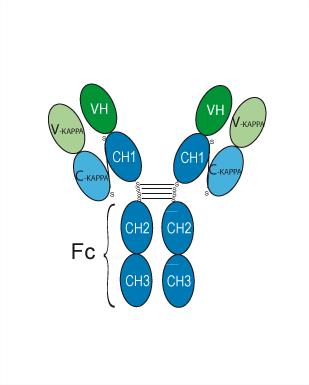
Human IgG2 kappa
-
Recommend Isotype Controls
-
Format
-
Human IgG2 kappa
-
Product Properties
-
Appearance
Liquid
-
Formulation
Please refer to the lot-specific COA for specific buffer information.
-
Pureté
99.00%
-
Reconstitution
The product can be reconstituted/diluted with sterile PBS or saline.
-
Storage & Stability
Please store the product under the recommended conditions in the Certificate of Analysis.
-
Livraison
Shipping with dry ice.


Publications (3)
-
Journal Impact Factor
-
Most Recent
-
Cancer Cell
Identification of cycling regulatory T cell precursors as conductors of immune escape during breast carcinoma progression. [Abstract]2026 Jun 8;44(6):1179-1200.e14. PMID: 41997138 -
Cell Oncol (Dordr)
Lenvatinib-activated NDUFA4L2/IL33/PADI4 pathway induces neutrophil extracellular traps that inhibit cuproptosis in hepatocellular carcinoma. [Abstract]2025 Apr;48(2):487-504. PMID: 39585643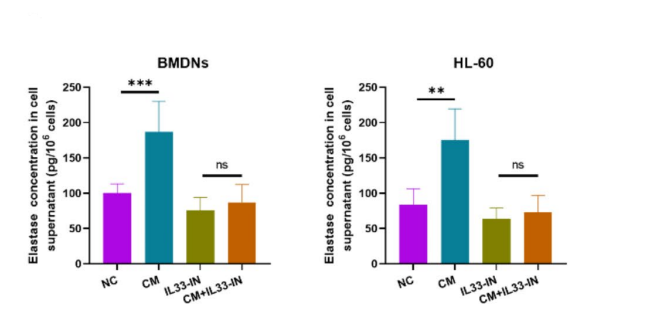
Astegolimab purchased from MedChemExpress. Usage Cited in: Cell Oncol (Dordr). 2025 Apr;48(2):487-504. [Abstract]
Astegolimab (IL33-IN). ELISA was used to detect the concentrations of mouse bone marrow-derived ribonuclease (BMDN) and elastase in HL-60 cell supernatant.
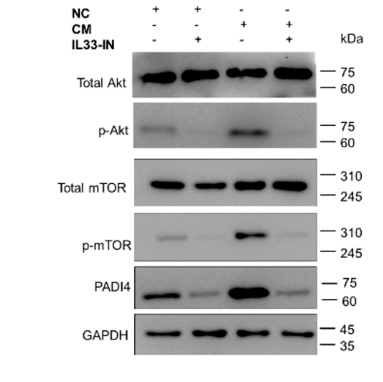
Astegolimab purchased from MedChemExpress. Usage Cited in: Cell Oncol (Dordr). 2025 Apr;48(2):487-504. [Abstract]
Astegolimab (IL33-IN). Western blot analysis of molecules associated with NET formation in mouse bone marrow-derived macrophages (BMDN).
-
Pureté et documentation


Références
[1]. Steven G Kelsen, et al. Astegolimab (anti-ST2) efficacy and safety in adults with severe asthma: A randomized clinical trial. J Allergy Clin Immunol. 2021 Sep;148(3):790-798. [Content Brief]
[2]. Yi N, et al. Lenvatinib-activated NDUFA4L2/IL33/PADI4 pathway induces neutrophil extracellular traps that inhibit cuproptosis in hepatocellular carcinoma. Cell Oncol (Dordr). 2025 Apr;48(2):487-504. [Content Brief]
[3]. Wu L, et al. Mechanistic role of RND3-regulated IL33/ST2 signaling on cardiomyocyte senescence. Life Sci. 2024 Jul 1;348:122701. [Content Brief]

Calculators
Concentration (start) × Volume (start) = Concentration (final) × Volume (final)


Astegolimab Related Classifications
HY-P99444 Related Classifications
 Powered by Bioz