



CDK2-IN-3

Based on 1 Customer Validation
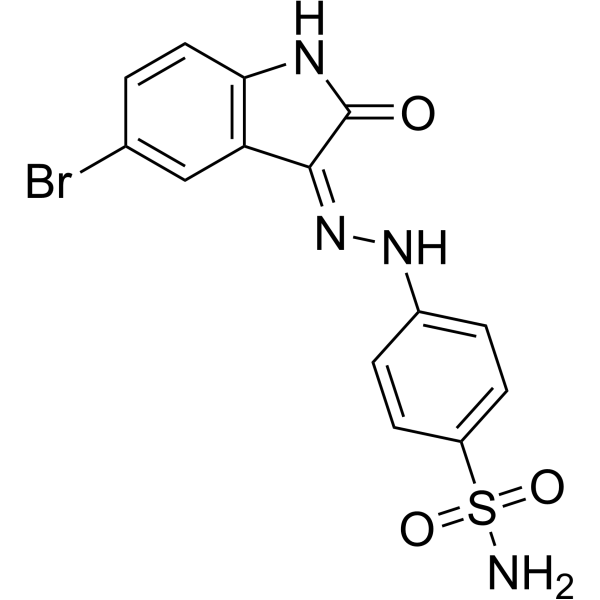
CDK2-IN-3 (compound 3) is a potent and selective CDK2 inhibitor with an IC50 of 60 nM.
Nur für Forschungszwecke. Wir verkaufen nicht an Patienten.
- Reinheit : 97.69%
- CAS. Nr.: 222035-13-4
- Formel: C14H11BrN4O3S
- Molecular Weight:395.23
-
Speicherung:Powder -20°C, 3 years ; In solvent -80°C, 6 months , -20°C, 1 month

To place orders, for customer services and technical support, please contact: MedChemExpress USA
Tel: 609-228-6898 E-mail: [email protected] [email protected]


-
 Biologische Aktivität
-
Chemical Information
-
Lösungsmittel & Löslichkeit
- Reinheit & Dokumentation
- Verweise
-
 Help & FAQs


-
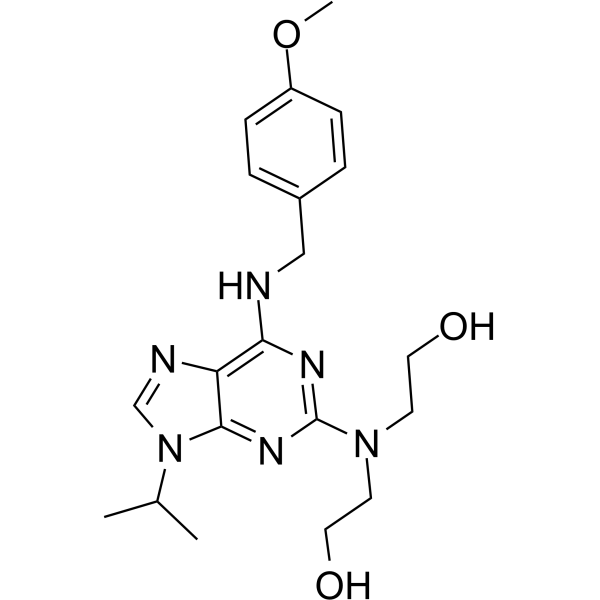
HY-15339
CVT-313CDK2 Inhibitor -
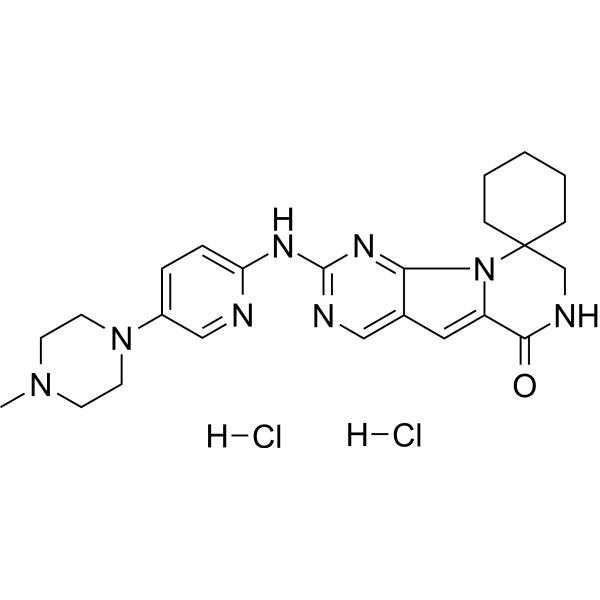
HY-101467A
Trilaciclib hydrochlorideCDK4/6 Inhibitor -
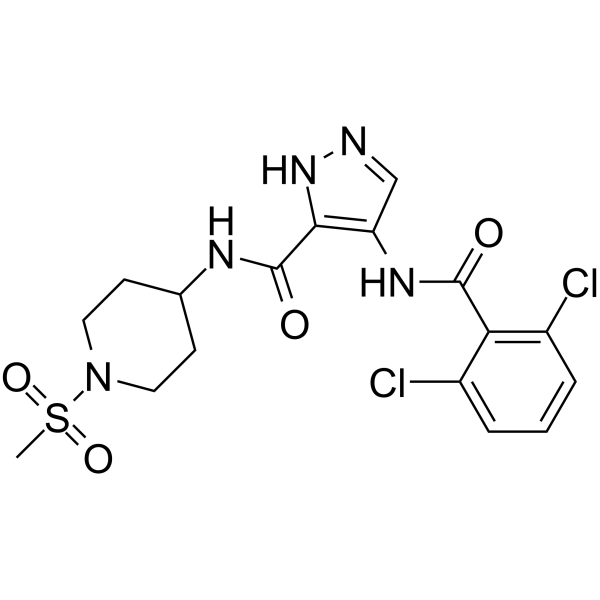
HY-15241
NVP-LCQ195CDK Inhibitor -
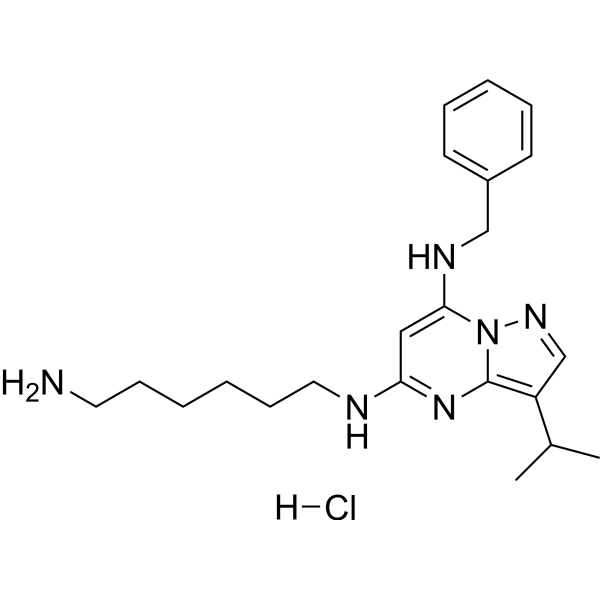
HY-13266A
BS-181 hydrochlorideCDK7 Inhibitor -
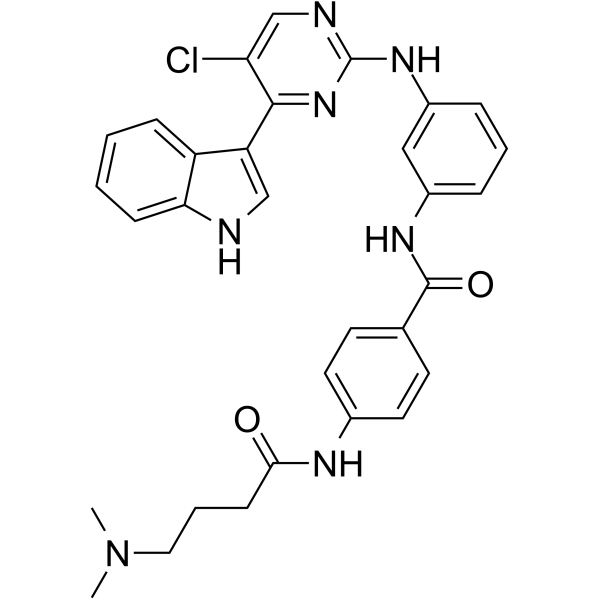
HY-19988
THZ1-R -
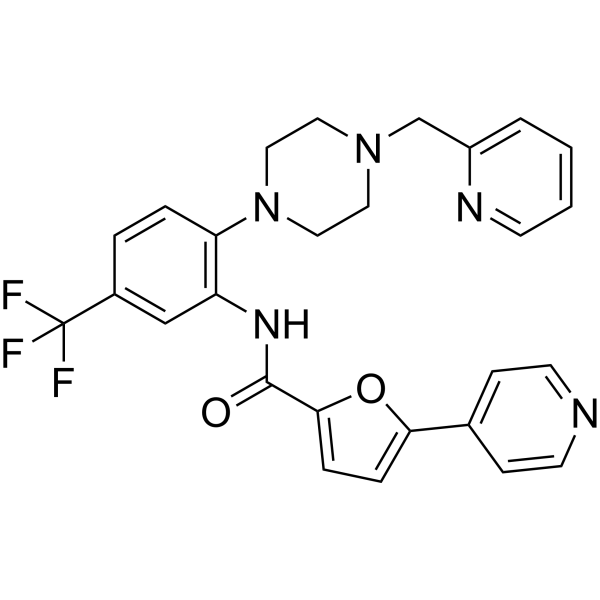
HY-117661
SPHINX31SRPK1 Inhibitor -
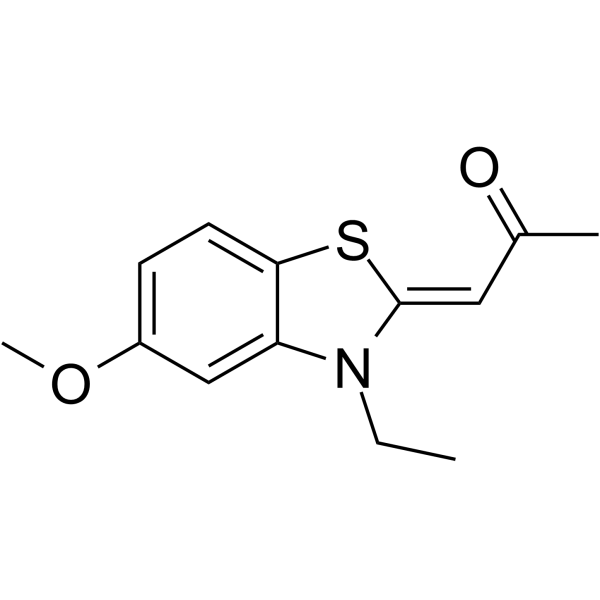
HY-15338
TG003CLK1 Inhibitor -

HY-101467AR
Trilaciclib hydrochloride (Standard)CDK4/6 Inhibitor


Biologische Aktivität
Beschreibung
IC50 & Target
[1]|
CDK2 60 nM (IC50) |
Cellular Effect
|
Cell Line

|
Type | Value | Description | References |
|---|---|---|---|---|
| Sf9 | IC50 |
0.031 μM
Compound: Fig.4B, R5C1
|
Inhibition of His-tagged CDK2/cyclin E (unknown origin) expressed in Baculovirus infected Sf9 cells using histone H1 as substrate in presence of [gamma-33P]-ATP by radiometric filter binding assay
Inhibition of His-tagged CDK2/cyclin E (unknown origin) expressed in Baculovirus infected Sf9 cells using histone H1 as substrate in presence of [gamma-33P]-ATP by radiometric filter binding assay
|
[PMID: 30234987] |
| Sf9 | IC50 |
0.738 μM
Compound: Fig.4B, R5C1
|
Inhibition of GST-tagged CDK5/p25 (unknown origin) expressed in Baculovirus infected Sf9 cells using histone H1 as substrate as substrate in presence of [gamma-33P]-ATP by radiometric filter binding assay
Inhibition of GST-tagged CDK5/p25 (unknown origin) expressed in Baculovirus infected Sf9 cells using histone H1 as substrate as substrate in presence of [gamma-33P]-ATP by radiometric filter binding assay
|
[PMID: 30234987] |
| Sf9 | IC50 |
1.1 μM
Compound: Fig.4B, R5C1
|
Inhibition of GST-tagged CDK9/CyclinT1 (unknown origin) expressed in Baculovirus infected Sf9 cells using YSPTSPS-2 KK peptide as substrate as substrate in presence of [gamma-33P]-ATP by radiometric filter binding assay
Inhibition of GST-tagged CDK9/CyclinT1 (unknown origin) expressed in Baculovirus infected Sf9 cells using YSPTSPS-2 KK peptide as substrate as substrate in presence of [gamma-33P]-ATP by radiometric filter binding assay
|
[PMID: 30234987] |
| Sf9 | IC50 |
1.3 μM
Compound: Fig.4B, R5C1
|
Inhibition of His-tagged CDK1/cyclin B1 (unknown origin) expressed in Baculovirus infected Sf9 cells using histone H1 as substrate in presence of [gamma-33P]-ATP by radiometric filter binding assay
Inhibition of His-tagged CDK1/cyclin B1 (unknown origin) expressed in Baculovirus infected Sf9 cells using histone H1 as substrate in presence of [gamma-33P]-ATP by radiometric filter binding assay
|
[PMID: 30234987] |
| Sf9 | IC50 |
19.7 μM
Compound: Fig.4B, R5C1
|
Inhibition of GST-tagged CDK7/cyclinH/MAT1 (unknown origin) expressed in Baculovirus infected Sf9 cells using YSPTSPS-2 KK peptide as substrate as substrate in presence of [gamma-33P]-ATP by radiometric filter binding assay
Inhibition of GST-tagged CDK7/cyclinH/MAT1 (unknown origin) expressed in Baculovirus infected Sf9 cells using YSPTSPS-2 KK peptide as substrate as substrate in presence of [gamma-33P]-ATP by radiometric filter binding assay
|
[PMID: 30234987] |
| Sf9 | IC50 |
2.8 μM
Compound: Fig.4B, R5C1
|
Inhibition of GST-tagged CDK4/cyclin D1 (unknown origin) expressed in Baculovirus infected Sf9 cells using RPPTLSPIPHIPR peptide as substrate in presence of [gamma-33P]-ATP by radiometric filter binding assay
Inhibition of GST-tagged CDK4/cyclin D1 (unknown origin) expressed in Baculovirus infected Sf9 cells using RPPTLSPIPHIPR peptide as substrate in presence of [gamma-33P]-ATP by radiometric filter binding assay
|
[PMID: 30234987] |
In Vitro
CDK2-IN-3 (12 µM, 24 hour) significantly protects CCL64 mink lung epithelial cells from cytotoxic damage induced by various chemotherapy drugs (Taxol, Etoposide (HY-13629), Cisplatin (HY-17394), 5-FU (HY-90006), Doxorubicin (HY-15142A))[1]. CDK2-IN-3 (7.5 µM, 6 hours) significantly blocks G1/S transition and inhibits DNA synthesis in human diploid fibroblasts[1].
MedChemExpress (MCE) has not independently confirmed the accuracy of these methods. They are for reference only.
-
Cell Line:Human diploid fibroblasts (HDFs)
-
Concentration:7.5 µM
-
Incubation Time:6 h
-
Result:Blocked G1/S transition, significantly reduced DNA synthesis (decreased percentage of BrdU-positive cells).
In Vivo
MedChemExpress (MCE) has not independently confirmed the accuracy of these methods. They are for reference only.
-
Animal Model:Cyclophosphamide (HY-17420)-Doxorubicin (HY-15142A) combination chemotherapy-induced alopecia neonatal Sprague-Dawley rat model (13 days)
-
Dosage:2.5-250 µg
-
Administration:Topical application, once daily for 1 week
-
Result:Effectively prevented alopecia in 50% of rats and provided partial protection in an additional 20%.


Chemical Information
-
CAS. Nr. 222035-13-4
-
Appearance Solid
-
Molecular Weight 395.23
-
Formel C14H11BrN4O3S
-
Color Light yellow to yellow
-
SMILES
O=S(C1=CC=C(N/N=C2C(NC3=C\2C=C(Br)C=C3)=O)C=C1)(N)=O
-
Versand
Room temperature in continental US; may vary elsewhere.
-
Speicherung
Powder -20°C 3 years In solvent -80°C 6 months -20°C 1 month


Lösungsmittel & Löslichkeit
In Vitro:
DMSO : 100 mg/mL (253.02 mM; Need ultrasonic; Hygroscopic DMSO has a significant impact on the solubility of product, please use newly opened DMSO)
Please refer to the solubility information to select the appropriate solvent. Once prepared, please aliquot and store the solution to prevent product inactivation from repeated freeze-thaw cycles.
Storage method and period of stock solution: -80°C, 6 months; -20°C, 1 month. When stored at -80°C, please use it within 6 months. When stored at -20°C, please use it within 1 month.
Please refer to the solubility information to select the appropriate solvent. Once prepared, please aliquot and store the solution to prevent product inactivation from repeated freeze-thaw cycles.
Storage method and period of stock solution: -80°C, 6 months; -20°C, 1 month. When stored at -80°C, please use it within 6 months. When stored at -20°C, please use it within 1 month.
Konzentration (Stammlösung) × Volumen (Stammlösung) = Konzentration (Ziellösung) × Volumen (Ziellösung)
In Vivo:
Select the appropriate dissolution method based on your experimental animal and administration route.
- For the following dissolution methods, please ensure to first prepare a clear stock solution using an In Vitro approach and then sequentially add co-solvents:
- To ensure reliable experimental results, the clarified stock solution can be appropriately stored based on storage conditions. As for the working solution for In Vivo experiments, it is recommended to prepare freshly and use it on the same day.
- The percentages shown for the solvents indicate their volumetric ratio in the final prepared solution. If precipitation or phase separation occurs during preparation, heat and/or sonication can be used to aid dissolution.
Add each solvent one by one: 10% DMSO 40% PEG300 5% Tween-80 45% Saline
Solubility: ≥ 2.5 mg/mL (6.33 mM); Clear solution
This protocol yields a clear solution of ≥ 2.5 mg/mL (saturation unknown).
Taking 1 mL working solution as an example, add 100 μL DMSO stock solution (25.0 mg/mL) to 400 μL PEG300, and mix evenly; then add 50 μL Tween-80 and mix evenly; then add 450 μL Saline to adjust the volume to 1 mL.
Preparation of Saline: Dissolve 0.9 g sodium chloride in ddH₂O and dilute to 100 mL to obtain a clear Saline solution.
In Vivo Dissolution Calculator
Please enter the basic information of animal experiments:
-
-
-
-
Recommended: Prepare an additional quantity of animals to account for potential losses during experiments.
Please enter your animal formula composition:
-
%DMSO +
Recommended: Keep the proportion of DMSO in working solution below 2% if your animal is weak.
-
%+
-
+%Tween-80 + +
-
%Saline +
The co-solvents required include: DMSO, . All of co-solvents are available by MedChemExpress (MCE). , Tween 80. All of co-solvents are available by MedChemExpress (MCE).
Working solution concentration: 0.22 mg/mL
Method for preparing stock solution: mg drug dissolved in μL DMSO. Stock solution concentration: mg/mL.
1. Take μL DMSO stock solution;
2. Add μL .
μL , mix evenly;
3. Then add μL Tween 80, mix evenly;
4. Then add μL
Please ensure that the stock solution in the first step is dissolved to a clear state, and add co-solvents in sequence. You can use ultrasonic heating (ultrasonic cleaner, recommended frequency 20-40 kHz), vortexing, etc. to assist dissolution.


Reinheit & Dokumentation
-
Data Sheet (277 KB)
-
SDS (252 KB)
- English - EN (252 KB)
- Français - FR (252 KB)
- Deutsch - DE (252 KB)
- Norwegian - NO (252 KB)
- Español - ES (252 KB)
- Swedish - SV (252 KB)
- Italian - IT (252 KB)
- Korean - KR (252 KB)
- Portuguese - PT (252 KB)
-
Handling Instructions (2659 KB)
Verweise


Complete Stock Solution Preparation Table
Please refer to the solubility information to select the appropriate solvent. Once prepared, please aliquot and store the solution to prevent product inactivation from repeated freeze-thaw cycles.
Storage method and period of stock solution: -80°C, 6 months; -20°C, 1 month. When stored at -80°C, please use it within 6 months. When stored at -20°C, please use it within 1 month.
| Optional Solvent | Concentration Solvent Mass | 1 mg | 5 mg | 10 mg | 25 mg |
|---|---|---|---|---|---|
| DMSO | 1 mM | 2.5302 mL | 12.6509 mL | 25.3017 mL | 63.2543 mL |
| 5 mM | 0.5060 mL | 2.5302 mL | 5.0603 mL | 12.6509 mL | |
| 10 mM | 0.2530 mL | 1.2651 mL | 2.5302 mL | 6.3254 mL | |
| 15 mM | 0.1687 mL | 0.8434 mL | 1.6868 mL | 4.2170 mL | |
| 20 mM | 0.1265 mL | 0.6325 mL | 1.2651 mL | 3.1627 mL | |
| 25 mM | 0.1012 mL | 0.5060 mL | 1.0121 mL | 2.5302 mL | |
| 30 mM | 0.0843 mL | 0.4217 mL | 0.8434 mL | 2.1085 mL | |
| 40 mM | 0.0633 mL | 0.3163 mL | 0.6325 mL | 1.5814 mL | |
| 50 mM | 0.0506 mL | 0.2530 mL | 0.5060 mL | 1.2651 mL | |
| 60 mM | 0.0422 mL | 0.2108 mL | 0.4217 mL | 1.0542 mL | |
| 80 mM | 0.0316 mL | 0.1581 mL | 0.3163 mL | 0.7907 mL | |
| 100 mM | 0.0253 mL | 0.1265 mL | 0.2530 mL | 0.6325 mL |


CDK2-IN-3 Related Classifications
HY-112460 Related Classifications
 Powered by Bioz