



DJK-5
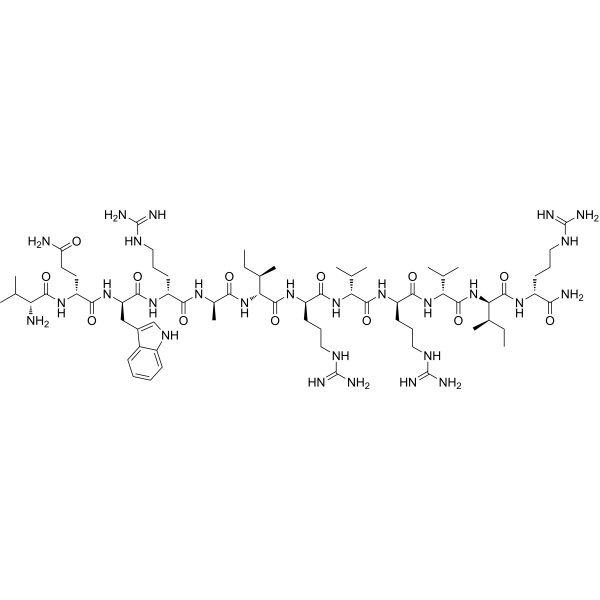
DJK-5 is an antimicrobial peptide that targets and degrades guanosine pentaphosphate and tetraphosphate (pppGpp and ppGpp). DJK-5 kills bacteria within dentinal tubules, dental plaque and preformed oral biofilms, delays biofilm recovery, reduces the abundance of extracellular polysaccharides and the structural integrity of biofilm matrices, and inhibits the formation and biomass accumulation of dental plaque biofilms. DJK-5 permeabilizes bacterial membranes, induces bacterial morphological changes, inhibits bacterial growth, and exerts a synergistic effect on bacterial biofilms when used in combination with traditional antibiotics and Colistin (HY-113678). DJK-5 exhibits protease resistance and broad-spectrum antibiofilm activity, though its activity decreases in fetal bovine serum. DJK-5 can be used in studies of pulpitis, mixed biofilm infections, skin abscesses, dental caries, infections associated with failed root canal therapy, and Pseudomonas aeruginosa biofilm-related respiratory tract infections.
Nur für Forschungszwecke. Wir verkaufen nicht an Patienten.
- CAS. Nr.: 1809102-71-3
- Formel: C70H123N27O13
- Molecular Weight:1550.90
-
Speicherung:
Please store the product under the recommended conditions in the Certificate of Analysis.

To place orders, for customer services and technical support, please contact: MedChemExpress USA
Tel: 609-228-6898 E-mail: [email protected] [email protected]


-
 Biologische Aktivität
-
Chemical Information
- Protokoll
- Reinheit & Dokumentation
- Verweise
-
 Help & FAQs


Alle Antibiotic Isoform-spezifische Produkte anzeigen
More

Biologische Aktivität
Beschreibung
In Vitro
DJK-5 (10 μg/mL; 3-4 min) + 8.5% EDTA + 6% NaOCl irrigation protocol potently kills mono-species Enterococcus faecalis and multi-species oral biofilms in human dentinal tubules (51-60.5% efficacy), delays biofilm recovery to 16 weeks, and demonstrates superior killing efficacy during re-irrigation of recovered biofilms compared to non-peptide protocols[1].
DJK-5 (18-24 h) exhibits planktonic antimicrobial activity against P. aeruginosa LESB58 (MIC 50 μg/mL in MHB, 100 μg/mL in DFG) and S. aureus USA300 LAC (MIC 25 μg/mL in MHB, 6.25 μg/mL in DFG), and shows synergistic activity with Colistin (HY-113678) against P. aeruginosa in MHB (FICI 0.5) and additive activity with Colistin against S. aureus in DFG (FICI 0.75)[2].
DJK-5 (50 μg/mL; 24 h after 72 h biofilm growth) alone has no activity against mature monomicrobial P. aeruginosa LESB58 or S. aureus USA300 LAC biofilms in DFG, but when combined with 125 μg/mL Colistin, it reduces S. aureus USA300 LAC monomicrobial biofilm CFU by 0.5-log (5-fold)[2].
DJK-5 (50 μg/mL; 24 h after 72 h biofilm growth) alone reduces S. aureus USA300 LAC CFU by 1.6-log (40-fold) in P. aeruginosa LESB58/S. aureus USA300 LAC co-biofilms in DFG, and when combined with either 125 μg/mL or 6.25 μg/mL Colistin, it exhibits synergistic activity, reducing P. aeruginosa CFU by up to ~3.3-log (2,140-fold) and S. aureus CFU by up to ~3.0-log (1,050-fold) compared to no treatment[2].
DJK-5 (50 μg/mL; 24 h after 1 h SHX pre-incubation) activity against P. aeruginosa LESB58/S. aureus USA300 LAC co-biofilms in DFG is abolished by induction of the stringent stress response with 1 mM SHX, and the synergistic activity of DJK-5 combined with 125 μg/mL Colistin is eliminated[2].
DJK-5 (50 μg/mL; 24 h after 72 h biofilm growth) alone reduces S. aureus USA300 LAC CFU in P. aeruginosa LESB58/S. aureus USA300 LAC co-biofilms in DFG, and when combined with 10 μg/mL Daptomycin (HY-B0108), it reduces P. aeruginosa CFU by ~1.5-log (30-fold) and exhibits synergistic activity against S. aureus, reducing CFU by 1.9-log (80-fold) compared to individual treatments[2].
DJK-5 (40 μg/mL; 3 h after 72 h biofilm growth) induces morphological changes in P. aeruginosa LESB58 (shortened rods) and S. aureus USA300 LAC (wrinkled, reduced-area cells) in monomicrobial and co-biofilms in DFG, and when combined with Colistin, it increases membrane damage and cellular debris formation in both species[2].
DJK-5 (50 μg/mL; 1 h after 72 h biofilm growth) alone increases membrane leakage from S. aureus USA300 LAC::pJB185sarAP1 by 25-fold in P. aeruginosa LESB58/S. aureus co-biofilms in DFG, and when combined with 125 μg/mL Colistin, it increases membrane leakage by 35-fold[2].
DJK-5 (50 μg/mL; 6 h) potently inhibits P. aeruginosa PAO1 association and biofilm formation on plastic and 3-D A549 lung epithelial cell aggregates in serum-free medium, with stronger activity on plastic, and exerts modest inhibitory activity on 3-D A549 cell-associated bacteria in medium containing 10% FBS; combination with Tobramycin (HY-B0441) enhances its efficacy in both media conditions[4].
MedChemExpress (MCE) has not independently confirmed the accuracy of these methods. They are for reference only. Further protocols information, click here.
In Vivo
MedChemExpress (MCE) has not independently confirmed the accuracy of these methods. They are for reference only.
-
Animal Model:CD-1/Swiss Webster mice (female, 6-7 weeks old, ~25 g, subcutaneous abscess model induced by bacterial co-inoculum)[2]
-
Dosage:3 mg/kg
-
Administration:direct injection into infected area; single dose; 1 hour post-infection
-
Result:Produced visual reduction of abscess lesions but did not exhibit antimicrobial activity against Pseudomonas aeruginosa or methicillin-resistant Staphylococcus aureus.
Enhanced anti-abscess activity when combined with colistin to reduce abscess sizes by 98% compared to dextrose control.
Reduced P. aeruginosa survival by ~4-log (11,000-fold) and S. aureus survival by ~3.5-log (3,000-fold) compared to control when combined with colistin.
Reduced both bacterial survivors by ~2.5-log (300-fold) compared to colistin alone when combined with colistin.
Enhanced efficacy when combined with daptomycin to reduce P. aeruginosa survival by ~2.4-log (250-fold) and S. aureus survival by ~4.5-log (32,000-fold) compared to control.


Chemical Information
-
CAS. Nr. 1809102-71-3
-
Molecular Weight 1550.90
-
Formel C70H123N27O13
-
Sequence
d-{Val-Gln-Trp-Arg-Ala-Ile-Arg-Val-Arg-Val-Ile-Arg}-NH2
-
Sequence Shortening
d-{VQWRAIRVRVIR}-NH2
-
Versand
Room temperature in continental US; may vary elsewhere.
-
Speicherung
Please store the product under the recommended conditions in the Certificate of Analysis.

Protokoll
-
Research Protocol for Infectious Diseases
Infectious-disease experiments test how pathogens interact with host barriers, innate immune receptors, inflammatory signaling, pathogen replication, and tissue injury; pattern-recognition receptors such as TLRs, RIG-I-like receptors, NOD-like receptors, and inflammasomes detect microbial molecules and activate NF-κB, interferon, and cytokine responses. The central hypothesis is that infection severity reflects the balance between pathogen burden and host response: protective inflammation restricts pathogen growth, whereas excessive or mislocalized inflammation contributes to tissue damage and disease phenotype. Unresolved questions include which host pathways are protective versus pathogenic, why some infection models fail to translate to human disease, and which combined readouts best predict clinically relevant infection outcomes.
-
Aerobic Bacterial Batch Culture on Broth/Agar
Aerobic bacterial batch culture grows a closed inoculated population in broth or on agar without continuous medium replacement; growth readouts include turbidity/OD for total suspended biomass and colony-forming units for viable cells able to form colonies on agar. OD-based growth curves reflect light scattering by cells, but OD is instrument-, pathlength-, species-, cell-size-, and density-dependent, so OD should be calibrated or interpreted alongside viable counts when quantitative cell density is required.


Reinheit & Dokumentation
Verweise

Calculators
Konzentration (Stammlösung) × Volumen (Stammlösung) = Konzentration (Ziellösung) × Volumen (Ziellösung)


DJK-5 Related Classifications
HY-P10159 Related Classifications
 Powered by Bioz