



Haloperidol decanoate

Based on 1 Customer Validation
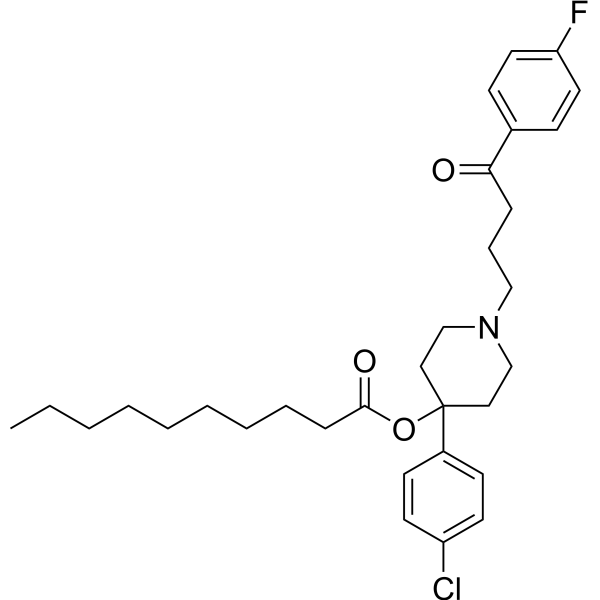
Haloperidol decanoate is a depot preparation of haloperidol, a commonly used butyrophenone derivative with antipsychotic activity. Haloperidol decanoate can increase the striatal D2 receptor in rat. Haloperidol decanoate can improve conditions of psychoses (mainly schizophrenia). Haloperidol decanoate can lead to increased accumulation of the dopamine metabolites homo-vanillic acid. Haloperidol decanoate can reduce intestinal transport, increase gastric emptying and reduce acid output in rat model.
Nur für Forschungszwecke. Wir verkaufen nicht an Patienten.
- Reinheit : 99.67%
- CAS. Nr.: 74050-97-8
- Formel: C31H41ClFNO3
- Molecular Weight:530.11
-
Speicherung:Powder -20°C, 3 years ; In solvent -80°C, 6 months , -20°C, 1 month

To place orders, for customer services and technical support, please contact: MedChemExpress USA
Tel: 609-228-6898 E-mail: [email protected] [email protected]


-
 Biologische Aktivität
-
Chemical Information
-
Lösungsmittel & Löslichkeit
- Protokoll
- Reinheit & Dokumentation
- Verweise
-
 Help & FAQs



Alle Dopamine Receptor Isoform-spezifische Produkte anzeigen
More

Biologische Aktivität
Beschreibung
In Vivo
[14C]haloperidol decanoate (34.25 mg/0.18 ml of sesame oil containing 1.5% benzyl alcohol, i.m., single dose) showed the highest levels of total radioactivity and haloperidol decanoate (HD) in examined lymph nodes and plasma in male Wistar rats[3].
Haloperidol decanoate (Compound HPD-D) (100 mg/kg, s.c., single dose) significantly increases the Bmax of [3H]spiperone binding in the striatum in rat model[4].
MedChemExpress (MCE) has not independently confirmed the accuracy of these methods. They are for reference only.
-
Animal Model:Male Wistar rats (60 d)[2]
-
Dosage:38 mg/kg
-
Administration:Intramuscular injection (i.m.), single dose
-
Result:Increased the gene expression of pro-inflammatory cytokines, COX-2 and iNOS.
Downregulated the transcriptional factor erythroid 2-related factor 2 (Nrf2) and the peroxisome proliferator-activated receptor-gamma coactivator (PCG-1α).
Increased glutamate uptake, the glutamate transporter GLAST gene expression, and the AChE and GPx activities.
Clinical Trial
| NCT Number | Sponsor | Condition | Start Date |
Phase

|
|---|---|---|---|---|
| NCT01329991 | Plexxikon| | 2011-05 | PHASE1 |


Chemical Information
-
CAS. Nr. 74050-97-8
-
Appearance Solid
-
Molecular Weight 530.11
-
Formel C31H41ClFNO3
-
Color White to off-white
-
SMILES
CCCCCCCCCC(OC1(C2=CC=C(Cl)C=C2)CCN(CCCC(C3=CC=C(F)C=C3)=O)CC1)=O
-
Versand
Room temperature in continental US; may vary elsewhere.
-
Speicherung
Powder -20°C 3 years In solvent -80°C 6 months -20°C 1 month


Lösungsmittel & Löslichkeit
In Vitro:
DMSO : 100 mg/mL (188.64 mM; Need ultrasonic; Hygroscopic DMSO has a significant impact on the solubility of product, please use newly opened DMSO)
Please refer to the solubility information to select the appropriate solvent. Once prepared, please aliquot and store the solution to prevent product inactivation from repeated freeze-thaw cycles.
Storage method and period of stock solution: -80°C, 6 months; -20°C, 1 month. When stored at -80°C, please use it within 6 months. When stored at -20°C, please use it within 1 month.
Please refer to the solubility information to select the appropriate solvent. Once prepared, please aliquot and store the solution to prevent product inactivation from repeated freeze-thaw cycles.
Storage method and period of stock solution: -80°C, 6 months; -20°C, 1 month. When stored at -80°C, please use it within 6 months. When stored at -20°C, please use it within 1 month.
Konzentration (Stammlösung) × Volumen (Stammlösung) = Konzentration (Ziellösung) × Volumen (Ziellösung)
In Vivo:
Select the appropriate dissolution method based on your experimental animal and administration route.
- For the following dissolution methods, please ensure to first prepare a clear stock solution using an In Vitro approach and then sequentially add co-solvents:
- To ensure reliable experimental results, the clarified stock solution can be appropriately stored based on storage conditions. As for the working solution for In Vivo experiments, it is recommended to prepare freshly and use it on the same day.
- The percentages shown for the solvents indicate their volumetric ratio in the final prepared solution. If precipitation or phase separation occurs during preparation, heat and/or sonication can be used to aid dissolution.
In Vivo Dissolution Calculator
Please enter the basic information of animal experiments:
-
-
-
-
Recommended: Prepare an additional quantity of animals to account for potential losses during experiments.
Please enter your animal formula composition:
-
%DMSO +
Recommended: Keep the proportion of DMSO in working solution below 2% if your animal is weak.
-
%+
-
+%Tween-80 + +
-
%Saline +
The co-solvents required include: DMSO, . All of co-solvents are available by MedChemExpress (MCE). , Tween 80. All of co-solvents are available by MedChemExpress (MCE).
Working solution concentration: 0.22 mg/mL
Method for preparing stock solution: mg drug dissolved in μL DMSO. Stock solution concentration: mg/mL.
1. Take μL DMSO stock solution;
2. Add μL .
μL , mix evenly;
3. Then add μL Tween 80, mix evenly;
4. Then add μL
Please ensure that the stock solution in the first step is dissolved to a clear state, and add co-solvents in sequence. You can use ultrasonic heating (ultrasonic cleaner, recommended frequency 20-40 kHz), vortexing, etc. to assist dissolution.


Reinheit & Dokumentation
-
Data Sheet (274 KB)
-
SDS (392 KB)
- English - EN (392 KB)
- Français - FR (392 KB)
- Deutsch - DE (392 KB)
- Norwegian - NO (392 KB)
- Español - ES (392 KB)
- Swedish - SV (392 KB)
- Italian - IT (392 KB)
- Korean - KR (392 KB)
- Portuguese - PT (392 KB)
-
Handling Instructions (2659 KB)
Verweise
[1]. R Beresford, et al. Haloperidol decanoate. A preliminary review of its pharmacodynamic and pharmacokinetic properties and therapeutic use in psychosis. Drugs. 1987 Jan;33(1):31-49. [Content Brief]
[2]. Schmitz, I., et al., (2025). A single dose of haloperidol decanoate induces short-term hippocampal neuroinflammation: focus on the glial response. Pharmacological reports : PR, 77(3), 800–808. [Content Brief]
[3]. Oh-e, Y., et al., (1991). Pharmacokinetics of haloperidol decanoate in rats. Journal of pharmacobio-dynamics, 14(11), 615–622. [Content Brief]
[4]. Akiyama, K., et al., (1987). Effect of chronic administration of haloperidol (intermittently) and haloperidol-decanoate (continuously) on D2 dopamine and muscarinic cholinergic receptors and on carbachol-stimulated phosphoinositide hydrolysis in the rat striatum. The Japanese journal of psychiatry and neurology, 41(2), 311–320. [Content Brief]


Complete Stock Solution Preparation Table
Please refer to the solubility information to select the appropriate solvent. Once prepared, please aliquot and store the solution to prevent product inactivation from repeated freeze-thaw cycles.
Storage method and period of stock solution: -80°C, 6 months; -20°C, 1 month. When stored at -80°C, please use it within 6 months. When stored at -20°C, please use it within 1 month.
| Optional Solvent | Concentration Solvent Mass | 1 mg | 5 mg | 10 mg | 25 mg |
|---|---|---|---|---|---|
| DMSO | 1 mM | 1.8864 mL | 9.4320 mL | 18.8640 mL | 47.1600 mL |
| 5 mM | 0.3773 mL | 1.8864 mL | 3.7728 mL | 9.4320 mL | |
| 10 mM | 0.1886 mL | 0.9432 mL | 1.8864 mL | 4.7160 mL | |
| 15 mM | 0.1258 mL | 0.6288 mL | 1.2576 mL | 3.1440 mL | |
| 20 mM | 0.0943 mL | 0.4716 mL | 0.9432 mL | 2.3580 mL | |
| 25 mM | 0.0755 mL | 0.3773 mL | 0.7546 mL | 1.8864 mL | |
| 30 mM | 0.0629 mL | 0.3144 mL | 0.6288 mL | 1.5720 mL | |
| 40 mM | 0.0472 mL | 0.2358 mL | 0.4716 mL | 1.1790 mL | |
| 50 mM | 0.0377 mL | 0.1886 mL | 0.3773 mL | 0.9432 mL | |
| 60 mM | 0.0314 mL | 0.1572 mL | 0.3144 mL | 0.7860 mL | |
| 80 mM | 0.0236 mL | 0.1179 mL | 0.2358 mL | 0.5895 mL | |
| 100 mM | 0.0189 mL | 0.0943 mL | 0.1886 mL | 0.4716 mL |


Haloperidol decanoate Related Classifications
HY-107969 Related Classifications
 Powered by Bioz