



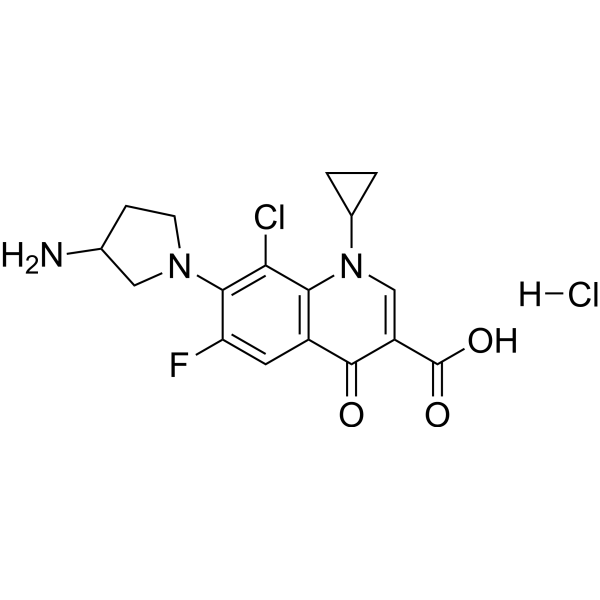
Clinafloxacin hydrochloride

Based on 1 Customer Validation
Clinafloxacin hydrochloride (AM 1091 hydrochloride) is a potent and broad-spectrum fluoroquinolone antibiotic, has inhibitory activity against gram-positive, gram-negative bacterias, and anaerobic pathogens in vitro. Clinafloxacin hydrochloride is against DNA gyrase and topoisomerase IV of S. aureus with IC50 values of 0.92 µg/ml and 1.62 µg/ml, respectively.
Nos produits utilisent uniquement pour la recherche. Nous ne vendons pas aux patients.
- Pureté : 99.58%
- CAS No.: 105956-99-8
- Formule: C17H18Cl2FN3O3
- Masse moléculaire:402.25
-
Stockage:Powder -20°C, 3 years , 4°C, 2 years ; In solvent -80°C, 6 months , -20°C, 1 month

To place orders, for customer services and technical support, please contact: MedChemExpress USA
Tel: 609-228-6898 E-mail: [email protected] [email protected]


-
 Activité biologique
-
Chemical Information
-
Solvant et solubilité
- Protocole
- Pureté et documentation
- Références
-
 Help & FAQs


Voir tous les produits spécifiques à Isoform Antibiotic
More

Activité biologique
Description
IC50 & Target
|
Quinolone |
In Vitro
Clinafloxacin exhibits activity against S. pneumonia with an MIC of 1μg/ml for the parC-gyrA mutants[2].Clinafloxacin hydrochloride has antibacterial activities against target-altered mutant strains of S. aureus. It against Wild type S. aureus, gyrA mutant S. aureus and gyrA mutant S. aureus with MIC values of 0.016 µg/ml, 0.063 µg/ml and 0.915 µg/ml, respectively[3].
MedChemExpress (MCE) has not independently confirmed the accuracy of these methods. They are for reference only. Further protocols information, click here.
In Vivo
MedChemExpress (MCE) has not independently confirmed the accuracy of these methods. They are for reference only.


Chemical Information
-
CAS No. 105956-99-8
-
Appearance Solid
-
Masse moléculaire 402.25
-
Formule C17H18Cl2FN3O3
-
Color Light yellow to yellow
-
SMILES
O=C(C1=CN(C2CC2)C3=C(C=C(F)C(N4CC(N)CC4)=C3Cl)C1=O)O.[H]Cl
-
Synonyms
AM 1091 hydrochloride; CI 960 hydrochloride; PD127391 hydrochloride
-
Livraison
Room temperature in continental US; may vary elsewhere.
-
Stockage
Powder -20°C 3 years 4°C 2 years In solvent -80°C 6 months -20°C 1 month


Solvant et solubilité
In Vitro:
DMSO : 4.17 mg/mL (10.37 mM; Need ultrasonic; Hygroscopic DMSO has a significant impact on the solubility of product, please use newly opened DMSO)
Please refer to the solubility information to select the appropriate solvent. Once prepared, please aliquot and store the solution to prevent product inactivation from repeated freeze-thaw cycles.
Storage method and period of stock solution: -80°C, 6 months; -20°C, 1 month. When stored at -80°C, please use it within 6 months. When stored at -20°C, please use it within 1 month.
Please refer to the solubility information to select the appropriate solvent. Once prepared, please aliquot and store the solution to prevent product inactivation from repeated freeze-thaw cycles.
Storage method and period of stock solution: -80°C, 6 months; -20°C, 1 month. When stored at -80°C, please use it within 6 months. When stored at -20°C, please use it within 1 month.
Concentration (start) × Volume (start) = Concentration (final) × Volume (final)

Protocole
-
Cell Cytotoxicity Assay
Cytotoxicity assays are usually based on the assessment of cell membrane damage, which can also be indirectly detected by measuring cell viability. Detection methods include MTT assay, CKK-8 assay, LDH assay and ATP assay, etc.
-
Gram Staining of Tissue Sections
Gram staining of tissue sections is a histochemical technique used to differentiate Gram-positive and Gram-negative bacteria within histological specimens based on differences in bacterial cell wall structure and dye retention, adapted from classical bacteriological Gram staining into tissue-compatible “histological Gram stain” variants. In tissue applications, modifications of the Brown-Hopps and Brown-Brenn methods are commonly used to improve differentiation of microorganisms embedded within host connective tissue and to reduce overstaining or loss of Gram-negative signal, which are known limitations of earlier approaches. The principle relies on crystal violet-iodine complex retention in Gram-positive organisms and subsequent decolorization and counterstaining steps that allow contrast visualization of Gram-negative organisms against tissue background.


Pureté et documentation
-
Fiche technique (272 KB)
-
SDS (252 KB)
- English - EN (252 KB)
- Français - FR (252 KB)
- Deutsch - DE (252 KB)
- Norwegian - NO (252 KB)
- Español - ES (252 KB)
- Swedish - SV (252 KB)
- Italian - IT (252 KB)
- Korean - KR (252 KB)
- Portuguese - PT (252 KB)
-
Instruction de manipulation (2659 KB)
Références
[1]. M Takei, et al. Target preference of 15 quinolones against Staphylococcus aureus, based on antibacterial activities and target inhibition.Antimicrob Agents Chemother. 2001 Dec;45(12):3544-7. [Content Brief]
[2]. Randa H Abdelkreem, et al. DNA Gyrase and Topoisomerase IV Mutations and their effect on Quinolones Resistant Proteus mirabilis among UTIs Patients. Pak J Med Sci. Sep-Oct 2020;36(6):1234-1240. [Content Brief]
[3]. A Domenech, et al. Experimental study of clinafloxacin alone and in combination in the treatment of ciprofloxacin-susceptible and -resistant pneumococcal meningitis.Microb Drug Resist. 2003;9 Suppl 1:S53-9. [Content Brief]


Complete Stock Solution Preparation Table
Please refer to the solubility information to select the appropriate solvent. Once prepared, please aliquot and store the solution to prevent product inactivation from repeated freeze-thaw cycles.
Storage method and period of stock solution: -80°C, 6 months; -20°C, 1 month. When stored at -80°C, please use it within 6 months. When stored at -20°C, please use it within 1 month.
| Optional Solvent | Concentration Solvent Mass | 1 mg | 5 mg | 10 mg | 25 mg |
|---|---|---|---|---|---|
| DMSO | 1 mM | 2.4860 mL | 12.4301 mL | 24.8602 mL | 62.1504 mL |
| 5 mM | 0.4972 mL | 2.4860 mL | 4.9720 mL | 12.4301 mL | |
| 10 mM | 0.2486 mL | 1.2430 mL | 2.4860 mL | 6.2150 mL |


Clinafloxacin hydrochloride Related Classifications
HY-B0536A Related Classifications
 Powered by Bioz