



Eleven-Nineteen-Leukemia Protein IN-3
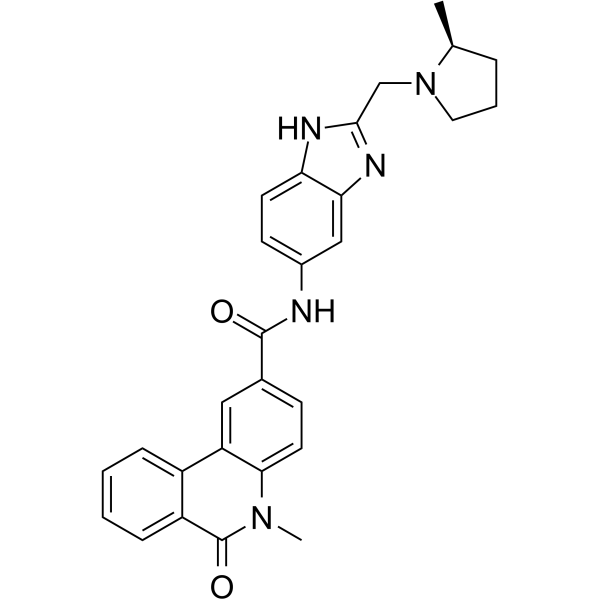
Eleven-Nineteen-Leukemia Protein IN-3 is an orally active inhibitor of ENL YEATS domain with an IC50 value of 15.4 nM. Eleven-Nineteen-Leukemia Protein IN-3 down-regulates MYC expression through ENL in cells and can enhances the thermal stability of ENL protein in vitro.
For research use only. We do not sell to patients.
- CAS No.: 2894121-83-4
- Formula: C28H27N5O2
- Molecular Weight:465.55
-
Storage:
Please store the product under the recommended conditions in the Certificate of Analysis.

To place orders, for customer services and technical support, please contact: MedChemExpress USA
Tel: 609-228-6898 E-mail: [email protected] [email protected]


-
 Biological Activity
-
Chemical Information
- Protocols
- Purity & Documentation
- References
-
 Help & FAQs




Biological Activity
Description
IC50 & Target
[1]|
Eleven-Nineteen-Leukemia YEATS domain 15.4 nM (IC50) |
Cellular Effect
|
Cell Line

|
Type | Value | Description | References |
|---|---|---|---|---|
| MOLM-13 | IC50 |
8.3 μM
Compound: 28
|
Antiproliferative activity against human MOLM-13 cells assessed as inhibition of cell growth measured after 72 hrs by Cell Titer-Glo luminescent assay
Antiproliferative activity against human MOLM-13 cells assessed as inhibition of cell growth measured after 72 hrs by Cell Titer-Glo luminescent assay
|
[PMID: 36645983] |
| MV4-11 | IC50 |
4.8 μM
Compound: 28
|
Antiproliferative activity against human MV4-11 cells assessed as inhibition of cell growth measured after 72 hrs by Cell Titer-Glo luminescent assay
Antiproliferative activity against human MV4-11 cells assessed as inhibition of cell growth measured after 72 hrs by Cell Titer-Glo luminescent assay
|
[PMID: 36645983] |
In Vitro
Eleven-Nineteen-Leukemia Protein IN-3 (Compound 28) has significant inhibitory effect on MV4-11 and MOLM-13 cell lines with IC50 values of 4.8 μM and 8.3 μM, respectively[1].
Eleven-Nineteen-Leukemia Protein IN-3 (5 µM; 6 h) significantly improves the thermal stability of endogenous ENL protein, but has insignificant effect on the thermal stability of GAS41 protein. Eleven-Nineteen-Leukemia Protein IN-3 can effectively inhibits the growth of MOLM-13 cells[1].
Eleven-Nineteen-Leukemia Protein IN-3 (5 µM; 72 h) inhibits the key oncogene MYC (about 50 %). Eleven-Nineteen-Leukemia Protein IN-3 can further down-regulates the expression of MYC in the ENL target gene when works with JQ-1 (HY-13030)[1].
MedChemExpress (MCE) has not independently confirmed the accuracy of these methods. They are for reference only. Further protocols information, click here.
-
Cell Line:MOLM-13 cells.
-
Concentration:5 µM.
-
Incubation Time:72 h.
-
Result:Showed inhibitory for MYC.
In Vivo
Eleven-Nineteen-Leukemia Protein IN-3 (5 mg/kg; i.v.; single dose) highly exposes in vivo[1].
Pharmacokinetic (PK) study in Male BALB/c mice[1]
| Administration | t1/2 (h) | Tmax (h) | Cmax (ng/mL) | AUC0-t (h•ng/mL) | AUC0-∞ (h•ng/mL) | MRT0-∞ (h) | |
| p.o. | 5.2 | 0.5 | 71.8 | 257 | 272 | 5.5 | |
| Administration | t1/2 (h) | AUC0-t (h•ng/mL) | AUC0-∞ (h•ng/mL) | Vss (L/kg) | CL (mL/min/kg) | MRT0-∞ (h) | F (%) |
| i.v. | 4.0 | 8290 | 8690 | 0.8 | 9.6 | 1.3 | 0.5 |
MedChemExpress (MCE) has not independently confirmed the accuracy of these methods. They are for reference only.


Chemical Information
-
CAS No. 2894121-83-4
-
Molecular Weight 465.55
-
Formula C28H27N5O2
-
SMILES
C[C@H]1CCCN1CC2=NC3=CC(NC(C4=CC=C5C(C6=CC=CC=C6C(N5C)=O)=C4)=O)=CC=C3N2
-
Shipping
Room temperature in continental US; may vary elsewhere.
-
Storage
Please store the product under the recommended conditions in the Certificate of Analysis.

Protocols
-
RNA extraction experimental
By lysing cells, releasing RNA, and removing impurities such as proteins and DNA, high-purity RNA products are finally obtained. The commonly used traditional method is the guanidine isothiocyanate/phenol/chloroform method (Trizol), which is suitable for a variety of animal materials including animal tissues, microorganisms, cultured cells, etc., and most plant materials.
-
Cell Cytotoxicity Assay
Cytotoxicity assays are usually based on the assessment of cell membrane damage, which can also be indirectly detected by measuring cell viability. Detection methods include MTT assay, CKK-8 assay, LDH assay and ATP assay, etc.


Purity & Documentation
References

Calculators
Concentration (start) × Volume (start) = Concentration (final) × Volume (final)


Eleven-Nineteen-Leukemia Protein IN-3 Related Classifications
HY-152471 Related Classifications
 Powered by Bioz