



EPZ004777 hydrochloride
Based on 11 publication(s) in Google Scholar
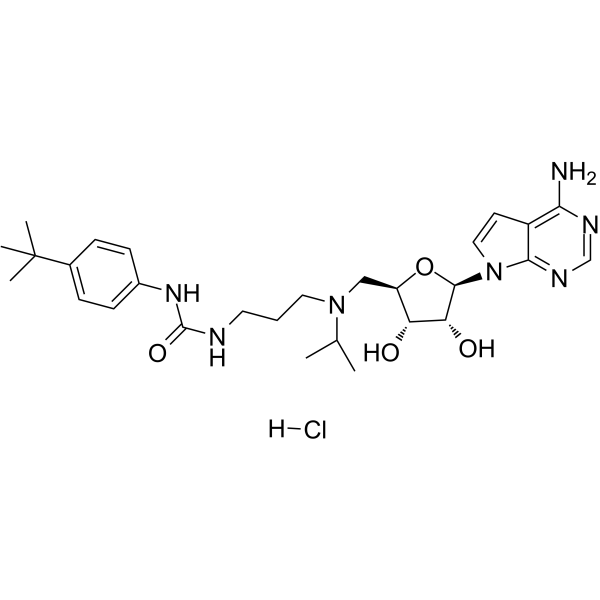
EPZ004777 hydrochloride is an effective and selective DOT1L inhibitor, with IC50 being 0.4 nM. EPZ004777 hydrochloride reduces the levels of H3K79me2 and H3K79me1, significantly down-regulating the expression of HOXA9 and MEIS1. EPZ004777 hydrochloride selectively inhibits the proliferation of MLL rearrangement cells and promotes the differentiation and subsequent apoptosis (apoptosis) of leukemia cells. EPZ004777 hydrochloride can be used for the study of leukemia.
For research use only. We do not sell to patients.
- Purity : 98.92%
- CAS No.: 1380316-03-9
- Formula: C28H42ClN7O4
- Molecular Weight:576.13
-
Storage:
4°C, sealed storage, away from moisture and light
* In solvent : -80°C, 6 months; -20°C, 1 month (sealed storage, away from moisture and light)

To place orders, for customer services and technical support, please contact: MedChemExpress USA
Tel: 609-228-6898 E-mail: [email protected] [email protected]


-
 Biological Activity
-
Chemical Information
-
Solvent & Solubility
- Protocol
- Purity & Documentation
- References
-
 Help & FAQs


Publications Citing Use of MedChemExpress (MCE) EPZ004777 hydrochloride
More- Cancer Res. 2026 Jul 15;86(14):3588-3603. [Abstract]
- Nat Commun. 2026 Feb 12;17(1):1214. [Abstract]
- Sci Adv. 2023 Jun 2;9(22):eadc9273. [Abstract]
- Acta Pharmacol Sin. 2022 Feb;43(2):457-469. [Abstract]
- Diabetes. 2025 Oct 1;74(10):1825-1838. [Abstract]
- Oncogene. 2024 Jun;43(25):1900-1916. [Abstract]
- Cell Syst. 2018 Apr 25;6(4):424-443.e7. [Abstract]
- Oncogenesis. 2021 Jul 12;10(7):48. [Abstract]
- Hematol Oncol. 2019 Dec;37(5):617-625. [Abstract]
- bioRxiv. 2023 Oct 19.
- Patent. US20180263995A1.
 Customer Validation & Images

-
Cell Proliferation/Viability Assay
-
WB
-
WB
-
Cell Proliferation/Viability Assay
-
In Vivo Efficacy Study
All Histone Methyltransferase Isoforms
More

Biological Activity
Description
IC50 & Target
|
DOT1L |
In Vitro
EPZ004777 demonstrates potent, concentration-dependent inhibition of DOT1L enzyme activity with an IC50 of 400±100 pM. EPZ004777 displays remarkable selectivity for inhibition of DOT1L over other HMTs(PRMT5, 521±137 nM; others, >50 μM). The effect of extended EPZ004777 treatment is remarkably specific for the MLL-rearranged cell lines. The number of viable MV4-11 and MOLM-13 cells is dramatically reduced by EPZ004777, whereas the growth of Jurkat cells is unaffected. A small population of MV4-11 cells remain viable in the presence of EPZ004777, but their number remain constant when growth curves are tracked over longer periods indicating that they have ceased to divide. The proliferation of MLL-AF9-transformed cells is strongly inhibited by EPZ004777 at concentrations of 3 μM or greater[1]. EPZ004777 selectively inhibits proliferation of MLL-AF10 and CALM-AF10 transformed murine bone marrow cells[2].
MedChemExpress (MCE) has not independently confirmed the accuracy of these methods. They are for reference only.
In Vivo
MedChemExpress (MCE) has not independently confirmed the accuracy of these methods. They are for reference only.


Chemical Information
-
CAS No. 1380316-03-9
-
Appearance Solid
-
Molecular Weight 576.13
-
Formula C28H42ClN7O4
-
Color Light yellow to yellow
-
SMILES
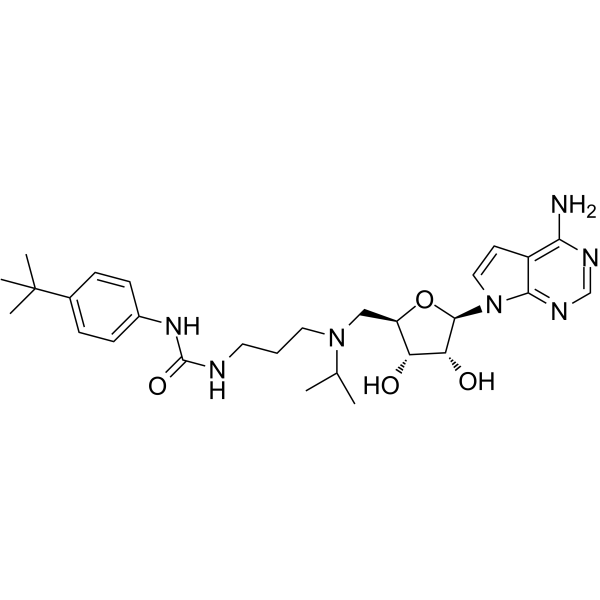
NC1=C2C(N([C@H]3[C@H](O)[C@H](O)[C@@H](CN(C(C)C)CCCNC(NC4=CC=C(C(C)(C)C)C=C4)=O)O3)C=C2)=NC=N1.[H]Cl
-
Shipping
Room temperature in continental US; may vary elsewhere.
-
Storage
4°C, sealed storage, away from moisture and light
* In solvent : -80°C, 6 months; -20°C, 1 month (sealed storage, away from moisture and light)


Publications (11)
-
Journal Impact Factor
-
Most Recent
-
Cancer Res
Targeting DOT1L Reactivates HERV-K to Drive Cell-Autonomous and Paracrine Senescence in Adenocarcinoma of the Esophagogastric Junction. [Abstract]2026 Jul 15;86(14):3588-3603. PMID: 42084229 -
Nat Commun
Human iPSC-based Modeling of Pulmonary Fibrosis Reveals p300/CBP Inhibition Suppresses Alveolar Transitional Cell State. [Abstract]2026 Feb 12;17(1):1214. PMID: 41680175 -
Sci Adv
Gain-of-function mutations in the catalytic domain of DOT1L promote lung cancer malignant phenotypes via the MAPK/ERK signaling pathway. [Abstract]2023 Jun 2;9(22):eadc9273. PMID: 37256945
EPZ004777 hydrochloride purchased from MedChemExpress. Usage Cited in: Sci Adv. 2023 Jun 2;9(22):eadc9273. [Abstract]
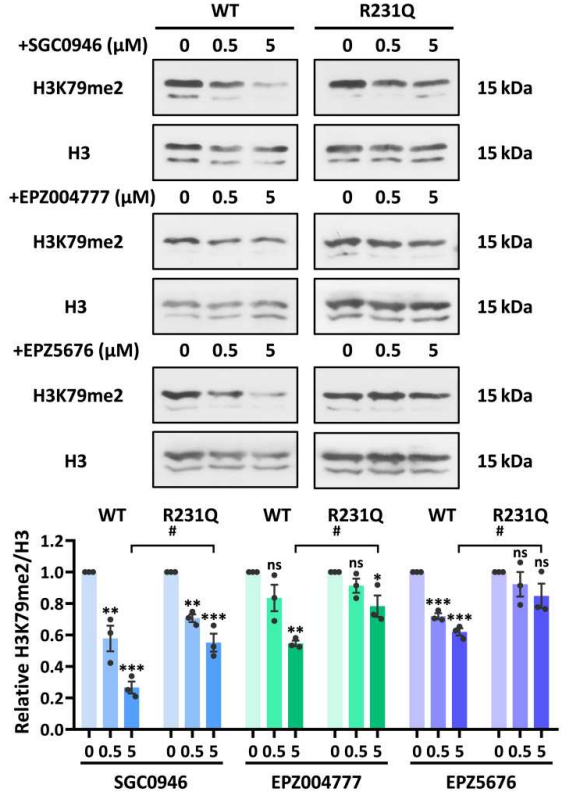
H3K79me2 levels in HCI-H460 cells expressing WT or R231Q DOT1L after treatment with different concentrations (0.5, and 5 μM, 9 days) of DOT1Lis (SGC0946, EPZ004777, and EPZ5676)
-
Acta Pharmacol Sin
2022 Feb;43(2):457-469. PMID: 33850273 -
Diabetes
Molecular Mechanisms of Human Pancreatic Islet Dysfunction Under Overnutrition Metabolic Stress. [Abstract]2025 Oct 1;74(10):1825-1838. PMID: 40773375 -
Oncogene
The DNA damage-independent ATM signalling maintains CBP/DOT1L axis in MLL rearranged acute myeloid leukaemia. [Abstract]2024 Jun;43(25):1900-1916. PMID: 38671157
EPZ004777 hydrochloride purchased from MedChemExpress. Usage Cited in: Oncogene. 2024 Jun;43(25):1900-1916. [Abstract]
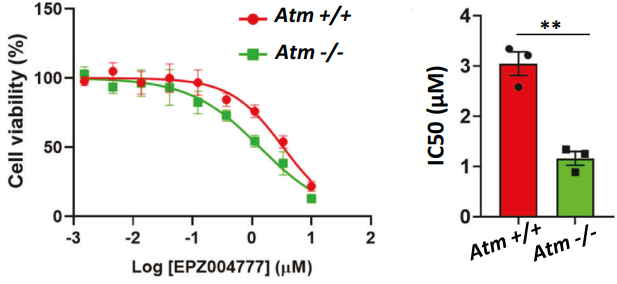
LSCs from Atm+/+ and Atm−/− F2 recipients were treated with different doses of the DOT1L inhibitor (EPZ004777) for 7 days. The cell viability was then determined by the CCK8 assay.
-
Cell Syst
A Library of Phosphoproteomic and Chromatin Signatures for Characterizing Cellular Responses to Drug Perturbations. [Abstract]2018 Apr 25;6(4):424-443.e7. PMID: 29655704 -
Oncogenesis
Disruptor of telomeric silencing 1-like promotes ovarian cancer tumor growth by stimulating pro-tumorigenic metabolic pathways and blocking apoptosis. [Abstract]2021 Jul 12;10(7):48. PMID: 34253709
EPZ004777 hydrochloride purchased from MedChemExpress. Usage Cited in: Oncogenesis. 2021 Jul 12;10(7):48. [Abstract]
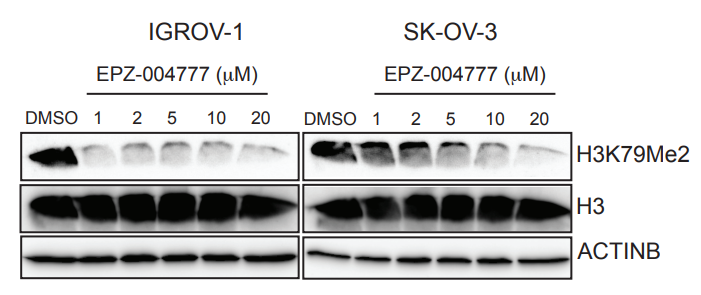
The indicated ovarian cancer cell lines were treated with various concentrations of DOT1L inhibitors EPZ004777 for 48 h. H3K79dimethyl marks were then measured. Histone H3 and ACTINB proteins were measured as loading controls. The results demonstrated that EPZ004777 effectively inhibited H3K79 dimethylation (H3K79me2) modification.
EPZ004777 hydrochloride purchased from MedChemExpress. Usage Cited in: Oncogenesis. 2021 Jul 12;10(7):48. [Abstract]
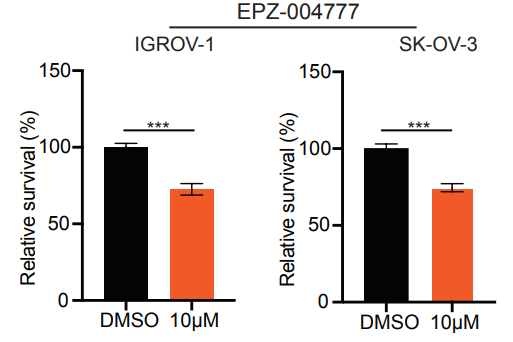
The indicated ovarian cancer cell lines were treated with the DOT1L inhibitor EPZ004777 (10 µM) and SGC0946 (20 µM) for 3 days and analyzed for cell survival in MTT assays. The results showed that EPZ004777 could effectively inhibit the short-term growth of ovarian cancer cells.
EPZ004777 hydrochloride purchased from MedChemExpress. Usage Cited in: Oncogenesis. 2021 Jul 12;10(7):48. [Abstract]
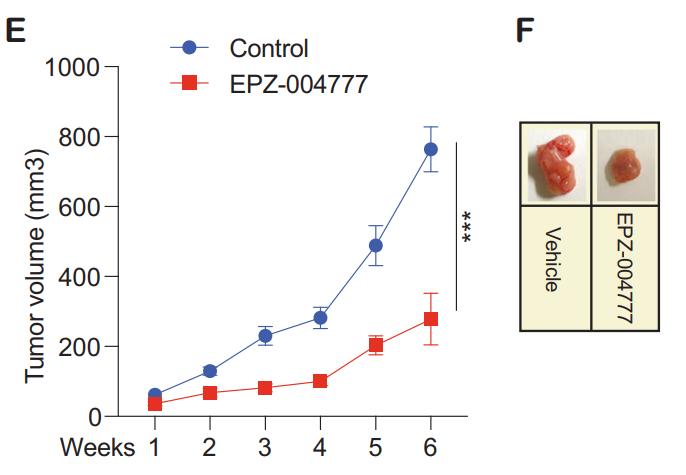
IGROV-1 cells were injected subcutaneously into the flanks of NSG mice (n = 5). The mice were treated with EPZ004777 (50 mg/kg) intraperitoneally every day and analyzed for tumor growth. Tumor sizes were measured each week and the average tumor volume is plotted (E). Representative images of the tumors from the mice after 6 weeks of EPZ004777 treatment are shown (F). The results showed that treatment with EPZ004777, a DOT1L inhibitor, elicited inhibitory effects on ovarian cancer tumor growth in vivo in xenograft models.
-
Hematol Oncol
Establishment and characterization of a DOT1L inhibitor-sensitive human acute monocytic leukemia cell line YBT-5 with a novel KMT2A-MLLT3 fusion. [Abstract]2019 Dec;37(5):617-625. PMID: 31701557 -
-


Solvent & Solubility
In Vitro:
H2O : 100 mg/mL (173.57 mM; Need ultrasonic)
DMSO : 100 mg/mL (173.57 mM; Need ultrasonic; Hygroscopic DMSO has a significant impact on the solubility of product, please use newly opened DMSO)
Please refer to the solubility information to select the appropriate solvent. Once prepared, please aliquot and store the solution to prevent product inactivation from repeated freeze-thaw cycles.
Storage method and period of stock solution: -80°C, 6 months; -20°C, 1 month (sealed storage, away from moisture and light). When stored at -80°C, please use it within 6 months. When stored at -20°C, please use it within 1 month.
* Note: If you choose water as the stock solution, please dilute it to the working solution, then filter and sterilize it with a 0.22 μm filter before use.
Please refer to the solubility information to select the appropriate solvent. Once prepared, please aliquot and store the solution to prevent product inactivation from repeated freeze-thaw cycles.
Storage method and period of stock solution: -80°C, 6 months; -20°C, 1 month (sealed storage, away from moisture and light). When stored at -80°C, please use it within 6 months. When stored at -20°C, please use it within 1 month.
* Note: If you choose water as the stock solution, please dilute it to the working solution, then filter and sterilize it with a 0.22 μm filter before use.
Concentration (start) × Volume (start) = Concentration (final) × Volume (final)
In Vivo:
For the following dissolution methods, please prepare the working solution directly:
It is recommended to prepare fresh solutions and use them promptly within a short period of time.
The percentages shown for the solvents indicate their volumetric ratio in the final prepared solution. If precipitation or phase separation occurs during preparation, heat and/or sonication can be used to aid dissolution.
Add each solvent one by one: PBS
Solubility: 100 mg/mL (173.57 mM); Clear solution; Need ultrasonic

Protocol
Cell Assay[1]
For assessment of cell proliferation and viability in human cell lines, exponentially growing cells are plated, in triplicate, in 96-well plates at a density of 3×10⁴ cells/well in a final volume of 150 μL. Cells are incubated in the presence of 3 μM (proliferation curve), or increasing concentrations (IC50 determination) of EPZ004777 up to 50 μM. Viable cell number is determined every 3-4 days for up to 18 days using the Guava Viacount assay and analyzed on a Guava EasyCyte Plus instrument. On days of cell counts, growth media and EPZ004777 are replaced and cells split back to a density of 5×10⁴ cells/well. Total cell number is expressed as split-adjusted viable cells per well. For each cell line, IC50 values are determined from concentration-dependence curves at each time point using Graphpad Prism software. Experiments to determine IC50 values continued until IC50 values stabilized (day 18 for THP-1 cells, day 14 for all other cell lines)[1].
MedChemExpress (MCE) has not independently confirmed the accuracy of these methods. They are for reference only.
Animal Administration[1]
Mice[1]
Nine-week-old female nude mice (nu/nu) are injected subcutaneously with MV4-11 cells in the right flank (200 μL of a 5×10⁷ cells/mL suspension in a 1:1 mixture of PBS and Matrigel). Mice are randomized to treatment groups when tumor sizes reached 300-400 mm3. Six mice received subcutaneous implant of osmotic pumps, containing 50 mg/mL EPZ004777 in 10% ethanol, 90% water, and five control mice received no pump implant. Six days after pump implant, animals are sacrificed and tumor samples from treated and control animals are collected for immunoblot analysis. For the disseminated leukemia model, MV4-11 cells are transduced with the pMMP-LucNeo retrovirus. Eight-week-old female NOD.Cg-PrkdcscidIl2rgtm1Wjl/SzJ (NSG) mice are purchased from Jackson Laboratories. A total of 1×10⁷ MV4-11-LucNeo cells are injected intravenously via the lateral tail vein. Engraftment of disseminate leukemia is determined by bioluminescence imaging after injection of 75 mg/kg of D-luciferin. Animals with documented leukemia are divided into treatment groups consisting of vehicle (15% ethanol, 50% PEG300, 35% water) loaded osmotic pumps, or EPZ004777 at 50, 100, or 150 mg/mL. Osmotic pumps are replaced after one week. Irritation caused by compound precipitation is observed in the 100 and 150 mg/mL dose groups, precluding additional pump replacements. Animals are monitored daily for clinical symptoms, and are euthanized when they displayed signs of distress consistent with terminal leukemic disease. Log-rank analysis is used to determine statistical significance of the survival curves.
MedChemExpress (MCE) has not independently confirmed the accuracy of these methods. They are for reference only.


Purity & Documentation
-
Data Sheet (280 KB)
-
SDS (252 KB)
- English - EN (252 KB)
- Français - FR (252 KB)
- Deutsch - DE (252 KB)
- Norwegian - NO (252 KB)
- Español - ES (252 KB)
- Swedish - SV (252 KB)
- Italian - IT (252 KB)
- Korean - KR (252 KB)
- Portuguese - PT (252 KB)
-
Handling Instructions (2659 KB)
References
[1]. Daigle SR, et al. Selective killing of mixed lineage leukemia cells by a potent small-molecule DOT1L inhibitor. Cancer Cell. 2011 Jul 12;20(1):53-65. [Content Brief]
[2]. Chen L, et al. Abrogation of MLL-AF10 and CALM-AF10-mediated transformation through genetic inactivation or pharmacological inhibition of the H3K79 methyltransferase Dot1l. Leukemia. 2013 Apr;27(4):813-22. [Content Brief]
[3]. Deshpande AJ, et al. Leukemic transformation by the MLL-AF6 fusion oncogene requires the H3K79 methyltransferase Dot1l.Blood. 2013 Mar 28;121(13):2533-41. [Content Brief]


Complete Stock Solution Preparation Table
Please refer to the solubility information to select the appropriate solvent. Once prepared, please aliquot and store the solution to prevent product inactivation from repeated freeze-thaw cycles.
Storage method and period of stock solution: -80°C, 6 months; -20°C, 1 month (sealed storage, away from moisture and light). When stored at -80°C, please use it within 6 months. When stored at -20°C, please use it within 1 month.
| Optional Solvent | Concentration Solvent Mass | 1 mg | 5 mg | 10 mg | 25 mg |
|---|---|---|---|---|---|
| H2O / DMSO | 1 mM | 1.7357 mL | 8.6786 mL | 17.3572 mL | 43.3930 mL |
| 5 mM | 0.3471 mL | 1.7357 mL | 3.4714 mL | 8.6786 mL | |
| 10 mM | 0.1736 mL | 0.8679 mL | 1.7357 mL | 4.3393 mL | |
| 15 mM | 0.1157 mL | 0.5786 mL | 1.1571 mL | 2.8929 mL | |
| 20 mM | 0.0868 mL | 0.4339 mL | 0.8679 mL | 2.1696 mL | |
| 25 mM | 0.0694 mL | 0.3471 mL | 0.6943 mL | 1.7357 mL | |
| 30 mM | 0.0579 mL | 0.2893 mL | 0.5786 mL | 1.4464 mL | |
| 40 mM | 0.0434 mL | 0.2170 mL | 0.4339 mL | 1.0848 mL | |
| 50 mM | 0.0347 mL | 0.1736 mL | 0.3471 mL | 0.8679 mL | |
| 60 mM | 0.0289 mL | 0.1446 mL | 0.2893 mL | 0.7232 mL | |
| 80 mM | 0.0217 mL | 0.1085 mL | 0.2170 mL | 0.5424 mL | |
| 100 mM | 0.0174 mL | 0.0868 mL | 0.1736 mL | 0.4339 mL |
* Note: If you choose water as the stock solution, please dilute it to the working solution, then filter and sterilize it with a 0.22 μm filter before use.


EPZ004777 hydrochloride Related Classifications
HY-15227A Related Classifications
 Powered by Bioz